


A striking case posted by a site owner on Reddit shows how dramatically Google visibility can collapse without pages disappearing from the index.
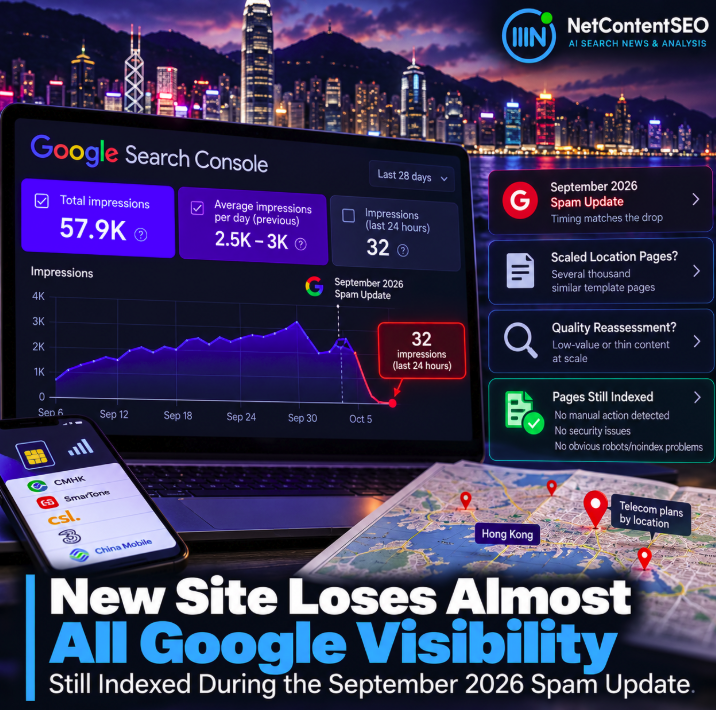
The Hong Kong telecom comparison site launched around September 6, 2026. According to Search Console data shared by the owner, Google initially picked it up quickly, with impressions climbing to roughly 2,500–3,000 per day by mid-to-late September.
Then visibility collapsed. The latest 24-hour Search Console report cited in the post showed just 32 impressions, zero clicks and an average position of 32.4. The owner says the pages remain indexed, with no manual action, security issue or obvious robots/noindex problem. Original r/DoSEO case
57,900 impressions in 28 days — then almost nothing
The site's 28-day Search Console totals were 57,900 impressions and 679 clicks, with a 1.2% CTR and average position of 10.3.
Those figures make the sudden decline particularly interesting. This is not a case where clicks fell while impressions remained stable. Search visibility itself appears to have contracted sharply, while average ranking deteriorated at the same time.
The timing overlaps Google's September 2026 spam update
The owner noted that the decline occurred while Google's September 2026 spam update was rolling out.
Timing alone does not prove causation. Google does not provide a site-specific message saying that an algorithmic spam system affected a particular domain, and there is no evidence in this case of a manual penalty.
But a site-wide visibility change during an active spam update makes algorithmic reassessment one reasonable hypothesis to investigate alongside technical and quality causes.
The site contains thousands of location pages
The structural detail that makes this case particularly relevant for SEO is scale.
The website compares home broadband, 5G home broadband and mobile plans in Hong Kong. A large proportion of its several thousand URLs represent real residential estates, because broadband availability and offers can vary by location.
Those pages therefore have a legitimate underlying use case. But the owner acknowledges that they use a common template and that provider and plan information overlaps across many locations.
Real locations do not automatically make scaled pages valuable
This distinction matters. A page does not become high quality simply because the location in its title exists.
Google can still evaluate whether thousands of location pages provide enough unique value to justify their individual presence in search results.
If changing the estate name produces a page whose useful information is otherwise substantially identical, the site may create a large amount of search-targeted inventory without adding equivalent user value.
That does not prove that these pages caused this site's drop. It does explain why they deserve close examination.
Scaled content and doorway risk are not exactly the same thing
SEOs sometimes use “scaled content” and “doorway pages” interchangeably, but the concepts are different.
Scaled content becomes a spam concern when many pages are produced primarily to manipulate rankings rather than help users. Doorway abuse typically involves pages created to rank for similar queries that funnel users toward essentially the same destination or experience.
A genuinely location-dependent broadband comparison service can avoid both patterns if each estate page contains meaningful location-specific availability, pricing, infrastructure or decision-making information.
The risk rises when thousands of URLs exist mainly because thousands of geographic names can be inserted into a template.
Indexed does not mean Google must keep ranking the page
The case is also a useful reminder that indexing and ranking are separate systems.
A URL can remain technically indexed while losing most of the queries for which Google previously retrieved it. Search Console can therefore continue showing valid indexed pages even while impressions collapse.
This pattern has appeared in other 2026 reports. Some site owners have described severe visibility losses with pages still indexed and no manual action, while other cases later recovered without a clear site-side fix.
Those anecdotes do not establish a single Google bug or algorithm. They demonstrate why “site: still works” is not enough to diagnose a visibility collapse.
A new site's early rankings should not be treated as a stable baseline
The domain's age is another major variable. At roughly one month old, it has very little ranking history.
Early visibility can change dramatically as Google collects more signals about a new site's pages, internal structure, duplication, usefulness and external reputation.
Calling this a formal “honeymoon period” would overstate what Google has documented. But it is reasonable to expect early rankings on a new domain to be less stable than mature historical performance.
Do not immediately delete thousands of URLs
A collapse this severe deserves investigation, but reacting by immediately deleting or rewriting the entire site during an active update can make diagnosis harder.
The first step should be segmentation in Search Console: compare estate pages, provider pages, comparison pages and editorial content separately. Determine whether every template lost visibility at the same time and whether query diversity collapsed along with impressions.
Next, inspect representative URLs rather than relying only on aggregate indexing counts. Compare what each location page offers that users cannot get from the parent comparison pages or neighboring estate URLs.
What we would investigate first
For a site with this profile, NetContentSEO would examine page-type performance before and after the drop, query loss by directory, canonical selection, crawl behavior, server responses, internal linking and sitemap changes.
We would then measure template similarity across the estate pages and identify how much location-specific information is actually unique.
Finally, we would compare pages that retained impressions with pages that lost them. That contrast can be more informative than trying to infer a single site-wide “penalty.”
The NetContentSEO takeaway
This Reddit case is not proof that Google's September spam update targeted location pages, nor is it evidence of a confirmed Google bug.
It is, however, an unusually clear example of an increasingly important distinction: a site can remain indexed while Google dramatically reduces how often its pages are selected for queries.
For large programmatic or location-based sites, the question is therefore not simply “Are these pages real?” It is “Does each page provide enough uniquely useful information to deserve being retrieved independently?”
The answer to that question may matter far more than the number of URLs Google technically keeps in its index.