

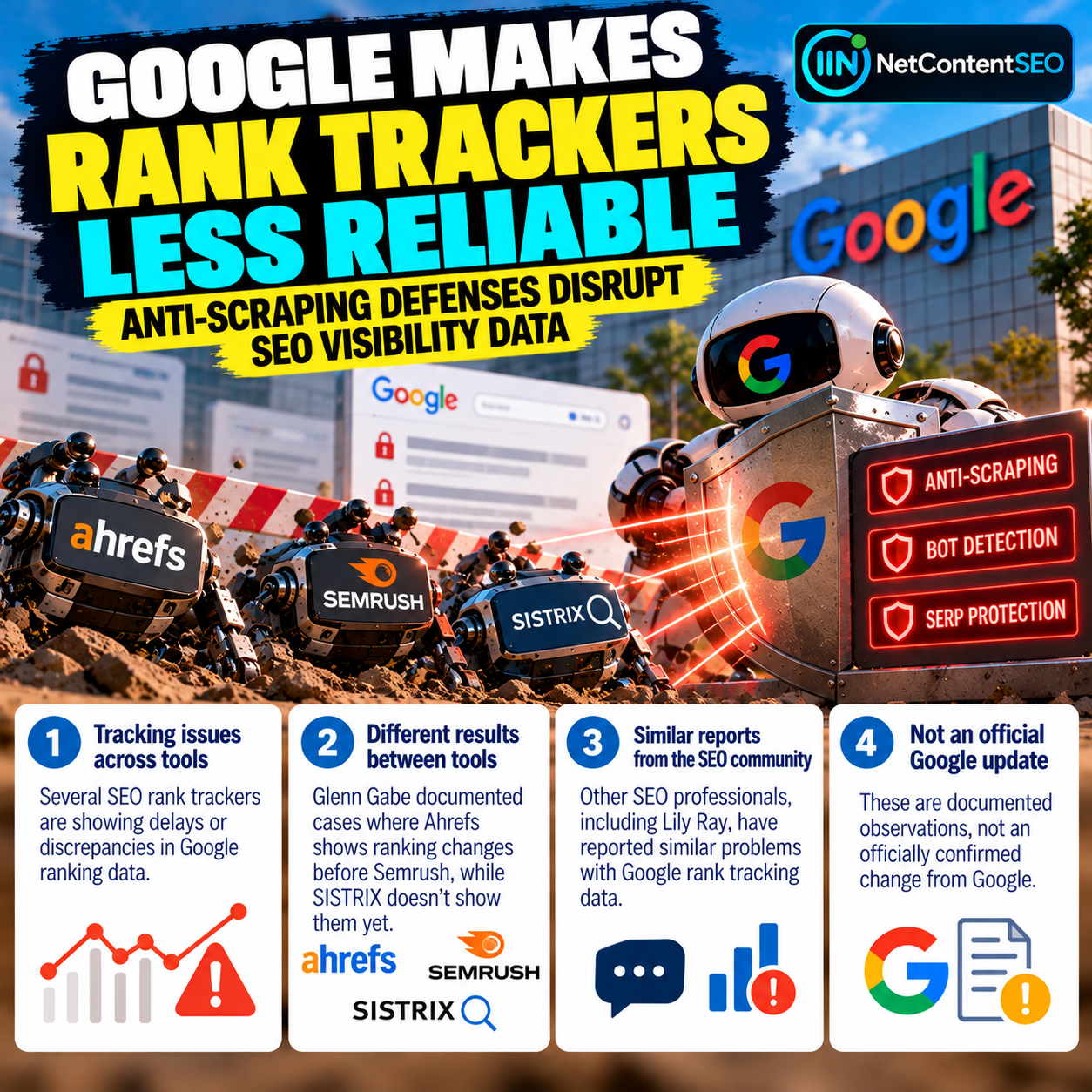

Google rank-tracking data may be becoming less consistent across SEO tools, according to observations reported by several search professionals. On 12 October 2026, Search Engine Roundtable described delays and discrepancies in third-party Google ranking reports, amid suggestions that stronger anti-scraping measures may be affecting tools that collect search results at scale.
Glenn Gabe documented examples in which Ahrefs showed ranking changes before Semrush, while SISTRIX had not yet reflected the same movements. Lily Ray also reported similar issues. These are documented observations from the SEO community, not an official Google confirmation that it has changed its systems or deliberately disrupted rank trackers.
What SEO professionals are reporting
- Delays and discrepancies: some rank-tracking tools appear to report changes at different times or show different ranking data.
- Different tool readings: examples shared by Glenn Gabe showed Ahrefs detecting changes before Semrush, while SISTRIX had not yet displayed them.
- Similar concerns: Lily Ray and other SEO professionals have reported issues with third-party Google rank tracking.
These examples illustrate a practical problem for SEO teams: when platforms disagree, it becomes harder to decide whether a movement reflects an actual change in search visibility, a collection delay or a difference in how each tool samples the results.
Is Google blocking rank trackers?
The reports have raised the possibility that Google has intensified its defences against automated scraping of search engine results pages (SERPs). However, the evidence cited in the report does not establish the precise technical cause, and Google has not officially confirmed a change aimed at third-party rank trackers.
It is therefore more accurate to describe the situation as reported tracking disruption and inconsistent data, rather than a confirmed Google policy or algorithm update. Different collection methods, locations, devices, query sets and update schedules can also contribute to discrepancies between tools.
Why rankings may differ between tools
Rank trackers do not necessarily collect every result in the same way or at the same moment. Their readings can vary according to:
- Collection timing: tools may refresh keywords on different schedules.
- Location and device: search results can differ by market, language, device and search context.
- Sampling and coverage: platforms may track different keyword sets or use different collection approaches.
- Delays or collection failures: missing or delayed SERP data can make a chart appear flat or cause a change to show up later.
These are general reasons why tools can disagree; they do not prove which factor caused the specific observations reported in October 2026.
How SEO teams should respond
- Compare more than one source. When a major movement appears in a single tool, check another tracker before treating it as confirmed.
- Check first-party performance data. Use Google Search Console clicks, impressions and query-level trends as a complementary source, while remembering that Search Console is not a direct replacement for a fixed-position rank tracker.
- Look for broader patterns. Review groups of keywords, landing pages and markets rather than reacting to one isolated position change.
- Annotate anomalies. Record when tools disagree or show unusual delays so reporting teams can distinguish data-quality concerns from business performance changes.
- Avoid premature conclusions. Do not immediately attribute every discrepancy to an algorithm update or a deliberate Google intervention.
Can rank-tracking data still be trusted?
Rank trackers remain useful for observing trends, comparing competitors and monitoring defined keyword sets. But no single third-party report should be treated as a perfect, real-time representation of every Google search result. When tools disagree, the right response is to investigate the discrepancy and corroborate it with additional evidence.
For reporting, it is also important to distinguish ranking position from actual search performance. A position change may not translate directly into clicks, while impressions and clicks can shift for reasons beyond rank alone. Combining rank tracking with Search Console, analytics and a clear record of site changes gives teams a more reliable basis for interpretation.
What remains unconfirmed
The observations reported on 12 October do not establish that Google has officially changed its anti-scraping systems, that all rank trackers are affected, or that every discrepancy is caused by scraping restrictions. The exact scale, duration and technical cause remain unconfirmed in the cited report.
The takeaway
Reports of delays and discrepancies across Google rank trackers are a reminder to validate ranking movements before making SEO decisions. Ahrefs, Semrush and SISTRIX may not reflect changes at the same time, according to examples shared by SEO professionals. Until Google confirms a relevant change or stronger evidence establishes the cause, describe this as a reported tracking-data issue—not an official Google update.
Source
Search Engine Roundtable — Third-Party Google Rank Tracking Struggling Now