

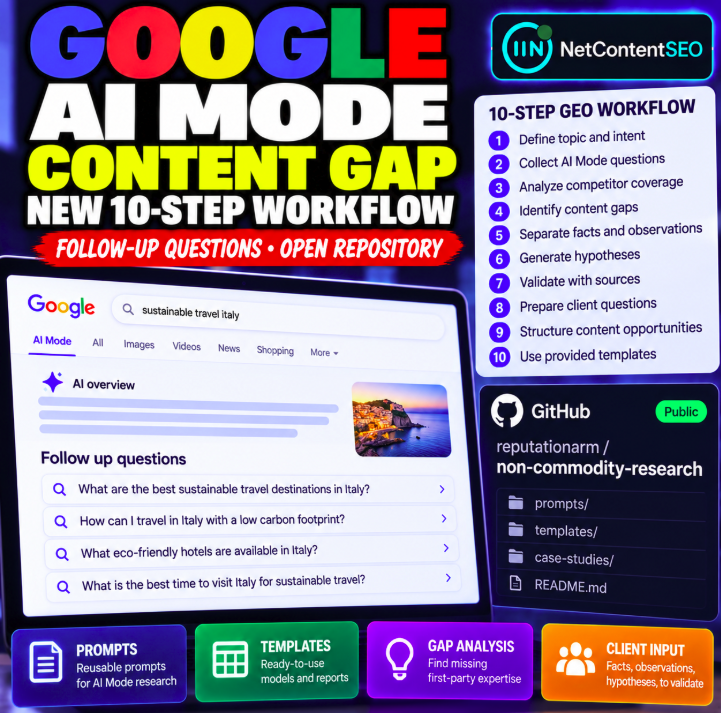

A public 10-stage workflow from Claudia Tomina turns Google AI Mode's suggested follow-up questions into a practical method for identifying content gaps and missing first-party expertise. Published on October 9, 2026, the method is accompanied by a public repository containing reusable prompts and templates. It analyses the questions users may ask next in AI Mode and compares them with the information competitors provide, helping teams identify where original knowledge may be missing.
This is a published GEO research methodology and case study—not a new Google feature, an official Google workflow or proof that using the method improves rankings.
How the workflow uses AI Mode follow-up questions
The core idea is to treat follow-up questions in Google AI Mode as clues about the next information needs a user may have. Researchers can use those questions to map the subject beyond the initial query, then compare the implied needs with competitor pages and the information available from the client.
The goal is not simply to produce more content. It is to identify useful questions that existing competitor content does not answer adequately and determine whether the organisation has first-party experience, evidence or expertise that can fill those gaps.
A 10-stage GEO research method
Claudia Tomina presents the method as a 10-stage workflow supported by reusable prompts and templates in a public GitHub repository. The workflow combines question discovery, competitor-content analysis and evidence handling to help teams turn observations into a more structured research process.
The repository and accompanying article are the primary references for the exact stages and templates. Teams reusing the method should consult the original material rather than infer a different sequence from this summary.
Why separate facts, observations and hypotheses?
A key part of the method is keeping different levels of certainty separate. It distinguishes verified facts, direct observations, hypotheses and information that still needs confirmation from the client. That separation matters because AI-generated answers, visible interface behaviour and competitor-page reviews do not all provide the same strength of evidence.
- Verified facts: information supported by evidence that has been checked.
- Observations: what the researcher directly sees in AI Mode or on competitor pages, recorded with enough context to reproduce the observation.
- Hypotheses: possible explanations or opportunities that need further testing.
- Client confirmation needed: claims about internal processes, customer experience, proprietary expertise or first-party facts that external research cannot establish.
This approach helps prevent an unverified assumption from becoming a content brief or a published claim. It also makes it easier to identify where the client must contribute knowledge that cannot be found in public competitor content.
How content gaps become first-party content opportunities
Once the follow-up questions have been mapped, researchers can compare them with the coverage available on competing pages. A gap may indicate that a question is unanswered, addressed only superficially or missing the kind of practical detail that the client can provide from direct experience.
Not every missing answer is automatically a worthwhile article. Teams still need to assess audience relevance, business value, evidence availability and whether the client can add genuinely useful information. The method is best treated as a research aid for prioritisation, not an automatic content-generation recipe.
What GEO and SEO teams can take from it
- Expand beyond the initial query. Follow-up questions can reveal adjacent information needs worth researching.
- Analyse the gaps, not just competitor keywords. Look for missing explanations, evidence, examples and first-party perspectives.
- Keep an evidence trail. Record what was observed, what was verified and what remains hypothetical.
- Involve the client early. Ask for confirmation where a proposed answer depends on internal expertise or experience.
- Prioritise quality over volume. Publish only when there is a clear audience need and a credible way to provide a better answer.
What the workflow does not prove
The publication of a repeatable research method does not mean Google endorses it or that AI Mode follow-up questions directly reveal ranking factors. The case study does not, by itself, demonstrate that following the workflow improves rankings, citations or traffic. Those outcomes would require separate measurement.
AI Mode interfaces and suggested follow-up questions can also vary. Researchers should record the query, date, market and observed interface where relevant, and avoid treating one result as a permanent or universal representation of user behaviour.
Frequently asked questions
What is the new Google AI Mode content-gap workflow?
It is a public 10-stage GEO research method from Claudia Tomina that uses AI Mode follow-up questions to investigate missing information in competitor content and identify potential opportunities for first-party expertise.
Is it an official Google feature?
No. It is an external research methodology that uses Google AI Mode as an input. It is not a new feature announced by Google.
Where can I find the prompts and templates?
They are available in the public GitHub repository linked below, alongside the article explaining the method.
Does using the workflow improve rankings?
The publication describes a research method and case study, not proof of a ranking improvement. Any SEO or GEO impact would need to be measured independently.
Why separate facts from hypotheses?
Doing so helps teams avoid turning assumptions into published claims and shows where client confirmation or additional evidence is required.
The takeaway
Google AI Mode follow-up questions can be used as inputs for structured GEO research, and Claudia Tomina has published a 10-stage workflow with reusable prompts and templates. Its practical value is in mapping unanswered needs, checking competitor coverage and identifying where a client can contribute first-party expertise. It remains a public methodology—not a Google feature or evidence of ranking gains.
Sources
Original GitHub repository — Non-Commodity Research workflow; Search Engine Land — Google AI Mode follow-up questions as a content research method (October 9, 2026).