

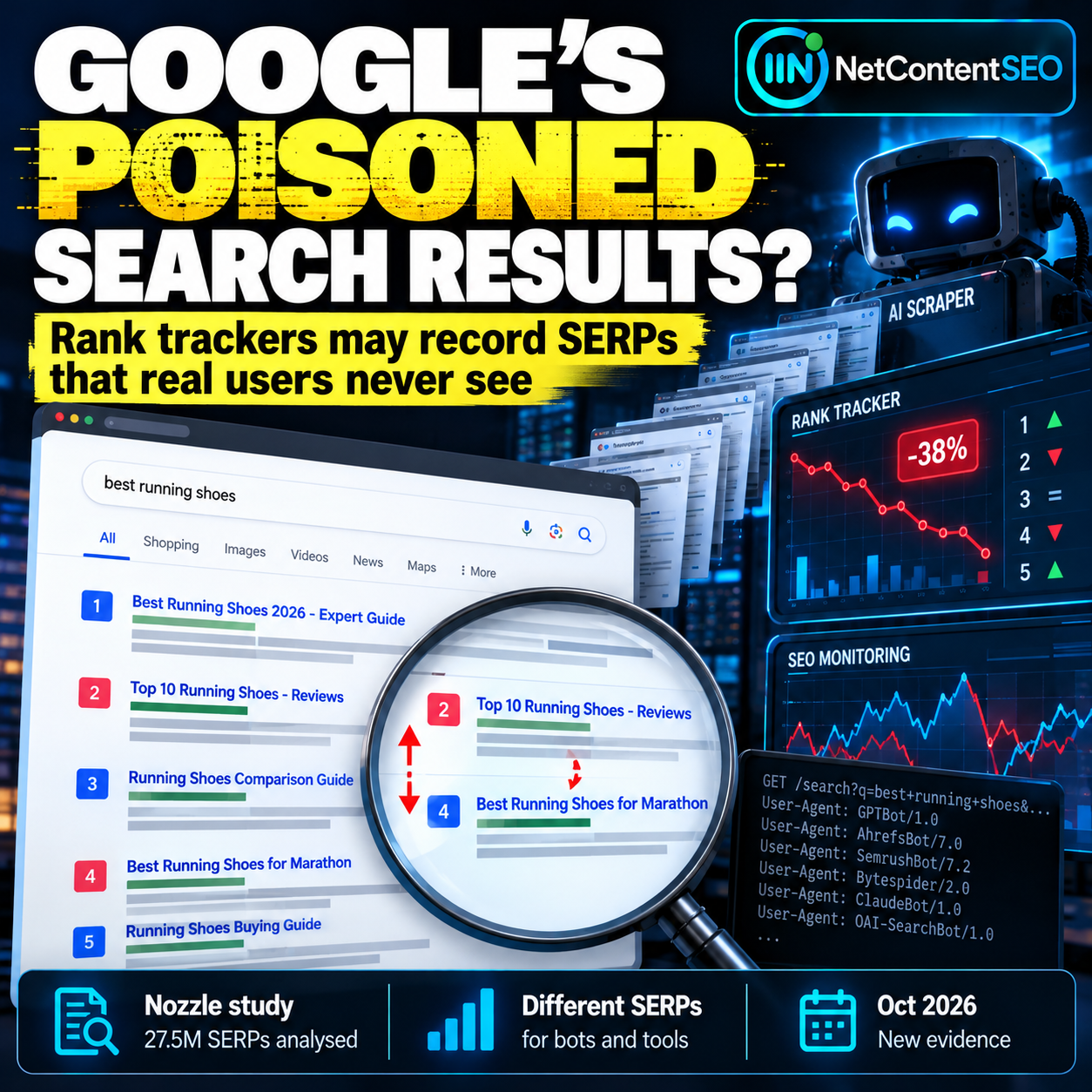

Google may be serving rank trackers search results that look normal but contain a different set of websites from the results those queries usually return. A report by Mashable highlights concerns that Google's efforts to limit automated scraping may be affecting both SEO rank-tracking tools and AI systems that collect search results. The underlying evidence includes research published by Nozzle, a search-data provider—not an official confirmation from Google.
Nozzle's study, published on 10 October 2026, analyzed 27.5 million search engine results pages (SERPs), with data through 9 October. It classified 8.0% of the SERPs it collected from 13 September onward as “poisoned,” compared with 0.17% in its earlier baseline period. In this context, “poisoned” describes a normal-looking page in which many of a query's usual results are missing and later return; it does not mean that the results contain malware.
What does “poisoned SERP” mean?
A search engine results page can be incomplete because a request is blocked or challenged. Nozzle describes a more difficult scenario: a request returns a complete-looking page, but the organic results differ sharply from the sites that normally appear for that keyword. If a rank tracker stores that page as valid, it may report a sudden ranking loss that real searchers did not experience.
Nozzle says the organic results on pages it classified as poisoned retained only 20.7% of the sites from the previous SERP, compared with 88.5% in its baseline. Its analysis also found that a tracked site missed the top 10 on 58.6% of poisoned SERPs, compared with 2.7% before the anomaly. These are findings from Nozzle's collection and definitions, not a universal measurement of all Google searches.
What the research found
- 27.5 million SERPs analyzed: Nozzle compared results collected through 9 October 2026.
- 8.0% classified as poisoned: the share of judged SERPs collected from 13 September onward, versus 0.17% in the baseline period.
- Usual sites disappear: poisoned pages retained 20.7% of the sites from the previous SERP, compared with 88.5% in the baseline.
- Short-lived anomalies: Nozzle reports that 77.9% of poisoned SERPs had their usual sites back within three days.
- Different result mix: Nozzle observed social networks and forums such as Reddit, Facebook, LinkedIn, Instagram and Quora appearing more often in the affected pages.
The figures describe Nozzle's dataset and its classification method. Other providers may observe different rates because of differences in collection routes, keyword sets, geography, timing and how an anomalous result page is identified.
Why this is different from a normal ranking drop
When a page loses visibility because of a genuine ranking change, the movement should be investigated through several signals: the query and landing page, Search Console impressions and clicks, the observed SERP, and the timing of site or search changes. A poisoned result can imitate a ranking crash inside a tracker while the usual sites return on a later fetch.
The fact that an anomaly is temporary does not prove every short-term drop is false. The key is to check whether the movement is corroborated elsewhere and whether the affected query's result set has changed in a way that is inconsistent with its normal history.
Is Google deliberately poisoning results?
Nozzle interprets the pattern as a response to automated scraping, and the Mashable report discusses the implications for rank trackers and AI scrapers. However, Google has not officially confirmed that it is deliberately swapping results to mislead these tools. The observed data supports a report of anomalous, normal-looking SERPs in the studied collection; the precise intent and mechanism should remain attributed to the reporting and researchers rather than stated as an established Google policy.
This distinction matters. A blocked request, a CAPTCHA, a technical collection failure and a complete but anomalous SERP are different outcomes. A tool may need different safeguards for each, and a plausible-looking page can be especially difficult to detect automatically.
What this means for SEO reporting
Rank trackers remain useful for monitoring trends, comparing competitors and checking defined keyword sets. But a sudden movement in one provider's report should not automatically trigger a technical change or a conclusion that Google's algorithm has demoted a site.
- Corroborate major movements. Compare a suspicious change with a second rank tracker and, where possible, a direct inspection of the relevant result page.
- Check Google Search Console. Review query- and page-level impressions, clicks and average position over an appropriate period. Search Console is complementary evidence, not a perfect real-time replacement for a rank tracker.
- Look for recovery. If a dramatic drop reverses quickly, investigate data collection and SERP consistency before treating it as a durable ranking change.
- Annotate reporting anomalies. Record affected dates, keywords, markets and providers so clients and teams can distinguish data-quality events from confirmed performance changes.
- Avoid reactive site changes. Do not rewrite content, disavow links or change technical settings solely because a single tracker suddenly reports a collapse.
What it means for AI Search and scraping
The report also raises questions for services that collect Google results to support AI applications, search analysis or competitive intelligence. If a system relies on automated retrieval and receives a plausible but atypical SERP, it may use a distorted snapshot of the search landscape.
That is a risk to data quality, not proof that every AI system is affected or that AI-generated answers are necessarily wrong. Different services may use licensed APIs, direct crawling, their own indexes or other retrieval methods. The impact depends on the data source and collection path each service uses.
For SEO and GEO teams, the practical lesson is to document the provenance of visibility data and avoid treating any one third-party ranking or AI-search measurement as ground truth. Compare independent signals, retain historical context and label uncertainty when the underlying collection may be unstable.
What remains uncertain
Nozzle's research provides substantial evidence of anomalous SERPs in its own collection, but it does not establish the exact share of all Google searches affected, nor does it prove that every rank-tracking or AI-scraping service receives the same results. Google's intent and the full technical mechanism have not been officially confirmed. The reported rate should therefore be presented with its dataset and dates attached.
The takeaway
SEO teams may need to treat sudden rank-tracker collapses with more caution when the underlying SERP itself could be anomalous. Nozzle's analysis of 27.5 million pages found that 8.0% of its collected SERPs from 13 September onward met its definition of “poisoned,” compared with 0.17% in the baseline. Google has not confirmed deliberate result poisoning. Until more is known, validate major movements with Search Console, additional data sources and the query's actual result history before making SEO decisions.