
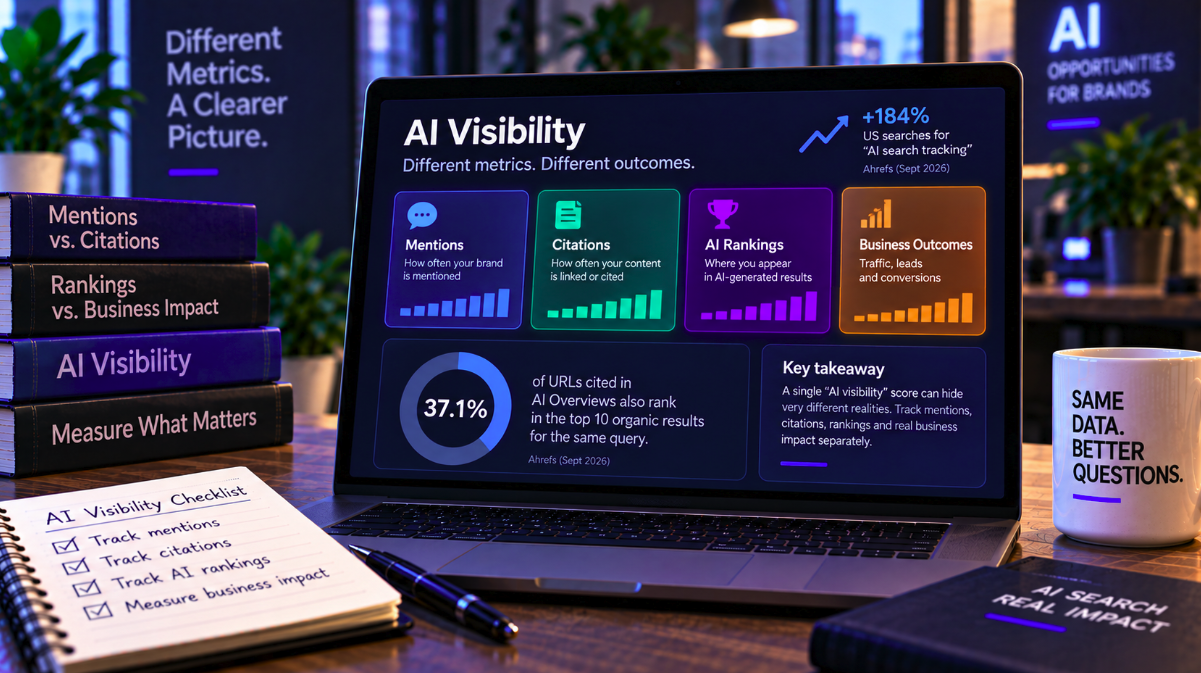
AI visibility is becoming easier to measure and harder to interpret. Tools can now tell marketers how often a brand appears across ChatGPT, Google AI Overviews, AI Mode and other answer engines, then compress that activity into a single percentage. The problem is that the number can rise for several completely different reasons—and those reasons do not necessarily produce the same business result.
A September 9 analysis from Search Engine Journal, based on Ahrefs research, argues for separating at least four layers: brand mentions, source citations, search rankings and real-world outcomes. Interest in the category is clearly accelerating: Ahrefs reports that U.S. search demand for “AI search tracking” increased 184% over the past year, while “AI rank tracking” rose 175%. Those numbers measure search interest rather than tool adoption, but they show how quickly a new analytics category is forming.
The danger is that the category is standardizing around a convenient headline score before marketers have agreed on what that score should mean. A brand mentioned in an AI answer has achieved something different from a page cited as evidence. A URL cited by an AI Overview has achieved something different from a page ranking first in conventional search. And all three can improve while traffic, leads or revenue move in the opposite direction. Treating them as one metric can hide the diagnosis precisely when a team needs to understand what changed.
Mentions and citations describe different kinds of visibility
A mention occurs when an AI answer names the brand. A citation occurs when the system links or attributes information to a URL. Those events can overlap, but they do not have to. A company may be recommended by name without receiving a source link, while its research or product page can be cited as evidence in an answer that primarily discusses a competitor. One is a measure of brand presence; the other is a measure of source attribution.
Retrieval complicates the picture further. Ahrefs analyzed 1.4 million ChatGPT prompts and observed Reddit URLs being retrieved at scale, yet Reddit was cited in only 1.93% of cases in the resulting analysis. Retrieval logs do not necessarily establish that every retrieved URL was opened, read or influential, but the gap illustrates why a citation report cannot reveal the entire information pipeline. A source can enter consideration without appearing in the visible answer, while another can become the citation the user actually sees.
For measurement, that means a declining citation rate with a stable mention rate poses a different strategic question from declining mentions with stable citations. The first may point toward source competition or content coverage; the second may indicate that competitors are winning the brand recommendation itself. An aggregate score can make those two situations look identical.
Only 37.1% of AI Overview citations also rank in the organic top 10
The relationship between AI citations and conventional rankings is similarly incomplete. In Ahrefs’ analysis of 863,000 keywords and four million AI Overview URLs, only 37.1% of cited URLs also appeared in Google’s organic top 10 for the same query. Another 26.2% ranked between positions 11 and 100, while 36.7% did not appear in the top 100 for that exact query.
The finding does not make traditional SEO irrelevant. More than a third of citations overlap the top 10, which is substantial, and organic visibility can still contribute to discoverability, authority and traffic. But the remaining citations demonstrate that an AI Overview is not simply copying the first page of Google into a generated answer. Google can use query fan-out, decomposing a search into related sub-queries and retrieving information that performs well for those adjacent needs even when the page does not rank highly for the original wording.
This is why rank tracking and citation tracking answer different questions. Ranking tells a team how a URL performs in conventional search for a specified query. Citation tracking tells it whether the page became evidence in an AI-generated response. If rankings remain steady while citations decline, looking only at positions will miss the change; if rankings fall while citations remain stable, a combined visibility score could conceal a conventional SEO problem that still matters elsewhere in the funnel.
Correlation can make the wrong optimization tactic look obvious
Ahrefs’ schema research provides a useful example of how easily AI visibility data can be misread. Pages cited by AI systems were almost three times more likely to contain JSON-LD than pages that were not cited. Taken alone, that correlation could produce a simple recommendation: add schema to get more AI citations.
Ahrefs then examined 1,885 pages that added JSON-LD between August 2025 and March 2026 and compared their citation patterns with 4,000 controls. The intervention did not produce a statistically significant citation lift for AI Mode or ChatGPT, where changes versus controls were +2.4% and +2.2% respectively. AI Overview citations fell 4.6%, a small but statistically significant decrease, although Ahrefs explicitly says it cannot determine whether schema caused the decline. The sample also consisted of pages already receiving substantial AI Overview citations, so it does not answer whether structured data helps a previously invisible page become discoverable in the first place.
The lesson is methodological rather than anti-schema. A characteristic that is common among visible pages may correlate with the deeper reasons those pages perform well—stronger sites, richer content, better technical implementation or greater editorial investment—without being the lever that caused the visibility. AI measurement needs controlled comparisons wherever possible before turning an observed pattern into an optimization rule.
Business outcomes are the layer a visibility score cannot replace
Even perfect measurement of mentions, citations and rankings would still stop short of the commercial question. Ahrefs analyzed 300,000 informational keywords using desktop Google Search Console data and found that the top organic result’s click-through rate on queries with an AI Overview was 58% lower than expected without one. Queries without AI Overviews also experienced CTR declines over the comparison period, so Ahrefs describes the 58% as an additional reduction associated with the AIO environment rather than the entirety of the broader trend.
That study is correlational and should not be treated as a sitewide traffic forecast, but it exposes the central problem with visibility as a success metric. A brand can maintain an organic ranking, gain an AI citation and increase its measured presence while receiving fewer clicks. Conversely, a relatively small volume of AI referrals could be commercially valuable if those visitors convert unusually well. Visibility describes exposure; it does not determine the value of that exposure.
For a useful reporting system, marketers therefore need to connect AI presence with analytics: referral sessions where they can be identified, conversions, leads, subscriptions, revenue, branded-search changes and other outcomes relevant to the business. Google’s Search Console AI performance reporting can add impressions for AI features, although Search Engine Journal notes that the dedicated report did not include click or query data at publication. No single source currently closes the attribution loop perfectly, which makes separating the layers more important rather than less.
A better AI visibility dashboard starts with four questions
The practical alternative to one opaque score is not to abandon aggregation entirely. It is to preserve the underlying dimensions before summarizing them. Mentions answer whether the brand enters the conversation. Citations answer whether the company’s pages or research are being used as visible evidence. Rankings answer whether traditional search discoverability is strengthening or weakening. Outcomes answer whether any of those forms of exposure are creating business value.
Those metrics should also be measured consistently. AI responses are probabilistic, so repeating the same prompt can produce different brands and sources. Changing a tracker’s prompt set, switching model versions or altering sampling frequency can move a score even when the underlying market has not materially changed. Ahrefs recommends sufficiently large prompt sets to identify patterns rather than overreacting to individual responses, and teams should record methodology changes so a dashboard does not mistake measurement drift for competitive movement.
The 37.1% overlap between AI Overview citations and organic top-10 rankings is a useful symbol of the larger measurement problem. AI visibility is connected to traditional search but not reducible to it; citations are connected to mentions but not interchangeable with them; and neither guarantees a click or a customer. The industry’s growing demand for “AI search tracking” will produce increasingly sophisticated scores, but sophistication is not the same as clarity.
The most useful dashboard may therefore be the one that refuses to answer “How visible are we?” with a single number. It should instead show where the brand is mentioned, where its content is cited, how those pages rank, and what users do afterward. One score can be convenient for an executive slide. Four separate outcomes are far more useful for deciding what to fix next.