

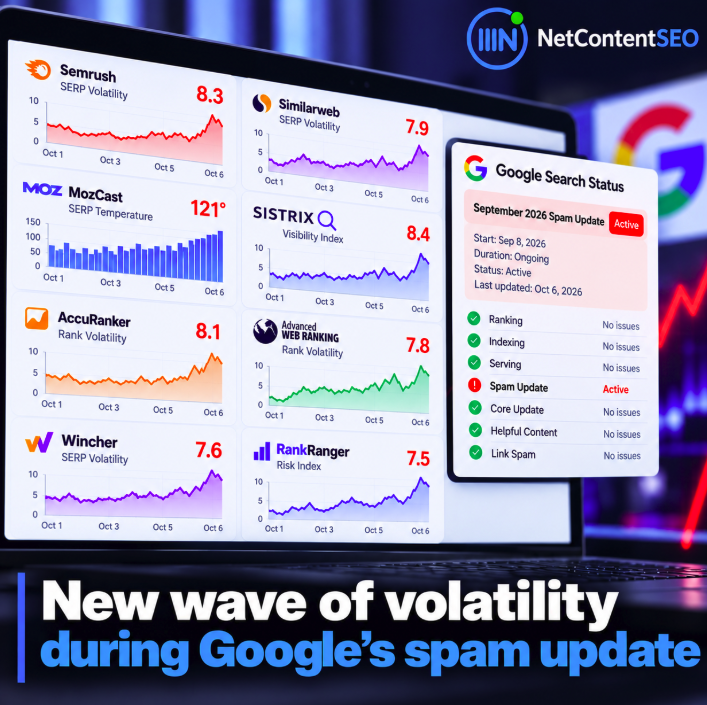

A new wave of Google Search volatility is appearing while the September 2026 Spam Update is still officially active. Multiple independent tracking systems showed another acceleration between October 4 and October 6, creating what looks like a third major period of ranking movement during the rollout.
The important caveat is timing. The volatility is real across several monitoring platforms, but Google's official Search Status Dashboard still lists the September 2026 Spam Update as active. That means the latest movement should not yet be described as the final phase or the end of the rollout.
Multiple volatility sensors are moving together
Semrush, MozCast, AccuRanker, Wincher, Similarweb, Sistrix and other monitoring systems have shown renewed turbulence. When several independent sensors accelerate at roughly the same time, the pattern is more useful than a spike seen by only one provider.
Even so, third-party volatility tools do not identify the cause of every ranking change. They measure movement across tracked search results; they cannot prove that each individual site's gains or losses were caused directly by the spam update.
The September 2026 Spam Update is still active
This distinction matters because SEO teams often try to diagnose ranking losses before an update has finished propagating. If Google still reports the rollout as active, positions may continue to change as systems recalculate signals and different parts of the index are processed.
A temporary recovery or decline during an active rollout therefore should not automatically be treated as the site's new baseline. The current third wave may represent another stage of the update, normal post-processing volatility, or overlapping Search behavior. The available evidence does not yet establish which explanation applies universally.
Separate algorithmic losses from Discover volatility
Sites with meaningful Google Discover traffic need an additional layer of diagnosis. Discover can move sharply even when traditional Search rankings remain comparatively stable, and those changes can distort site-wide traffic graphs.
Before attributing a decline to the spam update, compare Web Search and Discover separately in Search Console. Check whether impressions and clicks fell across ordinary queries and landing pages, or whether the apparent loss is concentrated in Discover exposure.
Look for page-level and query-level patterns
A genuine algorithmic shift often leaves patterns. Groups of pages may lose visibility together, specific query classes may move, or sections built with the same editorial or programmatic approach may behave similarly.
By contrast, isolated daily fluctuations across unrelated URLs can be normal SERP movement. Comparing affected templates, topics, authorship patterns, link profiles and content types can help determine whether the change has a coherent footprint.
Do not react to every sensor spike
Volatility tools are useful warning systems, not site-specific diagnostic tools. A red sensor does not mean every website should immediately rewrite content, remove pages or change internal linking.
During an active spam rollout, aggressive changes can make later analysis harder because the site itself is changing while Google's systems are still moving. Unless there is an obvious policy or quality problem that should be corrected regardless of rankings, preserving clean before-and-after data can be more valuable than reacting to each daily swing.
A practical checklist for the third wave
SEO teams should first confirm whether the change appears in Search Console rather than relying only on external sensors. Segment Web Search and Discover, compare affected countries and devices, inspect page groups and query clusters, and note the exact dates when visibility changed.
Then compare those movements with the official update timeline. As long as Google continues to mark the September 2026 Spam Update as active, conclusions about recovery, penalties or final winners and losers remain provisional.
The current signal is therefore important but incomplete: a third acceleration is visible across multiple volatility trackers, while Google has not confirmed that the rollout is over. The strongest analysis will come after the update closes and the resulting ranking patterns have had time to stabilize.