
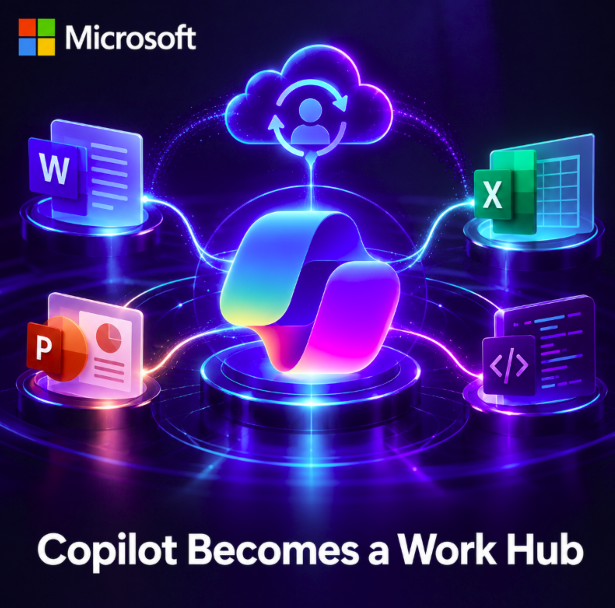
Microsoft is bringing conversation, document creation, coding and persistent agents into a more unified Copilot experience. For SEO and content teams, the strategic question is how discovery changes when researching a topic and turning it into a work product happen inside the same assistant.
An official announcement precedes the latest coverage
Microsoft’s September 25, 2026 announcement describes Home, Code and Autopilot, with capabilities arriving through staged rollouts and previews. Home brings Chat and Cowork together, while Office in Copilot supports editable Word, Excel and PowerPoint files. Code draws on the technology underlying GitHub Copilot.
Microsoft identifies Autopilot as the successor name to Scout and describes a cloud-hosted agent with its own identity, memory and workspace. It can continue recurring work within organizational permissions. The announcement places Home and Code in the Frontier rollout and describes expansion of Autopilot’s private preview.
The user-supplied October 1 The Verge report frames the wider rethink as an “OS for work.” Its full text was not accessible during verification. We could not independently establish the claim that Scout’s desktop client is entering maintenance mode. The verified status is an official product announcement with progressive availability, rather than a universally available release.
Research can become part of completing a task
Our editorial interpretation is that a work assistant can change the context in which information gets selected. A user preparing a supplier comparison may need evidence, pricing explanations and an editable presentation in one sequence. The relevant discovery opportunity may occur during that task, rather than through a separate visit to a search engine.
This does not establish a new Copilot ranking rule or prove a decline in website traffic. It suggests a useful question for publishers: can their information support a specific work decision, and can a reader or assistant understand what evidence backs it?
Persistent agents make freshness worth monitoring
A recurring research task creates different needs from a one-off lookup. In a hypothetical weekly supplier review, an assistant might need to distinguish a current offer from last month’s terms. A publisher can make that distinction easier by clearly dating material updates, explaining what changed and keeping important product information consistent.
These are editorial recommendations, not confirmed Autopilot selection criteria. The announcement does not demonstrate which public sources the agent will choose, how often it will revisit them or how external content will be attributed in every workflow.
Content teams should preserve evidence through creation
When research becomes a document or slide deck, source context can be lost during summarization. Teams using an assistant should review factual claims, retain useful links and distinguish source evidence from the assistant’s interpretation. A polished file is still a draft requiring editorial judgment.
For brands creating public material, clear product descriptions, accessible documentation and explicit qualifications remain useful foundations. There is no evidence in this announcement that a special format guarantees inclusion in Copilot-generated work.
Measure the actual discovery journey
Keep mentions, source links, referred visits and resulting business actions as separate observations. An assistant using a fact in an internal document does not necessarily generate a visit to the source. Conversely, an appearance in an answer does not establish that it influenced a purchasing decision.
Microsoft’s announced direction brings more stages of work into Copilot. The opportunity for SEO and AI Search teams is to understand those task contexts and provide dependable information for them, while assessing each capability against its actual availability and observable behavior.