

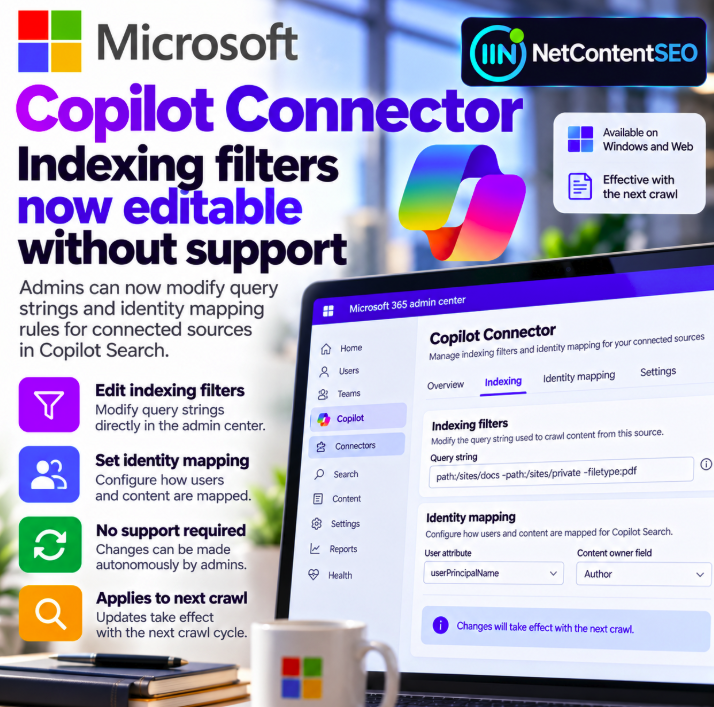

October 6, 2026 — Microsoft has documented a self-service change for administrators managing connected data sources in Microsoft 365 Copilot Search. Administrators can update connector query strings and identity-mapping rules without opening a Microsoft support request. According to the release note, changes become effective with the next crawl.
This is an operational update for enterprise search governance, not an announcement about Google's public search indexing or a guarantee that modified content will appear in every Copilot answer.
What changed?
Connector administrators can now adjust two important aspects of connected-source configuration directly: query strings, which can define or filter the content collected from a source, and identity mapping rules, which associate identities from external systems with the appropriate users in Microsoft 365. Previously, some such changes required support intervention; the documented update makes them administrator-managed.
When do the changes take effect?
Microsoft says changes take effect on the next crawl. That distinction matters: saving a new rule does not necessarily mean all indexed content is immediately updated. The time until a change is reflected depends on the connector's crawling schedule and processing. Administrators should confirm the subsequent crawl and validate the resulting indexed content and permissions.
Why query-string filters matter
Connected sources may contain both relevant and irrelevant information. A query or filter can determine which records enter the enterprise search pipeline. If configured too narrowly, important documents might be omitted; if too broadly, outdated or unnecessary content may become retrievable. The exact syntax and available filtering options depend on the connector and source system.
Why identity mapping matters
Identity mapping helps the connector interpret users and access permissions across different systems. Incorrect mappings can produce missing results for legitimate users or raise governance concerns about how source permissions are represented. A mapping change should therefore be reviewed and tested as a security-sensitive configuration update, not merely a relevance adjustment.
Impact on Copilot Search and AI-generated answers
Copilot Search depends on the data it can retrieve and the access rights associated with that data. Changing a connector's inclusion rules or identity mappings can alter the set of material available as context for retrieval and AI-assisted responses. However, being indexed does not guarantee that a document will be selected, summarized or cited for any particular question.
A practical administrator checklist
- Record the current configuration: export or document query strings and identity-mapping rules before making changes.
- Define the intended scope: identify which content should be included or excluded and which identities should resolve to which users.
- Review permissions: ensure changes preserve the source system's intended access boundaries.
- Apply the update: use the supported administrative controls for the relevant connector.
- Wait for the next crawl: confirm crawl completion rather than assuming immediate effect.
- Test representative searches: check results for authorized users and verify that excluded or restricted material is handled correctly.
- Monitor regressions: watch for missing documents, unexpected matches or permission discrepancies.
Is this enterprise SEO?
The analogy is useful but has limits. Public SEO focuses on making web content discoverable to search engines and users. Enterprise search governance focuses on which internal records are indexed, how they are permissioned and whether they can be retrieved in a work context. The same principles of clear information architecture and content quality apply, but connector rules are not public web ranking signals.
NetContentSEO analysis
Making indexing filters and identity mapping self-service gives organizations more direct control over the information available to Copilot Search. It also increases the need for change management: a small configuration edit can reshape the enterprise retrieval corpus at the next crawl. For AI visibility inside organizations, retrievability starts with source selection, identity integrity and reliable crawling—well before an assistant chooses what to include in an answer.
Official source
Microsoft Learn — Microsoft 365 Copilot release notes (October 6, 2026).