

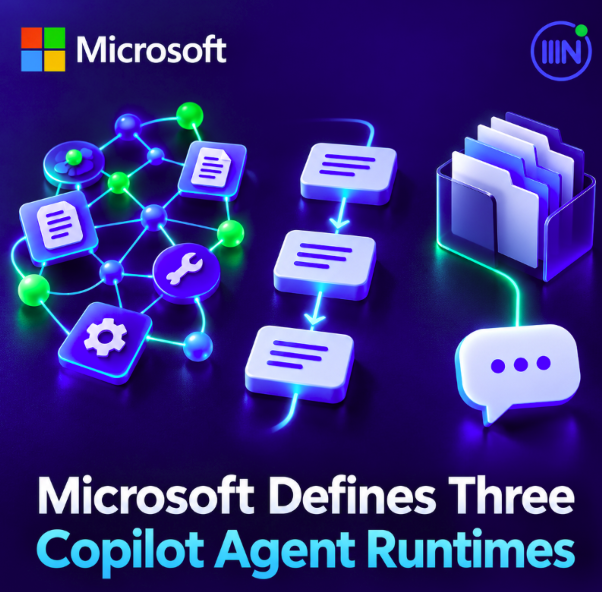

Microsoft is making the execution layer of Copilot Studio agents more explicit. Its harness overview, updated on 1 October 2026, describes three options: the GitHub Copilot harness, the standard harness and the Copilot chat harness. For SEO teams building monitoring or research assistants, the useful question is which runtime matches the work, rather than simply which model produces the strongest answer.
A harness sits between the model and an agent’s configuration. It manages model calls, context and tool execution. Microsoft positions the GitHub Copilot option for complex tasks, the standard option for structured processes, and Copilot chat for extending Microsoft Copilot Chat with enterprise knowledge. This is an official documentation update, not evidence that every capability has just launched or is available in every tenant.
Three options without a rigid reasoning-versus-retrieval split
The GitHub Copilot harness supports work across connectors, MCP and connected agents, alongside skills, memory, document handling and sandbox execution. Microsoft also distinguishes it from the GitHub Copilot service: the shared name does not mean Copilot Studio customer data is processed by that service.
The architecture comparison adds an important qualification. Both the standard and GitHub Copilot harnesses can plan, call tools and combine AI with deterministic steps. Standard agents can use retries and tool chains. The distinction lies in scale, shared context and responsibility for adapting the execution path, rather than one runtime reasoning while another merely retrieves information.
That nuance changes the buying and design decision. A more autonomous runtime can add latency and credit consumption to a simple task without improving the result. Conversely, a process involving large files, changing evidence and several outputs may become cumbersome when every handoff and exception has to be designed separately.
Match the runtime to the SEO job
Consider a monitoring workflow that receives a known report, checks a defined threshold and prepares an alert. A standard harness may be proportionate because the inputs and response path are bounded. The team can define what counts as an issue and test the same procedure repeatedly. There is little commercial value in allowing the assistant to invent a new investigation for every routine fluctuation.
Source verification presents a different problem. An analyst may need to locate an original announcement, compare it with secondary coverage, resolve inconsistent dates and produce an evidence-linked briefing. A reasoning-heavy runtime could help coordinate those steps and adapt when a source is unavailable. This is a proposed use case, not a Microsoft guarantee that the agent will verify claims correctly.
For an internal assistant answering questions about approved SEO playbooks or brand guidance, the Copilot chat harness may fit the everyday knowledge-access experience. Connecting a repository does not establish that its contents are complete or current. Owners still need to maintain authoritative documents and evaluate whether answers cite the right material.
AI citation analysis also needs a clear measurement design. An agent can organise observations from supported data sources, but its runtime does not create access to competitor accounts, hidden analytics or every response generated by an AI platform. Define the query sample, timestamps and evidence captured before automating interpretation.
Evaluate outcomes before migration
Teams should test candidate architectures against the same representative tasks: a routine alert, an ambiguous source claim and an investigation requiring multiple files. Compare correctness, useful evidence, completion time and consumption. Include failed tool calls and missing information, because recovery is valuable only if it produces a trustworthy result.
The documentation makes runtime selection a practical part of agent design. For SEO and AI Search operations, the opportunity is to use predictable workflows for bounded monitoring and reserve more adaptive orchestration for investigations that justify it. The architecture should improve the quality and cost of the work before becoming a reason to rebuild an existing agent.