

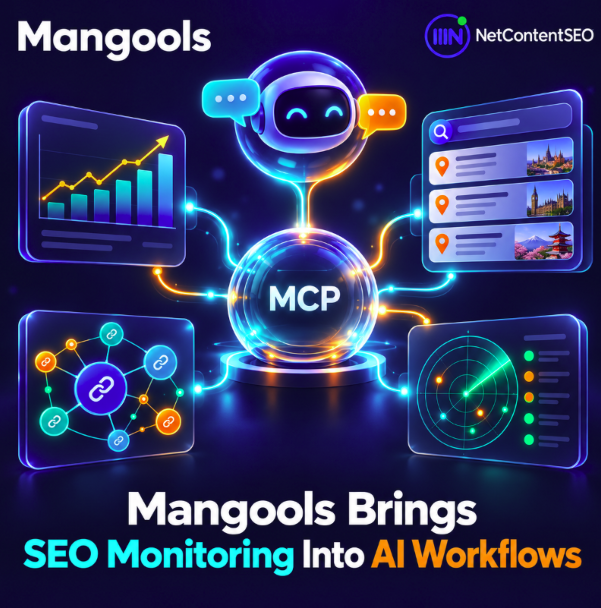

Mangools has an official remote MCP server in beta, offering approximately 35 tools across its SEO products. The official page, reported as discovered on October 3, 2026, does not display a publication date. Its capabilities cover keyword research, localized SERP analysis, ranking, backlinks, content gaps and AI Search Watcher.
Mangools lists verified compatibility with Claude, ChatGPT, Cursor and Claude Code, and provides configuration guidance for Copilot Studio and other clients. Authentication uses OAuth or an API token. Tool calls count against Mangools API quotas, regardless of authentication method.
From requesting a report to changing the monitoring setup
The server includes actions to create and update SERPWatcher tracking, manage keyword lists, generate AI monitoring prompts and create or modify AI Search Watcher monitors. Creating monitors consumes paid quota, and rank-tracking changes can consume paid resources depending on the plan. Mangools recommends confirmation for those calls. This is a connector with capabilities to change account resources, rather than a purely observational interface.
That distinction matters when a request begins as analysis but ends with a proposed action. Asking an assistant to identify a visibility gap could lead to a useful recommendation for new tracking. Creating that tracking is a separate operational decision, with a scope and resource requirement that should be explicit.
Our recommendation is to separate the proposed monitoring specification from its execution. Define the brand, competitors, locations and prompt set first. Review that specification before allowing changes. This makes the intended outcome easier to inspect and helps avoid broad requests creating more monitoring than a team intended.
SEO rankings and AI mentions remain different measurements
The AI Search Watcher product page describes monitoring brand appearances and citations across ChatGPT, Google AI Overviews, AI Mode, Gemini, Claude, Grok, Mistral and Llama. Mangools says it repeats prompts to capture variations and produce aggregate measurements. These are vendor-described capabilities; we have not independently tested their coverage or accuracy.
A conversational workflow can bring those observations into the same discussion as traditional rankings. It does not make the underlying measurements interchangeable. A keyword position, a brand mention and a cited URL answer different questions. An assistant’s narrative should preserve those distinctions instead of compressing them into a single claim that visibility improved.
For example, a team might inspect a set of localized commercial queries, compare the domains appearing in those results and examine brand mentions for related AI prompts. That is a proposed analytical workflow, not evidence that every dataset shares the same location settings, time period or audience.
Build a reproducible conversational audit
The editorial opportunity is to make routine analysis easier to request while keeping the evidence visible. A useful report should identify the tool and dataset used, the relevant query or prompt, the observation period and the limitations of the comparison. When information is missing, the assistant should identify the gap rather than infer a negative result.
Track the monitoring configuration as carefully as the resulting metrics. If prompts, competitors or locations change, an apparent improvement may reflect a different measurement set. Keep a consistent comparison group and document additions separately. This is especially useful when several people can request changes through natural language.
For SEO and GEO teams, the Mangools beta offers a way to combine analysis and monitoring management in an AI conversation. Its commercial value will depend on the quality of the workflow, the reliability of its outputs and the resources it consumes. Begin with a defined task, review any proposed account changes and evaluate the result before expanding its role in ongoing reporting.