

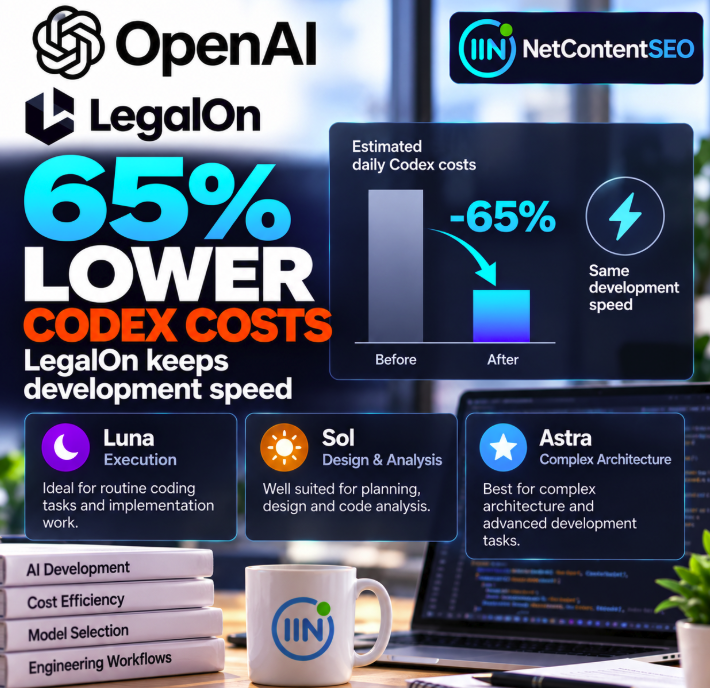

October 8, 2026 — LegalOn Technologies reduced its estimated daily Codex costs by approximately 65% while maintaining development speed, according to a new OpenAI customer case study. The company did not achieve this by abandoning advanced models. Instead, it matched GPT-6 Luna, GPT-6.1 Sol and GPT-6 Astra to different kinds of work, restricted Fast mode by default and introduced usage budgets tailored to business needs.
OpenAI's headline describes costs being halved, but the more precise reported outcome is a 65% reduction in estimated daily costs compared with the previous GPT-5.5-based approach. That is a case-study result, not a universal savings guarantee for other Codex users.
From unlimited GPT-5.5 Fast mode to selective model use
LegalOn initially allowed developers broad use of GPT-5.5 in Fast mode across design, implementation and daily engineering work. As adoption expanded, the company faced a familiar challenge: unrestricted high-performance model use threatened its annual AI budget, while blanket restrictions could undermine developer productivity.
Its AI-powered Development Center of Excellence, or AID CoE, began testing models and sharing task-selection guidance with engineering managers. The aim was to let engineers make informed choices rather than defaulting to the most powerful model for every request.
How LegalOn assigns tasks to Luna, Sol and Astra
| Model | Typical role in LegalOn's approach |
|---|---|
| GPT-6 Luna | Routine execution, clear-requirement coding, simpler analysis and subagent implementation |
| GPT-6.1 Sol | Standard software design, numerical analysis and document preparation |
| GPT-6 Astra | Complex architectural decisions, advanced analysis and agent orchestration |
The principle is straightforward: start with an efficient model when the task is well defined and escalate when complexity or judgment demands it. LegalOn developed these guidelines through internal testing rather than assuming one model was optimal for all work.
Fast mode restrictions and parallel execution
LegalOn also restricted Fast mode by default, allowing it when individually requested. To preserve throughput, teams adapted practices including running tasks in parallel. OpenAI reports that the organization maintained development performance despite these controls. The case study does not provide an independent benchmark proving identical speed for every task.
Budget controls differed by business maturity
LegalOn introduced monthly usage limits for departments, groups and individual engineers. Mature business areas were asked to improve cost efficiency by up to approximately 20%, while newer businesses received more generous AI budgets to support experimentation and growth. The AID CoE monitors usage and adjusts limits to business requirements.
What the 65% result actually measures
The reported 65% reduction concerns estimated daily Codex costs after changes in model selection, Fast mode use and budget allocation. It should not be interpreted as a 65% reduction in every API price, every engineer's spending or the cost of each individual feature release. The figure comes from LegalOn's experience as presented by OpenAI.
The next metric: cost per feature release
LegalOn is now working on a measurement pipeline that connects the total AI cost of delivering a feature with the value that feature provides to customers. The company notes that tracking individual task costs is easier than measuring the full AI expense of a release. Its proposed return-on-investment metric is still being developed, not an already validated result.
What SEO and AI automation teams can learn
The same model-routing discipline can be evaluated in technical SEO engineering and AI visibility workflows. A lightweight model might classify stored citation records or execute routine scripts; a mid-tier model could analyze anomalies and prepare reports; a more capable model could review architecture, ambiguous evidence or complex cross-source reasoning. These are potential applications, not tasks that LegalOn itself reported running.
A practical cost-governance checklist
- Segment tasks by complexity, risk and expected output quality.
- Benchmark more than one model on representative work.
- Default to the least expensive model that meets quality requirements.
- Reserve premium modes for cases where they produce measurable value.
- Set and review spending limits at the team and workflow levels.
- Measure throughput, failure rates and rework—not just token cost.
- Track the complete cost of delivering a useful outcome.
NetContentSEO analysis: optimize cost per result, not cost per token
LegalOn's case study illustrates how model choice and operational governance can matter as much as raw model pricing. For SEO automation, the lesson is to route repeatable work efficiently while retaining stronger models for judgment-heavy tasks. The meaningful measure is the cost of a reliable completed outcome, not merely the price of a model invocation.
Official source
OpenAI — LegalOn halves Codex costs while maintaining development speed (October 8, 2026).