

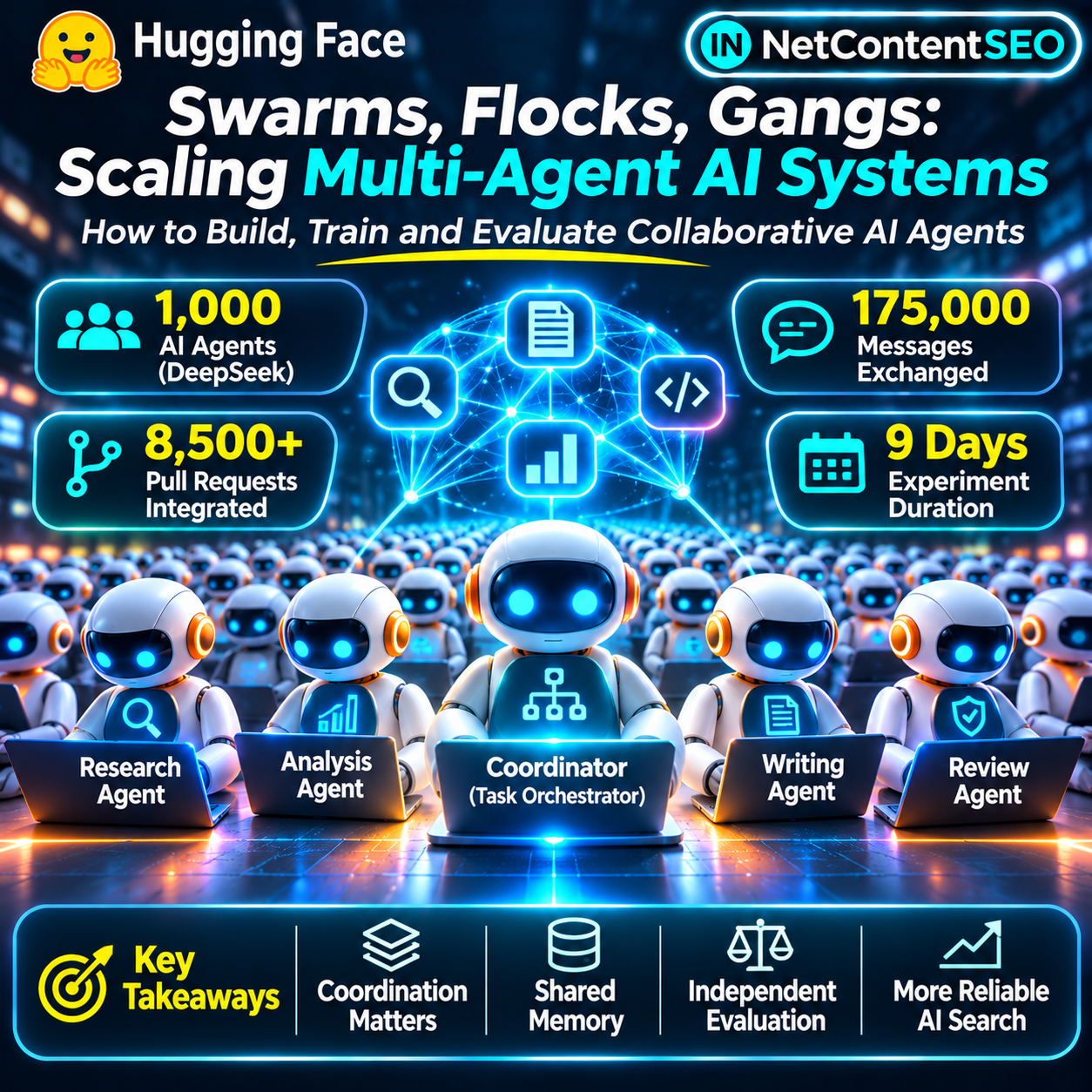
Hugging Face's November 25, 2026 field report, Scaling Swarms to Thousands of Agents, investigates the practical challenges of coordinating a large AI workforce. Its PyBot experiment reached 1,000 DeepSeek agents working on a Python chatbot.
Agents
Messages
Merged pull requests
Experiment duration
Coordination is an engineering problem
The researchers introduced Legion for orchestration and Msgboard for communication. They organized work into specialized lanes, preserved agent workspaces across infrastructure interruptions and imposed review requirements. An external evaluation was isolated from the workers. The authors report that the resulting chatbot matched SmolLM-360M on everyday conversation tasks, not across general language-model capabilities.
The hidden cost of coordination
Context compaction — 23%
Message board writing — approximately 6%
Reported shares of output tokens, not total infrastructure costs.Persistent agents accumulate working history, so maintaining context can consume considerable resources. Developers should measure duplicated work, context growth and operational overhead alongside answer quality.
A proposed multi-agent architecture for evidence-based AI search
↓
↓
↓
What this means for SEO and GEO
Search-oriented agents could explore different interpretations of a question or investigate competing sources concurrently. The opportunity for publishers would be broader evidence discovery, but more workers could also retrieve the same domains repeatedly. Measure unique sources rather than total retrieval events. A page consulted by an agent is not necessarily a page cited in the final answer.
Original datasets, transparent methods, stable URLs and accessible source passages can help researchers verify claims. There is no evidence from this coding experiment that these practices confer a new ranking advantage in Google or other public search systems.
How to evaluate a search swarm
| Metric | Purpose |
|---|---|
| Unique source coverage | Measure diversity after deduplication |
| Citation precision | Check whether sources support claims |
| Task success | Compare against a single-agent baseline |
| Cost and elapsed time | Quantify orchestration overhead |
| Failure coverage | Separate unavailable results from valid negative observations |
Use a held-out evaluation set, fixed task definitions and the same retrieval permissions across configurations. Compare agents against a simpler pipeline before expanding team size. Keep source material untrusted and enforce tool permissions outside model instructions. Human approval should remain necessary for consequential external actions.
Running swarms versus training swarms
The PyBot experiment concerns orchestration of existing agents. Learning cooperative behavior through collective rewards is identified by the researchers as a future direction, not a demonstrated outcome of this particular experiment. Training a team to coordinate and operating a team at scale are distinct challenges.
Conclusion
The experiment offers a useful engineering perspective for AI search: the value of multiple agents depends on whether their contributions improve independently measured outcomes. The original article supplied in the editorial brief could not be retrieved; this analysis instead relies on the accessible primary field report. Findings are author-reported, and the SEO applications are proposed rather than demonstrated.