

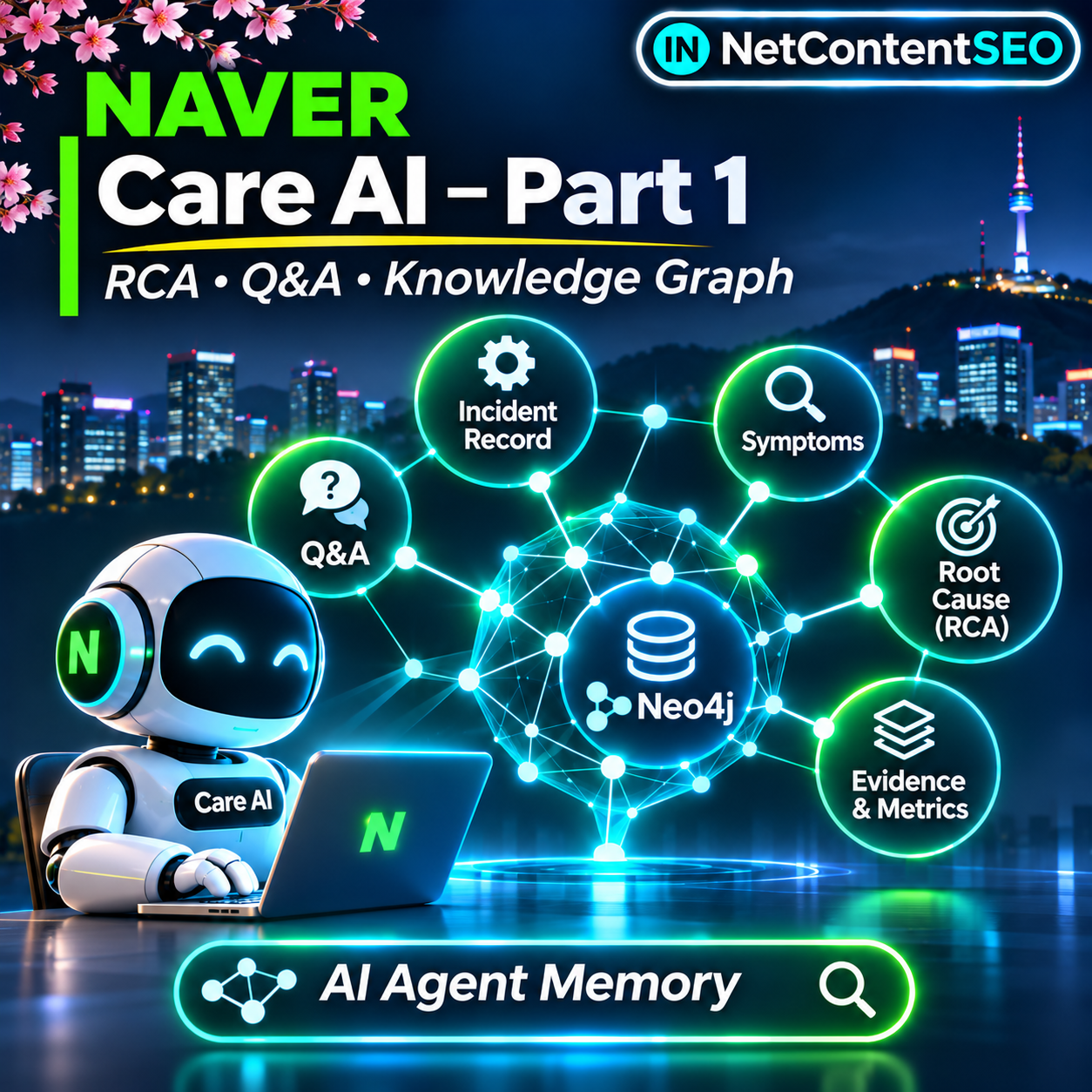

Organizational knowledge is often trapped in closed support tickets. Even a carefully documented resolution may be difficult to retrieve when a similar problem returns. On November 25, 2026, NAVER D2 published an Engineering Day session explaining how its Care AI agent addresses this problem through structured operational memory.
From support conversations to reusable evidence
The project concerns n3r, NAVER's internal Kubernetes-based container platform. Engineers extract root cause analysis (RCA) and question-and-answer material from operational issues using language models, validate the extracted information and retain it in Neo4j. The presentation follows a real inquiry about a stalled OpenSearch upgrade and discusses hybrid retrieval, LLM reranking and the use of cluster-state information to identify relevant precedents.
Why symptoms are not enough
Two incidents can produce the same visible error while having different underlying causes. Conversely, a single underlying fault may manifest through several apparently unrelated symptoms. For example, in a hypothetical infrastructure system, an upgrade might stall because of resource exhaustion or because a dependency is unavailable. A useful knowledge representation distinguishes observed behavior from the explanation and the evidence that supports it.
A conceptual architecture for operational memory
Editorial conceptual diagram, not NAVER's exact implementation or database schema.
Hybrid retrieval and reranking: complementary tools
In a typical retrieval pipeline, lexical search can find exact identifiers and error messages, while semantic retrieval can recognize differently worded descriptions of a related problem. Graph relationships can add contextual associations. A reranker can then reconsider candidate results against the current question. These are general architectural options; the public session summary does not disclose NAVER's precise retrieval algorithms, graph schema or ranking weights.
Not every question is an incident
A mature agent should distinguish a request for instructions from a request for diagnosis. A question about supported configuration may require a verified policy or procedure, while an incident investigation needs current measurements and a defensible explanation. Mixing these categories can cause an agent to offer irrelevant troubleshooting or treat historical advice as current fact.
Practical implications for RAG and AI Search
Developers can adapt this approach by retaining source identifiers, timestamps, software versions, evidence and validation status alongside extracted facts. Historical records should be treated as candidates for investigation rather than proof of a current diagnosis. If evidence conflicts or a record is outdated, the system should communicate uncertainty and seek additional information.
For search applications, the same separation suggests evaluating retrieval recall, candidate reranking, evidence quality and answer accuracy independently. A citation can point to a relevant document without supporting the particular claim made by the model. Testing both relevance and factual support is therefore essential.
What this means for SEO and GEO
Knowledge-oriented publishers can make technical content more useful by explaining relationships between problems, causes and solutions, identifying the applicable product version and linking to supporting documentation. Such practices help readers and may support automated information extraction. They do not guarantee higher rankings or inclusion in generated answers. This internal operational case study does not establish changes to NAVER's public search algorithms.
Part two: from stored knowledge to reliable execution
The companion NAVER Engineering Day session addresses MCP tool responses, agent responsibilities and operational answer design. Together, the sessions illustrate two complementary engineering concerns: building useful organizational memory and controlling how an agent uses evidence. The first session's publicly indexed summary does not provide quantitative retrieval benchmarks, so no numerical performance improvement is attributed to its knowledge graph here.
The bottom line
Persistent agent memory is more useful when it preserves relationships, provenance and context rather than simply accumulating text. NAVER's case study offers a concrete starting point for teams investigating graph-enhanced retrieval and evidence-aware agents, while the effectiveness of any alternative deployment needs to be measured on its own data.
Source: NAVER D2, Engineering Day 10th, November 25, 2026. The official indexed summary was available for verification; direct page retrieval was unsuccessful.