
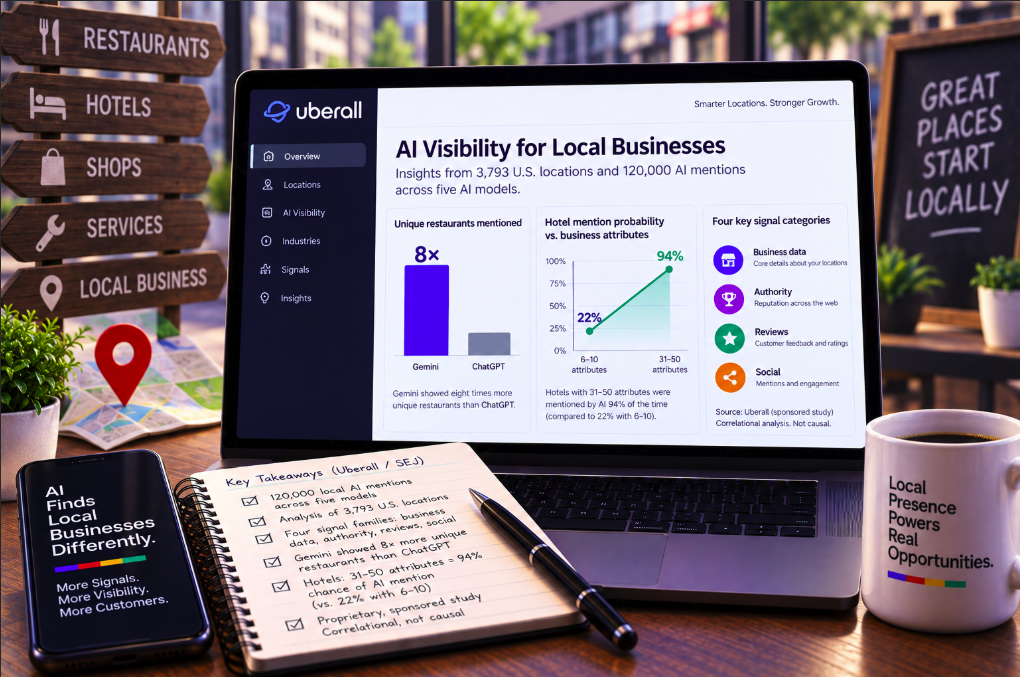
A proprietary study of more than 120,000 local-business mentions across five AI systems suggests that the businesses most visible in generative recommendations share a familiar set of characteristics: richer location data, stronger third-party authority, more review evidence and a larger social footprint.
The headline result comes from hotels. In Uberall's analysis, properties with only six to ten relevant business attributes had a 22% probability of being mentioned by the tested AI systems, while hotels with 31 to 50 attributes were mentioned 94% of the time.
The study, described in a September 10 sponsored article on Search Engine Journal, analyzed 3,793 U.S. business locations across restaurants, hotels, grocery stores, dental practices and banks. Uberall grouped the patterns it found into four categories: business data, authority, reviews and social signals.
The numbers are useful as directional evidence, but they should not be converted into a list of proven AI ranking factors. Uberall sells local marketing and AI-visibility software, the SEJ article explicitly identifies the research as sponsored, and the public materials do not provide the complete raw dataset or enough statistical detail for independent replication. Most importantly, the reported relationships are correlational: richer business profiles may accompany many other characteristics that make a hotel more likely to be recommended.
The dataset covers 120,000 mentions across 3,793 U.S. locations
Uberall says its internal GEO analyst examined more than 120,000 AI mentions involving 3,793 locations in U.S. cities ranging from Chicago to New York.
The businesses span five verticals: restaurants, hotels, grocery stores, dentists and banks. The research compares recommendations across ChatGPT, Gemini, Claude, Grok and Perplexity.
An earlier Uberall methodology article provides additional detail on how the testing was performed. It says the company ran each model against nine to eleven real-world prompt intents per vertical, ranging from broad discovery questions to more specific needs, and repeated prompt/model combinations 50 to 100 times.
That repeated-query design is important because generative systems can return different recommendations for the same prompt. A single response would be too unstable to support useful conclusions about local visibility.
The hotel attribute result is the most dramatic business-data finding
Google Business Profile attributes describe characteristics such as amenities, accessibility, services and other location-specific details. In hospitality, those fields can help represent whether a property has the features a traveler is actually asking for.
Uberall reports that hotels with six to ten relevant attributes had a 22% AI mention probability, while those with 31 to 50 attributes reached 94%.
That is a 72-percentage-point association between the two observed groups, not evidence that adding 25 attributes will mechanically raise an individual hotel's probability from 22% to 94%.
Hotels with richer profiles may also have stronger brands, more professional location management, larger review footprints, better photography and greater editorial coverage. Without a randomized intervention or a fully specified causal model, those factors can be difficult to separate.
Profile completeness appears to function as an eligibility signal
Uberall's interpretation is that business-data richness often influences whether a location becomes mentionable at all rather than determining how frequently it appears once it has crossed that threshold.
The same pattern appears in other verticals. The company says a completed Google Business Profile description was associated with a threefold increase in mention rates for grocery stores.
Photo count was another recurring signal. Uberall describes it as the strongest predictor of restaurant mention frequency, while in dental it predicted both whether a practice was mentioned and how frequently it appeared.
These observations support a practical local-search principle even without proving an LLM ranking mechanism: incomplete location profiles leave machines with fewer verified facts to use when comparing businesses.
Gemini surfaced eight times more unique restaurants than ChatGPT
The research also found large differences between models. Gemini reportedly surfaced eight times as many unique restaurants as ChatGPT during the same study.
Uberall characterizes Gemini as the most diverse recommendation system in the test, while ChatGPT produced a more concentrated and repeatable shortlist.
The company suggests Gemini's behavior may be related to its access to Google's local ecosystem, but that explanation should remain a hypothesis rather than a confirmed technical cause. The study observes output differences; it does not expose the providers' internal recommendation algorithms.
For local marketers, the practical implication is that “AI visibility” is not one market. A restaurant can perform differently depending on which assistant a customer asks.
Perplexity produced the most mentions per run
Uberall describes Perplexity as the most expansive of the five tested systems, generating the largest number of mentions per run and citing its sources directly.
That architecture naturally creates more opportunities for businesses to appear than a system that responds with a short list of three or four recommendations.
This is why raw mention counts should not be compared across models without considering answer format. Ten mentions from one assistant do not necessarily represent stronger visibility than three mentions from another if the first system routinely returns much longer lists.
Model-specific baselines are essential when building local AI share-of-voice metrics.
Claude was more conservative in healthcare-related recommendations
Uberall says Claude favored local and community businesses but was relatively reluctant to name individual healthcare providers.
The company connects that behavior to caution around recommendations that could resemble medical guidance. In its dental testing, Claude reportedly named practices mainly for prompts involving immediate clinical needs such as urgent or emergency care.
Again, this is Uberall's interpretation of observed model behavior rather than a disclosed Anthropic ranking rule.
It illustrates why vertical matters. A recommendation system may behave differently for a restaurant query than for a query involving healthcare, finance or another sensitive category.
Uberall groups the observed signals into BARS
The company summarizes its findings with the acronym BARS: Business data, Authority, Reviews and Social.
Business data covers profile completeness, descriptions, categories, attributes, photos and other location facts. Authority includes media coverage, editorial lists, Wikipedia and similar third-party evidence. Reviews capture volume, ratings and platform-specific reputation. Social includes signals such as Facebook and Instagram presence and audience size.
The framework is useful because it moves beyond the idea that local AI visibility can be solved by optimizing one website page.
Generative recommendation systems can synthesize information from many sources, making the broader entity footprint of a business relevant to how confidently it can be represented.
Authority was not the same thing as brand size
One of the more interesting findings is that raw organizational scale was a weak predictor of mention frequency across the five verticals.
Store count, practice count, deposit share and room supply did not consistently determine how often a brand appeared. Large brands did have an advantage in the probability of receiving at least one mention in grocery, hotels and banking, according to Uberall.
Restaurants and dentists were less dependent on chain scale, with independent businesses capable of outperforming larger brands.
This suggests that local AI recommendations are not simply reproducing market-share rankings, although the proprietary dataset is not sufficient to establish exactly how much independent businesses can overcome brand awareness.
Editorial coverage showed strong associations with AI mentions
Uberall found that media and editorial visibility repeatedly correlated with AI recommendations.
In banking, brands with at least 30 news mentions reportedly received 15 times the mention frequency. Grocery brands at that level reached a 100% mention rate in the study.
Presence on recognized editorial platforms was also associated with stronger visibility. Banks appearing on three or more editorial sites had a 13-fold mention increase, while Michelin recognition appeared in 94.5% of Perplexity restaurant responses.
These results are consistent with the idea that AI systems rely on established web sources when constructing recommendations. They do not prove that obtaining one additional media article directly causes an LLM to recommend a business more often.
Wikipedia mattered in some verticals but not all
Uberall reports that Wikipedia presence was positively associated with mentions for hotels, grocery stores and banks but not dentists.
That vertical difference is important because it argues against universal checklists. A source that strongly reinforces entity authority for a hotel brand may be irrelevant or unrealistic for a local dental practice.
The appropriate authority ecosystem depends on the type of business and the sources consumers already use to evaluate it.
Local AI optimization therefore looks less like adding the same citation everywhere and more like ensuring the business is accurately represented in the sources that matter within its category.
Review volume was more consistent than star rating
Across all five verticals, Uberall says review volume predicted AI mentions more consistently than average star rating.
For dentists, no star rating on the platforms analyzed reached statistical significance, according to the sponsored article. Mentioned practices averaged 643 reviews compared with 253 for practices that were not mentioned, and practices with more than 1,000 reviews reached a 92.9% mention rate.
For grocery stores, brands with higher review volume but lower ratings were mentioned 94.3% of the time, compared with 60.6% for highly rated brands with low review volume.
These are associations within Uberall's sample. They should not be interpreted as advice to sacrifice customer satisfaction for review quantity.
The banking result shows why correlations can be deceptive
Uberall reports that higher aggregate ratings on Yelp and Trustpilot were negatively correlated with bank mention frequency.
That does not mean poor ratings make banks more visible. The company's explanation is that national banking giants receive enormous numbers of customer interactions and complaints while also having the brand prominence that makes them common AI recommendations.
This is a textbook confounding problem. The negative correlation is likely capturing characteristics of large institutions rather than a preference by AI systems for badly reviewed banks.
It is also a reminder that every “AI ranking factor” claim should be tested for alternative explanations before it becomes an optimization recommendation.
Hotels were the exception on star ratings
Hospitality behaved differently from most of the other categories. Uberall says Google Business Profile star rating correlated more strongly with both hotel mention probability and frequency than review count did.
That makes intuitive sense because hotel quality is frequently evaluated through ratings, and travelers commonly include quality expectations in their queries.
But the category-specific result also weakens any universal statement that review volume always matters more than rating.
The more accurate conclusion is that review evidence matters across local AI visibility, while the relative importance of volume and rating varies by vertical and platform.
Yelp thresholds were prominent for restaurants and grocery stores
Uberall reports a 93.3% mention rate for restaurants with more than 1,000 Yelp reviews.
For grocery stores, more than 500 Yelp reviews corresponded with a 100% mention probability in the sample, while locations with fewer than ten reviews were mentioned only 13.3% of the time.
These thresholds are descriptive bins from a proprietary dataset, not guaranteed targets. A restaurant should not assume that reaching its thousandth Yelp review will trigger a sudden change in ChatGPT or Gemini visibility.
They are better understood as evidence that businesses with substantial accumulated social proof were much more visible in the tested recommendation environment.
Social signals appeared to play different roles
Uberall separates Facebook and Instagram into two distinct patterns.
Facebook follower count was associated with whether a business received a mention at all. For dentists, mentioned practices reportedly had almost five times as many followers as unmentioned practices, while Facebook follower count was the strongest social factor for banks.
Instagram was more closely associated with mention frequency after a business had already become visible. Restaurants with strong Instagram and Yelp footprints were mentioned almost seven times more frequently than businesses without that combination.
For boutique hotels, Uberall says Instagram was the strongest individual predictor of mentions in its analysis.
Social presence can be a proxy for many other things
A business with a large Instagram following is also likely to have more customer photos, influencer coverage, branded search demand, backlinks and editorial visibility.
That makes social follower count difficult to interpret causally. The model may use Instagram content directly, or the follower count may simply identify businesses that are already culturally prominent and well documented across the web.
The same problem applies to photo count, review volume and media mentions. Successful businesses tend to accumulate many signals simultaneously.
A multivariate model can reduce some confounding, but the public sponsored article does not provide enough complete statistical output to evaluate every dependency independently.
The public methodology is useful but incomplete
Uberall deserves credit for disclosing more methodology than many vendor AI-visibility studies. We know the approximate number of mentions and locations, the five verticals, the five model families, the number of prompt intents per vertical and the repetition range used in testing.
Important information remains unpublished in the materials reviewed for this article. There is no complete location list, raw response dataset, full prompt inventory, model-version log, confidence interval table or complete regression output available for independent audit.
We also do not have enough information to determine exactly how prompts were randomized, how location context was controlled across systems or how model changes during collection were handled.
Those omissions do not make the study useless. They limit the strength of the conclusions that can responsibly be drawn from it.
AI recommendation research has a reproducibility problem
Generative models change rapidly, and providers can alter retrieval, ranking, system prompts and model versions without preserving a stable public interface for researchers.
A local recommendation experiment run in August can produce different results in September even when the business data remains unchanged.
Repeated prompting helps measure output variability at one point in time, but it cannot guarantee that the same recommendation pattern will persist after a model update.
Local AI benchmarks should therefore include collection dates and be repeated regularly rather than treated as permanent ranking studies.
Uberall says listings vendors do not directly submit data to LLMs
One useful clarification from Uberall's own methodology material is that local marketing platforms do not have a universal pipeline that pushes a business listing directly into ChatGPT or Perplexity.
The company says influence is indirect: businesses improve their presence across search engines, directories, review platforms, websites, social networks and other sources that AI systems can retrieve or may have encountered during training.
This distinction matters because “optimize your business data for AI” can otherwise sound like there is a hidden LLM listing feed comparable to a traditional directory submission API.
There is not one universal direct-ingestion mechanism for the major assistants described in the research.
Local AI visibility is an entity-consistency problem
The four signal families make more sense when viewed through entity consistency rather than through classic page ranking.
An assistant trying to recommend a hotel needs confidence about what the property is, where it is located, what amenities it offers, how customers perceive it and whether independent sources consider it notable.
Google Business Profile supplies structured facts. Reviews provide experience evidence. Editorial sources contribute authority. Social platforms provide current activity, imagery and descriptive context.
When those sources agree, the system has a richer and more coherent representation of the business to work with.
Multi-location brands face a scale problem
A single hotel can manually audit its profile attributes and photographs. A brand operating hundreds or thousands of locations has a different challenge.
One branch may have complete accessibility attributes while another is missing them. One restaurant may have hundreds of recent photos while another still shows outdated imagery. Hours, categories and descriptions can drift across platforms.
AI recommendations expose the consequences at the location level because users ask for a business near a specific place, not an abstract corporate brand.
The operational advantage therefore belongs to organizations that can maintain accurate, rich location data consistently across their network.
Do not optimize toward arbitrary thresholds
The sponsored article recommends substantial photo counts, including 100 or more quality location-specific photos broadly and much larger libraries for restaurants and hotels seeking top-tier visibility.
Marketers should be careful not to convert descriptive observations into mechanical quotas. Two thousand irrelevant or duplicated photos are not automatically more useful than a smaller collection that accurately represents the location.
The same applies to attributes and reviews. Completeness should reflect the actual business, and review acquisition should remain authentic and policy-compliant.
The strategic target is a rich, trustworthy digital representation of the location, not gaming a vendor-reported threshold.
Different models require measurement by platform
The eightfold restaurant-diversity difference between Gemini and ChatGPT demonstrates why one aggregate “AI visibility score” can conceal important behavior.
A business may appear frequently in Perplexity because that system returns longer, source-rich answers while rarely entering ChatGPT's shorter shortlist. Gemini may surface a wider set of local options, creating opportunities for businesses outside the most obvious consensus choices.
Those differences can change which optimization work matters and how performance should be benchmarked.
Brands should measure mention probability, frequency and competitive set separately for each assistant rather than averaging them into a single number without normalization.
The study does not prove four new ranking factors
The language of “AI mention factors” is understandable as a marketing shorthand, but it should not be confused with provider-confirmed ranking documentation.
Uberall observed statistical relationships between business characteristics and generated recommendations. It did not inspect the internal weights used by ChatGPT, Gemini, Claude, Grok or Perplexity.
Some signals may influence retrieval directly. Others may be proxies for prominence, data quality or brand authority. Still others may be correlated with unmeasured variables.
The responsible takeaway is that these four families are associated with local AI visibility in Uberall's dataset, not that changing any single one will necessarily cause a predictable ranking increase.
The practical strategy is less exotic than the AI terminology
Despite the futuristic framing, most of the actions supported by the study are familiar local-marketing fundamentals.
Keep business names, addresses, hours, categories and attributes complete and consistent. Maintain useful photographs. Build genuine review volume without neglecting service quality. Earn credible media and industry coverage. Keep social profiles active enough to reflect the real location.
Those practices already help customers evaluate businesses and improve the quality of information available across the web. Their potential relevance to generative recommendations gives multi-location brands another reason to execute them consistently.
The strongest lesson from the 120,000-mention study is therefore not that hotels should race toward exactly 31 attributes because 94% is a magic AI threshold. It is that local AI systems appear to favor businesses surrounded by abundant, coherent evidence. The exact weights will change by model and vertical, and the proprietary correlations still need independent replication, but thin or inconsistent location data is increasingly difficult to defend as AI becomes another layer of local discovery.