
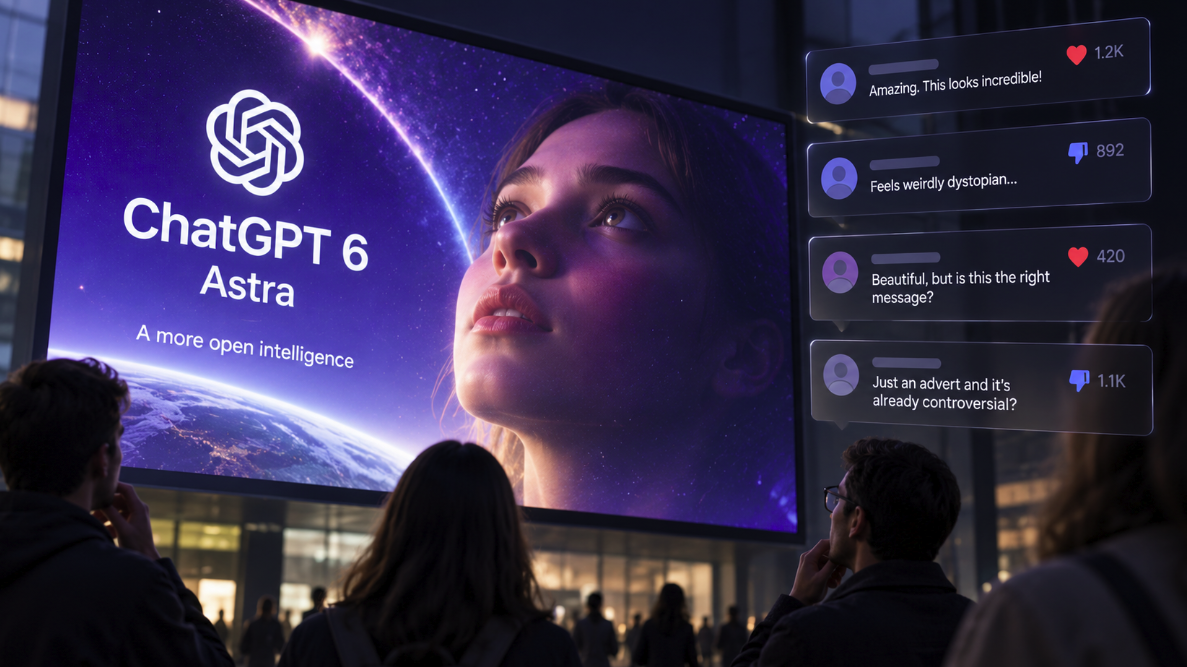
OpenAI’s launch campaign for GPT-6 Astra is doing more than advertising a new model. It is inadvertently staging a debate about what creative work is supposed to look like when an AI agent can operate the software, make the assets, assemble the experience and handle mundane tasks around the project with comparatively little human intervention.
That tension is at the center of a Creative Bloq report published September 6, which describes backlash to an Astra promotional video among parts of the Blender and creative communities. The criticism is not simply that OpenAI is promoting automation. It is that the advertisement presents a particular vision of creativity: one person directing a machine that can execute increasingly large portions of the process on command.
Astra is being marketed as an AI that acts inside creative tools
The controversy makes more sense in the context of what Astra is designed to do. OpenAI introduced GPT-6 Astra on September 3 as a model built for computer use, browsing, software engineering, science and professional work, with the ability to carry out complex multi-step tasks across software rather than merely generating text in a chat window. The company’s official launch materials describe Astra as its most capable model and emphasize its ability to work directly with computer interfaces.
The advertisement highlighted by Creative Bloq pushes that capability into visibly creative territory. The sequence includes Astra being asked to draw a rocket, convert it into a 3D model in Blender and place the result into a game, while also handling a dinner order. The point of the demo is clear: instead of switching manually between ideation, modeling, development and everyday logistics, the user can delegate a chain of actions to the model.
For OpenAI, that is a productivity story. For some artists and designers, it reads differently. Creative Bloq reports criticism from Blender users who objected to seeing a community-driven open-source tool associated with a message that can be interpreted as reducing the role of the craftsperson operating it. The publication also reported that an artist whose work appeared in Blender’s splash screen objected publicly to seeing it visible in the OpenAI advertisement.
The backlash is about the workflow, not just the technology
Creative software has absorbed automation for decades. 3D artists routinely use procedural tools, render automation, simulation, scripting and increasingly AI-assisted features. What makes agentic systems such as Astra more contentious is the breadth of the delegation. The model is not presented as one tool helping with one difficult step; it is presented as an operator capable of moving across tools and completing much of a workflow.
That changes the cultural argument. A feature that removes repetitive cleanup can give an artist more time to create. An agent that can generate the concept, build the model, manipulate the application and assemble an interactive result raises a different question: which parts of the process remain the creative work, and which parts become supervision?
The Astra campaign appears designed to make that breadth feel intuitive. But the smoother the workflow looks, the easier it becomes for viewers to project larger labor-market consequences onto the demonstration. Creative Bloq characterizes the advertisement’s solitary, screen-mediated vision of work as bleak, while other observers have made comparisons with fictional futures in which convenience gradually removes human participation from everyday activity.
Those reactions are interpretations rather than evidence that Astra will eliminate creative professions. The advertisement is a marketing demonstration, not a labor-market forecast. Yet advertising matters precisely because it tells audiences how a company imagines its technology being used. In this case, OpenAI is not merely showing faster text generation; it is showing software execution and creative production becoming conversational instructions.
Game development shows both sides of the argument
OpenAI’s own game-development case studies provide a more concrete example of the potential productivity gains. In a case study with Playco, the company says the game startup used Astra through its Playbot development environment to create three themed prototypes from a common grey-box foundation. Playco reported 50% fewer manual fixes than with the previous model and said most prototypes worked on the first attempt.
That is an attractive proposition for professional teams. Rapid prototyping allows developers to test more ideas before committing expensive engineering and art resources. If an agent can turn ten concepts into ten playable experiments, a team can evaluate actual interactions instead of debating sketches and specifications. Used that way, automation expands the number of creative possibilities a human team can explore.
The same capability also fuels anxiety about cloning and commoditization. If a model becomes good enough at interpreting visual references, manipulating game engines and reproducing interaction patterns, critics worry that the distance between seeing an existing creative work and producing a derivative imitation could shrink dramatically. Creative Bloq notes that this possibility is already part of the reaction around Astra’s game-development demonstrations.
There is a substantial difference between prototyping an original concept and copying someone else’s game, artwork or visual identity. The technology does not erase that distinction. But faster execution lowers the practical cost of both legitimate experimentation and potentially abusive imitation, which means questions around provenance, licensing and creative ownership will become more important as agentic systems gain access to professional applications.
Astra’s controversy extends beyond art
The advertising debate is also arriving alongside more serious scrutiny of Astra’s technical capabilities. OpenAI says the model is the first it has deployed to reach the Critical cybersecurity capability level under its Preparedness Framework, prompting stronger safeguards and monitoring. Its Astra safety overview says the model can, with appropriate tools and access, discover previously unknown software vulnerabilities and develop ways to exploit well-protected systems without continuous human guidance.
That does not directly relate to whether a Blender artist likes an advertisement, but both stories stem from the same underlying change: frontier AI systems are moving from producing outputs toward taking consequential sequences of actions. As their agency increases, questions about who remains in control become more concrete in cybersecurity, software development, design and everyday computer use alike.
The marketing challenge for OpenAI is therefore unusually delicate. Demonstrating Astra’s value requires showing how much work it can take off a user’s hands. But every additional step the model performs autonomously can also make the human role look smaller. The feature and the fear can be two interpretations of the same demo.
The most important creative question may be what humans choose to keep
The backlash around the Astra advertisement should not be reduced to artists resisting a new tool. Creative communities have repeatedly adopted technologies that automate difficult work when those technologies expand what creators can make. The deeper disagreement is over where assistance ends and substitution begins, and whether companies building agentic AI understand why people value the process of making things rather than only the speed of obtaining the finished result.
Astra may ultimately become a powerful collaborator for designers, developers and artists who deliberately decide which parts of a workflow to delegate. It may also make some forms of production cheaper and more automated. Both can be true at once. What the advertisement has exposed is that the industry has not reached a shared definition of progress in creative work.
For OpenAI, that makes the controversy around the campaign revealing. The strongest demonstration of an agent is that it can do more without the user. The strongest reassurance to a creative professional may be that the user still has meaningful reasons to do the work themselves. GPT-6 Astra sits directly inside that contradiction, and its advertising has made it visible before the technology has even reached everyone.