

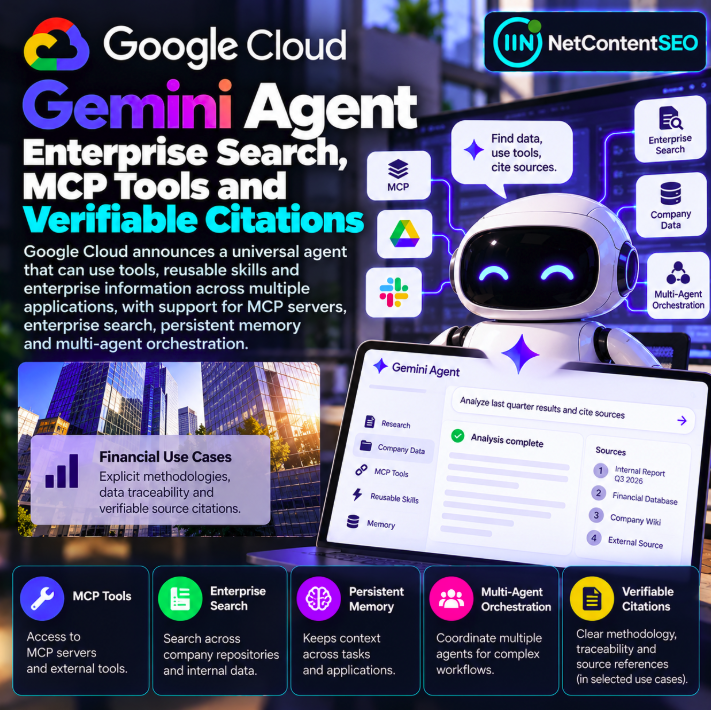

Google Cloud has announced Gemini Agent, an enterprise-focused agent experience designed to work across business applications, use tools and retrieve information from organizational data. Presented as part of Gemini at Work on October 8, 2026, the initiative brings together capabilities such as Model Context Protocol (MCP) server access, reusable skills, enterprise search, persistent memory and coordination between multiple agents.
Google also describes finance-oriented workflows emphasizing explicit methodologies, traceable data and verifiable source citations. For organizations exploring AI-assisted research, this is an important direction: agents are being positioned not only to generate answers but to connect those answers to enterprise evidence and operational tools.
Important distinction: Gemini Agent is an enterprise product announcement. It is not a Google Search ranking update, and verifiable citations inside enterprise research workflows should not be confused with public AI Overviews or Gemini web citation rankings.
Primary source: Google Cloud — Welcome to Gemini at Work 2026.
What is Google Gemini Agent?
Gemini Agent is described as a universal agent that can work with business information and tools across multiple applications. Rather than functioning solely as a conversational interface, the announced direction involves agents capable of finding relevant information, applying reusable instructions and coordinating actions through connected systems.
Its usefulness depends on the available integrations, access permissions, deployment configuration and supported capabilities. The announcement should not be read as a guarantee that every customer immediately has access to every feature.
The five capability areas in the announcement
| Capability | Role in enterprise workflows |
|---|---|
| MCP server access | Connect agents with supported external tools and data interfaces |
| Enterprise retrieval | Find relevant information in organizational repositories |
| Reusable skills | Apply repeatable procedures and specialized task instructions |
| Persistent memory | Retain useful context across supported interactions or tasks |
| Multi-agent orchestration | Coordinate specialized agents across more complex workflows |
These capabilities address different parts of an agent system. Tool access is not the same as retrieval; retrieval is not the same as memory; and orchestration is not a guarantee that outputs are correct.
MCP servers: a standardized route to tools
Model Context Protocol provides a framework through which compatible agents can interact with tools and information sources exposed by MCP servers. For an enterprise agent, this can expand the range of systems it can query or act upon without every integration being built as a bespoke conversational feature.
However, MCP compatibility does not imply unrestricted access to every service. Authentication, authorization, available server capabilities and organizational policy still determine what an agent can do.
Enterprise retrieval: finding information where businesses keep it
Business knowledge is often fragmented across document repositories, applications and internal databases. Enterprise retrieval is intended to help an agent locate information across supported sources and bring relevant evidence into a workflow.
For example, a team might need to compare internal policy documents, project notes and performance reports. A connected agent could potentially reduce the manual work of locating the material, but users must still verify that the retrieved documents are current, authoritative and appropriate for the task.
Reusable skills and consistent procedures
Reusable skills can encode recurring workflows or specialized instructions so that teams do not have to restate every step from scratch. This is particularly relevant to tasks that require consistent handling of sources, output formats, review checkpoints and organizational rules.
In practice, the quality of a reusable skill depends on its instructions and the reliability of the tools it invokes. Standardizing a procedure can improve consistency, but it can also repeat an error if the underlying workflow is poorly designed.
Persistent memory: continuity with governance requirements
Persistent memory is meant to help agents carry relevant context across supported tasks and interactions. That may make multi-stage research and operational work less repetitive.
But persistence introduces governance questions: what information is retained, who can access it, how it is corrected and when it is deleted. The announcement does not justify assuming unlimited memory, permanent retention or identical behavior across every enterprise deployment.
Multi-agent orchestration: coordinating specialized work
Complex tasks may benefit from dividing responsibilities between agents, such as one retrieving documents, another performing structured analysis and another preparing a report. Multi-agent orchestration provides a way to coordinate such roles.
That architecture can be powerful, but it also creates additional points where errors, missing context or unsupported assumptions can propagate. Human review and clear provenance become more important as workflows involve more steps.
Why finance workflows emphasize verifiable citations
Google's announcement also describes financial-sector workflows that produce explicit methodologies, traceability of underlying data and verifiable source citations. This matters because an analysis is more useful when reviewers can inspect not just its conclusion but the evidence and process behind it.
For example, a financial analyst may need to understand which documents supported a figure, how a comparison was calculated and what assumptions were used. Citations can help support that review, provided the referenced sources are actually accessible and the claims match the evidence.
Verifiable does not mean automatically correct. A cited source can be outdated, incomplete or misinterpreted. Source traceability improves auditability; it does not eliminate the need for expert validation.
Enterprise citations versus public AI search citations
This distinction is essential for SEO and GEO professionals. A citation inside an enterprise agent's financial research output points a reviewer to the material used for that task. A citation in a public AI search response is part of a consumer-facing retrieval and answer presentation system.
The two may share broad concepts such as source attribution, but the Gemini Agent announcement does not establish any change in how Google AI Overviews selects websites, ranks sources or generates public web citations.
What this could mean for SEO research teams
Organizations that already manage search analytics, technical audit exports, editorial guidelines and market research across multiple systems may find enterprise agent workflows useful. Possible applications include retrieving historical SEO reports, comparing documented recommendations or preparing source-backed research summaries.
These are potential applications of general enterprise capabilities, not dedicated SEO features announced by Google Cloud. Teams should evaluate supported integrations, permissions, data freshness and output accuracy before using agents for consequential decisions.
Example: a source-backed technical SEO research workflow
- Define the question. Specify which site, time period and issue the analysis concerns.
- Retrieve relevant records. Search authorized repositories for crawl reports, engineering notes and previous audits.
- Use approved tools. Invoke compatible MCP tools only where permissions and organizational policy allow.
- Apply a reusable review procedure. Require source links, timestamps and a clear separation of observations from hypotheses.
- Coordinate specialized tasks. Where supported, use different agents for retrieval, analysis and report assembly.
- Validate the findings. Check that cited documents support the conclusions and that recommendations are technically sound.
- Preserve accountability. Require human approval before changes to production websites or business systems.
Security and governance considerations
Connecting an agent to multiple repositories and tools increases the importance of access control. Organizations should assess which data each connection exposes, what actions can be performed and how outputs are logged and reviewed.
They should also consider prompt injection risks from retrieved documents, source quality, data retention and the possibility that an agent may misinterpret instructions. MCP integration and multi-agent coordination are capabilities, not substitutes for security design.
Availability: an announcement does not equal universal access
Google's October 8 announcement covers an evolving set of enterprise capabilities and programs. Availability can depend on the specific feature, customer access program, product configuration and region.
Before planning a deployment, businesses should check current Google Cloud documentation for the exact features and access requirements relevant to their environment. It would be misleading to describe every listed capability as immediately enabled for every Google Workspace or Google Cloud customer.
What the announcement does not establish
- A change to Google Search crawling, indexing or ranking.
- Higher visibility or more citations for websites in AI Overviews.
- Universal access to every Gemini Agent feature.
- Unrestricted access to all MCP servers or company data.
- Perfect accuracy merely because a research output includes citations.
- A new SEO-specific auditing or GEO optimization product.
FAQ
What is Gemini Agent?
A Google Cloud enterprise agent experience announced at Gemini at Work 2026, designed to use tools and organizational information across supported applications.
Does Gemini Agent support MCP?
Google describes access to MCP servers among the announced capabilities, subject to supported configurations and permissions.
Can it search enterprise repositories?
Enterprise retrieval is one of the described capabilities, with actual access determined by integrations and authorization.
Does it have persistent memory?
Persistent memory is part of the announced direction, but scope and availability depend on supported features and configurations.
What makes the finance workflows different?
Google highlights explicit methodologies, traceable data and source citations that reviewers can verify.
Does this affect Google AI Overview citations?
No such change is established. Enterprise research citations and public search citations are different systems.
NetContentSEO analysis
Gemini Agent illustrates the shift from isolated AI responses toward connected, tool-using enterprise workflows with more explicit source accountability. The most relevant development for AI visibility researchers is conceptual rather than algorithmic: source retrieval, provenance and auditability are becoming central features of agent systems. For SEO teams, the opportunity is to test source-backed internal research workflows—without mistaking this enterprise announcement for a change in public Google Search.
Primary source: Google Cloud — Welcome to Gemini at Work 2026.