

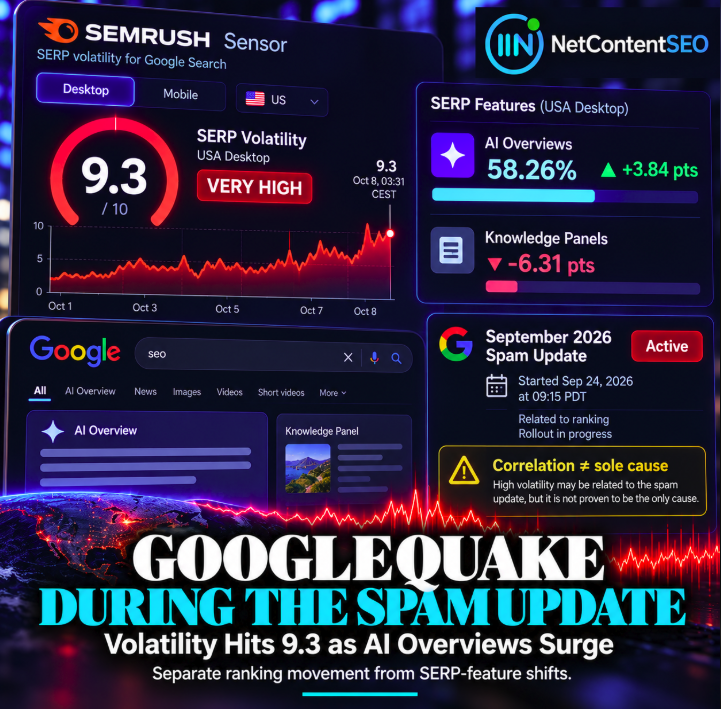

Google's search results are showing extreme movement while the September 2026 spam update is still officially rolling out.
At 03:31 CEST on October 8, Semrush Sensor registered 9.3 out of 10 — “Very High” — for US desktop SERP volatility. At the same observation point, AI Overviews were reported on 58.26% of the monitored SERPs, up 3.84 percentage points, while Knowledge Panels fell by 6.31 points.
Google's Search Status Dashboard simultaneously continued to list the September 2026 spam update as active.
The overlap is important. But it is not proof that the spam update alone caused every movement visible in the Sensor.
Semrush Sensor is flashing “Very High” volatility
Semrush Sensor measures daily changes in Google's search results across a fixed keyword set.
Semrush explains that it compares today's results with the previous day's results on an item-by-item basis and derives a normalized volatility score. Higher scores indicate larger changes in the observed SERPs.
A 9.3 reading therefore signals unusually strong movement in the monitored US desktop results.
This is a sensor reading, not a Google volatility metric
The 9.3 score does not come from Google.
It is Semrush's independent measurement of changes across its monitored SERPs. It should be treated as evidence of unusual observed volatility rather than an official Google statement about the magnitude of an algorithm update.
That distinction becomes especially important during confirmed ranking updates, when correlation is easy to mistake for attribution.
Google confirms the September spam update is still active
Google's official Search Status Dashboard says the September 2026 spam update began on September 24 at 09:15 PDT.
The incident affects Ranking, applies globally and to all languages, and Google initially said rollout could take up to two weeks.
As of the latest dashboard state checked for this article, the incident remained marked Active.
October 8 sits near the end of Google's original rollout window
October 8 is approximately two weeks after the September 24 start.
That makes the current volatility particularly noteworthy: the strongest movements are occurring while the official rollout remains open and near the end of Google's original “up to two weeks” estimate.
Google has not published a statement saying that the 9.3 Semrush Sensor reading represents a specific phase of the spam update.
AI Overviews are moving at the same time
The ranking turbulence is only one part of the observed SERP change.
In the reported Semrush Sensor snapshot, AI Overview occurrence reached 58.26%, an increase of 3.84 percentage points.
Knowledge Panels moved in the opposite direction, falling by 6.31 points.
That means the search results are changing not only in which pages rank, but also in which interface elements occupy the page.
Ranking volatility and SERP-feature volatility are different phenomena
This distinction is crucial for diagnosis.
A site can lose clicks even if its organic rank does not materially change when an AI Overview expands above it.
Conversely, a ranking can move while the surrounding SERP layout remains stable.
And both can happen at the same time.
Looking only at average position can therefore obscure the mechanism behind a traffic change.
Do not automatically blame the spam update for every movement
The timing makes the spam update an obvious variable, but the available evidence does not establish it as the sole cause of the current Sensor spike.
Google has not published a day-by-day map of which ranking systems are changing during the rollout.
Search results also change continuously because of normal ranking systems, refreshed content, query demand, competitors, indexing changes and SERP-feature experiments.
The defensible statement is that very high third-party SERP volatility is occurring while a confirmed Google spam update remains active.
The AI Overview increase deserves separate tracking
Semrush Sensor can monitor the occurrence of AI Overviews independently from ranking volatility.
That is useful because an increase in AI Overview prevalence changes the available organic click surface even if the underlying blue-link ordering remains similar.
Recent CTR research has repeatedly shown that SERP composition can materially change the value of an organic ranking.
For this reason, teams should not merge “ranking loss” and “AI Overview expansion” into one explanation.
Annotate September 24 in Search Console and GA4
SEO teams investigating changes should annotate September 24, 2026 as the beginning of the confirmed Google spam update.
Then compare performance before and after that date rather than reacting to a single day.
In Google Search Console, inspect clicks, impressions, CTR and average position by query, page, country and device.
In GA4, compare organic landing-page sessions and downstream conversions over the same periods.
Separate four diagnostic layers
A useful investigation should distinguish at least four layers: organic ranking movement, SERP-feature movement, click-through-rate movement and actual site traffic or conversions.
If rankings fall and impressions fall, the problem may be primarily ranking visibility.
If rank stays stable while CTR falls, inspect whether AI Overviews or other features are taking more screen space.
If Search Console clicks remain stable while GA4 sessions change, investigate analytics and landing-page behavior rather than assuming a ranking event.
Segment desktop and mobile
The current 9.3 alert concerns the reported US desktop Sensor view.
Do not assume the same magnitude applies to mobile, every country or every industry.
Google's ranking update is global, but third-party volatility scores can differ substantially by device, database and category.
Site-level diagnosis should therefore use the market and device mix that actually drives the site's traffic.
Check winners as carefully as losers
Spam updates are often discussed only through domains that decline.
But every ranking displacement creates relative winners as well.
Compare the domains replacing lost positions. Look for changes in content type, authority, intent match, site reputation, aggregation patterns and page quality.
That comparative analysis is usually more informative than trying to reverse-engineer the update from a site's own decline alone.
Avoid making emergency changes during unresolved volatility
When an official rollout remains active, daily positions can be noisy.
Large-scale content deletion, URL migrations, canonical changes or template rewrites made in response to one volatile snapshot can introduce additional variables exactly when measurement is already difficult.
Critical technical errors should of course be fixed immediately, but strategic changes should be based on a pattern rather than panic.
Spam updates require a broader audit than page-level optimization
If a site experiences a sustained decline that aligns with the rollout, review Google's spam policies at the site level.
That can include scaled content abuse, expired domain abuse, site reputation abuse, cloaking, hacked content, link spam and other policy areas.
A spam update should not be approached as a conventional “add more keywords to the page” optimization exercise.
AI visibility should be monitored alongside organic visibility
The simultaneous increase in AI Overview presence reinforces a second lesson.
A modern Google visibility audit should ask not only where the domain ranks organically but whether the domain appears as a source in AI Overviews and how often AI Overviews occupy the tracked query set.
Organic visibility and AI visibility can move independently.
A domain could retain a blue-link position while losing click share, or gain AI citations while its conventional organic position fluctuates.
NetContentSEO take
This is a genuine SEO alert, but not evidence for a single-cause narrative.
Semrush Sensor is showing extreme US desktop volatility at 9.3 while Google's September 2026 spam update remains officially active. At the same time, the observed SERP composition is shifting sharply, with AI Overviews rising and Knowledge Panels falling.
The correct response is to separate the signals.
Annotate September 24. Track rankings, AI Overview occurrence, citations, CTR and traffic independently. Segment by device and market. Compare winners and losers. And wait for enough post-rollout data before declaring what caused a site's movement.
The Googlequake is visible. Its causes still need to be measured rather than assumed.