

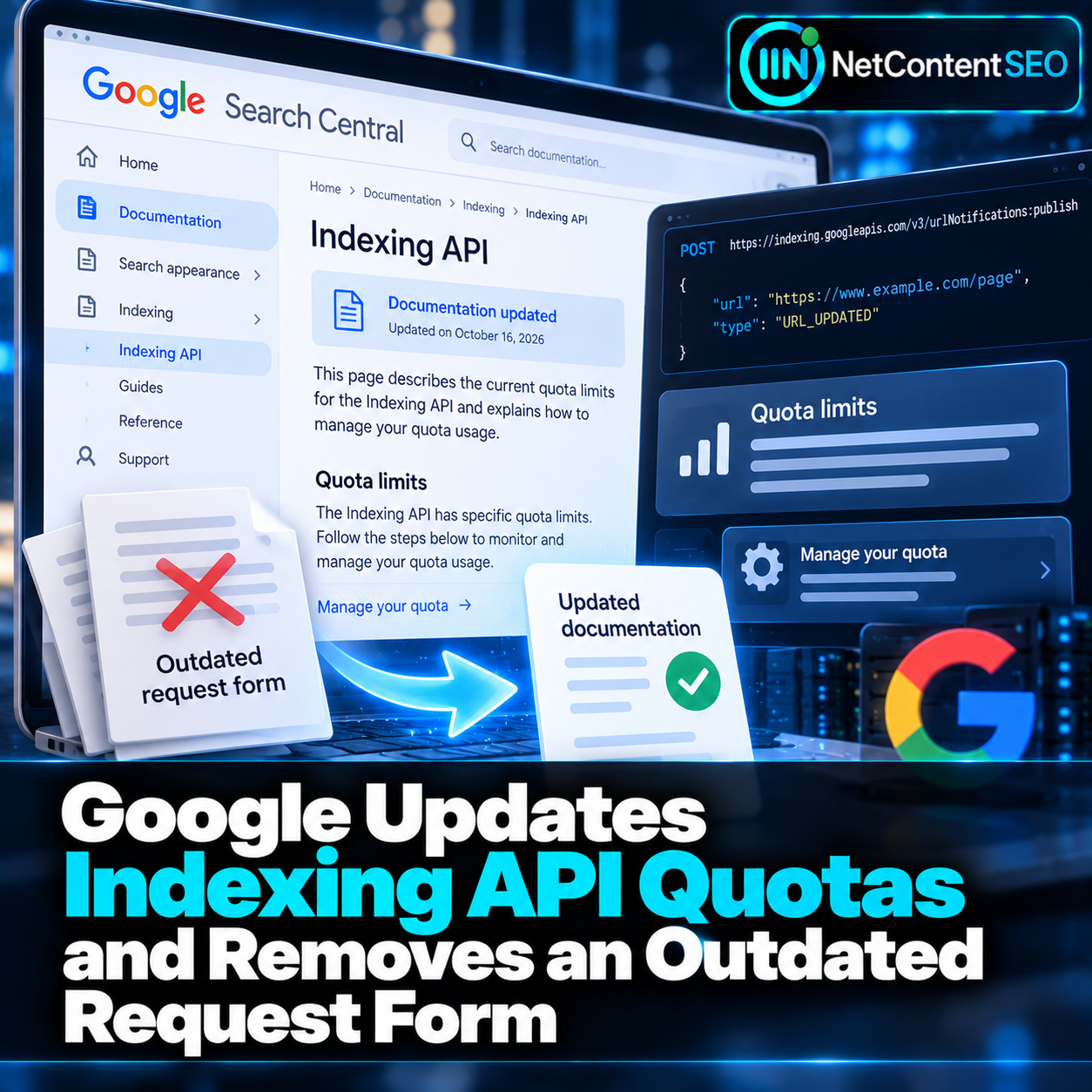

Google has reportedly updated its Indexing API quota documentation and removed an outdated request form, according to an October 16, 2026 entry referenced in the Google Search Central documentation updates. The reported change concerns documentation and quota-management guidance—not a confirmed increase in API limits or a wider rollout of the Indexing API.
What changed in the documentation?
The update is described as a revision to quota guidance so that developers can consult the current limits and procedures rather than relying on an obsolete request form. At the time of drafting, the specific October 16 changelog entry has not been independently verified, so the precise wording and any implementation details should be checked against Google's live documentation before publication.
Does this mean higher Indexing API quotas?
No quota increase has been confirmed by this report. Updating instructions about quotas is not the same as raising default allocations, approving additional requests or changing how often Google crawls a URL. Developers should check their own Google Cloud project quota settings and the current official API documentation rather than assuming new capacity.
Which URLs are eligible for the Indexing API?
Google's Indexing API has a restricted intended scope. Its documentation describes use for pages containing JobPosting structured data or BroadcastEvent embedded in a VideoObject. It is not a general-purpose API for submitting arbitrary blog posts, product pages or other standard URLs to Google's index.
For other page types, site owners should continue to use appropriate discovery and indexing mechanisms, including XML sitemaps, internal links and Google Search Console's URL Inspection workflows where relevant.
What should developers and SEOs do?
Teams using the Indexing API should review the latest quota and pricing documentation, confirm that their URLs are eligible, inspect usage in the associated Google Cloud project and update any internal runbooks that reference a retired request form. Avoid relying on screenshots or old tutorials for quota-escalation instructions.
What the update does not establish
There is no confirmed basis here to claim that Google is indexing pages faster, that API access has expanded to all content types, or that a quota increase has taken effect. Quota management, crawling and index inclusion are separate concepts: a successful API notification is not a guarantee of indexing.
NetContentSEO assessment
The practical takeaway is operational accuracy. When Google retires a quota-request workflow, developers need to update their documentation and procedures—but SEOs should not mistake administrative changes for a new indexing advantage. The most useful next step is to verify the live quota guidance and eligibility requirements before changing production integrations.
Official references: Google Search Central — Documentation Updates; Indexing API documentation; Quota and pricing.