

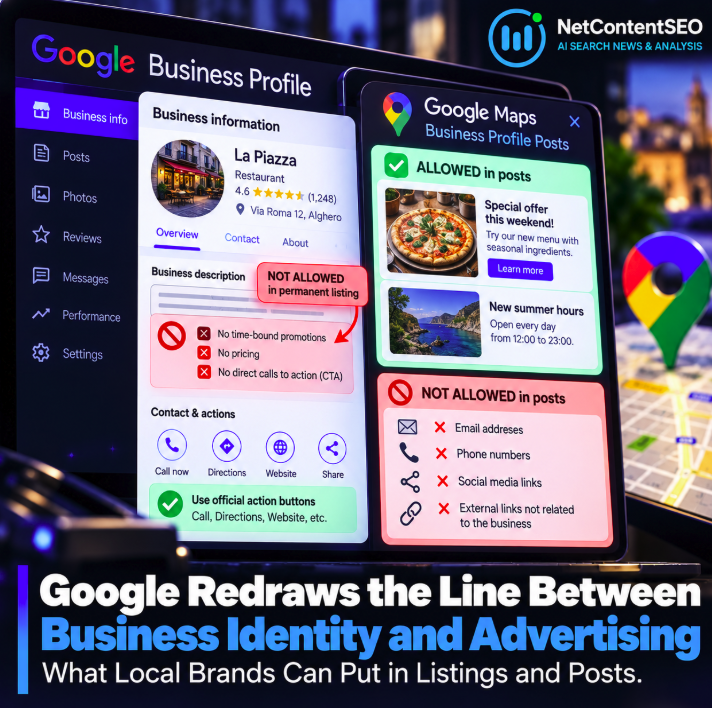

Google has clarified where promotion belongs inside Google Business Profile and Maps, drawing a sharper distinction between information that defines a business and content designed to advertise it.
The current Google Business Profile prohibited and restricted content policy explicitly says that permanent listing content must not contain time-bound promotions, pricing or direct calls to action. Promotional posts remain possible, but Google also defines limits on contact information and unrelated external links.
The wording was observed as changed on October 6, 2026. Google's policy page itself does not provide a visible publication date for this specific revision, so the date should be treated as the date the change was detected rather than a formally stated Google release date.
Permanent business information is not an advertising slot
Google explains the underlying principle clearly: contributions to Maps should reflect genuine experiences or define a business's permanent identity, rather than turning the listing itself into a marketplace.
For merchants, Google's current policy says promotional or commercial content in the listing is prohibited when it contains time-limited promotions, prices or direct calls to action.
This reinforces a distinction that matters for Local SEO. Fields intended to describe the business should remain durable and factual rather than being repeatedly rewritten around temporary campaigns.
Business descriptions already have similar restrictions
Google's separate guidelines for representing a business reinforce the same model.
The Business description should explain products, services, mission and history, while Google says it should not focus on special promotions, prices or sales offers. Links are also prohibited in that field.
Google even provides examples of unacceptable description copy built around a percentage discount or a specific product price.
Promotions still belong in Business Profile posts
The policy change does not mean Google has banned businesses from promoting offers through Business Profile.
Google's official documentation for creating posts continues to support Updates, Offers and Events. Offer posts can contain promotional sales or deals, including a title, dates, description, media, coupon code, link and terms and conditions.
Update posts can also include an action button linking users to a relevant business website where they can book, order or learn more.
The important change in interpretation is therefore not “promotion is forbidden.” It is that promotional material belongs in the surfaces designed for temporary commercial communication rather than in permanent identity fields.
Posts have their own restrictions
Google's prohibited-content policy says merchant posts cannot contain email addresses, phone numbers, social media links or links to other websites when those links are not related to the business.
Google's dedicated Business Profile posts policy adds more nuance around contact information. It says posts containing unverified contact information — including phone numbers, email addresses and social media handles — may be removed to reduce fraud or abuse.
For phone calls, Google recommends using the built-in Call now button, which relies on the verified phone number attached to the Business Profile.
Relevant business links remain supported
It would therefore be inaccurate to interpret the policy as a blanket ban on external links in posts.
Google's post-creation documentation explicitly allows action buttons with links and permits links in Offer posts. The restriction concerns links that are unrelated to the business, while other policy layers can still apply to particular content.
That distinction is important for Local SEO teams building automated posting systems.
Hotels face additional restrictions
Google applies stricter promotional rules to hotel posts.
Its Business Profile posts policy says hotels can publish relevant and timely local information, but they cannot create Offer posts or posts containing links to deals, promotions, special offers or discounts.
Google says this is intended to prevent confusion between promotional posts and the organic or advertised hotel prices shown elsewhere on the placesheet.
Local brands should separate identity data from campaign data
The safest operational model is straightforward.
Permanent profile fields should describe stable facts: what the company is, what it does, where it operates and the services or products it normally provides.
Campaign material — limited-time discounts, seasonal offers, events and temporary announcements — should use the dedicated post formats.
Verified action mechanisms such as website, booking and call buttons should handle conversion wherever possible instead of inserting promotional contact details into fields intended for descriptive information.
This matters for automated Local SEO
The distinction becomes especially important as businesses automate profile management across dozens or thousands of locations.
A system that copies campaign text into business descriptions or other permanent fields can create policy risk at scale. The same automation should understand the semantic role of each Business Profile surface before distributing content.
For agencies and multi-location brands, templates should therefore classify copy as either identity information or temporary promotional content before publishing.
The NetContentSEO takeaway
Google is drawing a clearer boundary between business identity and advertising in Maps and Business Profile.
The listing itself should represent stable, factual information. Posts remain a legitimate promotional surface for offers and updates, but they are subject to rules around contact details, relevance and business-specific links.
For Local SEO, the practical lesson is not to stop promoting. It is to put each type of information in the surface Google designed for it.
That distinction may become even more important as Google increasingly uses structured business information across Search, Maps and AI-generated local experiences: stable entity facts need to remain distinguishable from temporary marketing claims.