

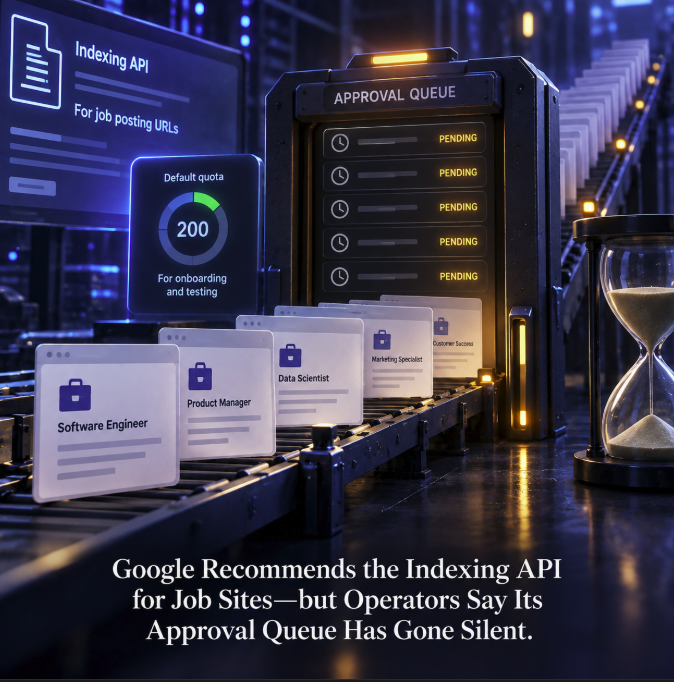

Google tells job sites that its Indexing API can prompt Googlebot to crawl job posting URLs sooner than a sitemap. For operators trying to run that recommendation at production scale, however, a growing set of reports describes a frustrating bottleneck: requests for the additional approval and quota required for real-world use are allegedly sitting for months without an approval, a rejection or even a visible status.
A September 21 investigation by Search Engine Journal collected reports from job-board operators and consultants who say the problem has persisted through 2026. The evidence is substantial enough to document a pattern, but it does not establish that Google has formally stopped approving requests. Google has not announced such a freeze, and the consultants gathering the reports explicitly acknowledge that they cannot prove the number of approvals is zero.
More than 100 job boards, but no confirmed explanation
SEO consultant Nick LeRoy, who operates SEOJobs.com and PPCJobs.com, said he and job-board consultant Alexander Chukovski have more than 100 job boards as data points. Based on those observations, they have hypothesized that Google may not have approved Indexing API submissions in 2026. LeRoy has also been careful about the limit of that claim, saying he cannot confirm that the true number of approvals is zero.
Chukovski separately reported visibility into at least 50 applications dating back to October 2025 and said none he could observe had gone through. Other job-site operators have posted similar experiences in Google's Search Central Community, including reports of waiting six to nine months, receiving no acknowledgement or reference number, and having no mechanism to determine whether a request is still pending or has effectively been rejected.
That distinction matters. A collection of operators seeing the same outcome is evidence of a practical problem for that group, but it is not equivalent to an official statement about Google's internal review queue. There could be approvals outside the consultants' sample, a slowdown rather than a halt, stricter eligibility checks, or another process issue that Google has not publicly described.
The default 200 quota is not production approval
The confusion becomes more consequential because Google's own documentation separates initial API access from production-scale use. Google's Indexing API quickstart states that the service provides a default quota of 200 for API onboarding and submission testing and that additional approval is required for usage and resource provisioning. Google clarified this distinction in its Search documentation changelog in September 2024, explaining that the default quota is intended for initial setup and testing.
In other words, seeing a quota of 200 in a Google Cloud project does not mean a job board has received the approval needed to rely on the API operationally. Sites seeking greater capacity are directed through Google's quota-request process, where the documentation says quota may increase or decrease based on document quality. The public documentation does not provide a normal review time for those requests.
That creates an awkward dependency for job sites because Google continues to recommend the API specifically for job posting URLs. Its job posting guidance says the Indexing API is preferable to sitemaps for those URLs because it can prompt Googlebot to crawl them sooner. Google also recommends maintaining a sitemap for full site coverage, so the API is not presented as a replacement for the site's broader crawling and discovery infrastructure.
There is no public status tracker for the approval request
The operational problem is not merely that reviews may be slow. Operators say they cannot tell where they stand. Google's public Indexing API documentation explains setup, quota and usage, but does not expose a workflow where an applicant can see a request marked as pending, under review, approved or rejected. The Google API Console can show the project's current quota, but that is not the same thing as a transparent application-status system.
For a small job site, the uncertainty may be manageable. For a board publishing and expiring large numbers of vacancies, it complicates engineering and SEO planning. The team can implement the API, verify authentication and test requests, yet remain unable to determine whether or when the project will receive the capacity needed for routine production submissions.
The reports collected by Search Engine Journal also describe an ambiguous technical symptom. Some operators say publish requests return HTTP 200, while a subsequent call to the API's getMetadata endpoint for the same URL returns 404. Google's documentation defines a successful HTTP 200 notification narrowly: it means Google may try to recrawl the URL soon. The documentation does not publicly establish that this 200-then-404 pattern is a definitive indicator of approval status.
Google has previously pointed to abuse of the API
Google's John Mueller addressed the broader concern in May after LeRoy raised stalled requests. In a public Bluesky response, Mueller said he was not aware of a particular issue but noted that the Indexing API is inundated by bloggers attempting to present themselves as legitimate eligible sites, adding that he imagined the team had become more cautious.
That comment offers context rather than a formal explanation of the current queue. It does not say Google stopped processing job-board requests, does not provide a review timeline and does not describe the criteria being used on individual applications. It does, however, align with Google's existing restrictions around the API and with its 2024 documentation update warning that Indexing API usage is subject to spam detection and that attempts to circumvent quotas can lead to access being revoked.
The history is important because the Indexing API has long attracted interest beyond its intended use cases. Faster URL discovery is attractive to almost any publisher, but Google's documentation limits the API to specific page types, including job posting and livestream pages. If ineligible sites repeatedly attempt to obtain or exploit access, stricter reviews would be understandable. What remains unresolved is whether legitimate job boards are now being caught in that caution and, if so, what they can expect from the approval process.
The real problem is the mismatch between recommendation and provisioning
For job-site operators, the issue is not simply that an optional Google feature is difficult to obtain. Google actively recommends the Indexing API for job posting URLs, while the API documentation says the default quota is for onboarding and testing and that further approval is required for actual resource provisioning. If that approval process has no published service level, no status tracker and months-long waits for some applicants, the recommendation becomes difficult to implement predictably.
This is particularly relevant to job boards because vacancies are unusually time-sensitive pages. A job can be posted, filled and removed within a short period, making prompt crawling more valuable than it is for evergreen content. The Indexing API is designed to notify Google when eligible URLs are added or removed, which is why uncertainty around production access affects more than a technical preference: it can influence how quickly a job board expects Google to discover changes in rapidly turning inventory.
None of this means that an unapproved job board is invisible to Google. Standard crawling and sitemaps remain available, and Google's job documentation still recommends sitemaps for complete site coverage. The problem is narrower: operators who follow Google's recommendation to implement the Indexing API say they cannot reliably progress from the testing quota to approved production capacity.
What job sites should take from the reports
Until Google clarifies the process, job sites should avoid interpreting silence as either approval or rejection. They should keep their conventional crawling and indexing foundations healthy, maintain accurate job posting structured data and sitemaps, and treat the Indexing API as an additional notification mechanism rather than the only route through which Google can discover vacancies.
Teams applying for additional quota should also document submission dates, project identifiers, current quota and any subsequent changes so they can distinguish a genuine quota increase from normal test access. Because Google's public documentation does not state a standard turnaround time, planning a launch around an assumed approval date introduces avoidable risk.
The larger question now belongs to Google. Multiple operators are reporting the same kind of silence, consultants say they have visibility across scores of job boards, and the company's documentation still directs eligible sites toward the API without describing how long production approval should take. That does not prove the queue has stopped. It does show that, for the operators waiting inside it, the difference between a slow review process and a dormant one has become practically impossible to see.