

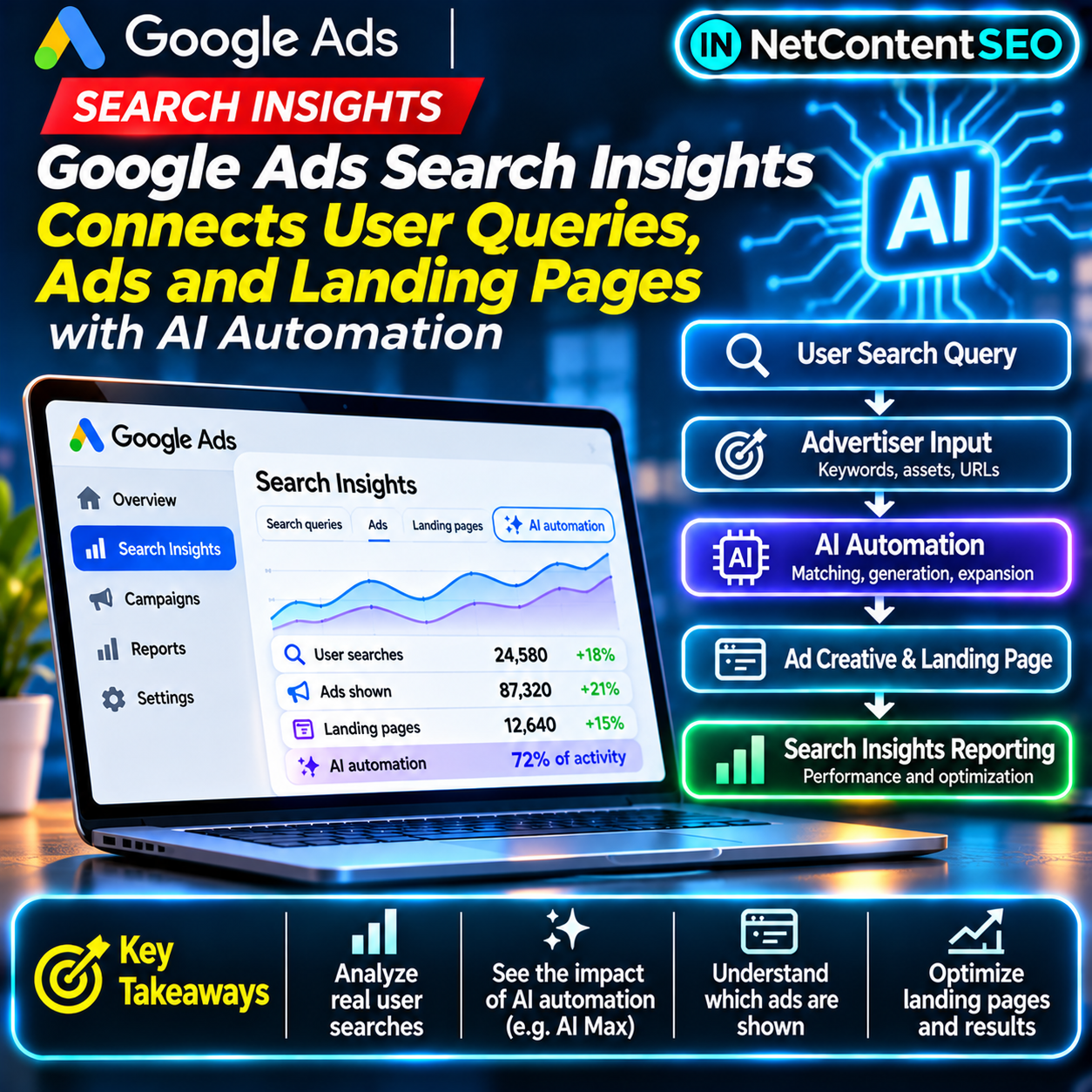

Google Ads is making the relationship between search intent, advertising creative and destination pages easier to inspect. On November 27, 2026, Barry Schwartz reported screenshots from a live advertising account shared by Govind Singh. Schwartz noted that the tool may have existed for some time, citing earlier Google material from June. This is a documented reporting capability rather than a confirmed November launch.
Understanding the role of automation
The observed interface helps explain how searches trigger ads, which creative elements appear and where visitors are directed. Its description distinguishes advertiser-provided inputs from Google's automated contributions. Separately, Google's official AI Max reporting documentation describes a combined search-term and ad-component report that connects queries, headlines and destinations.
↓
Keywords, creative assets and URLs
Matching, creative generation and expansion
↓
↓
Different reporting tools answer different questions
Google's search terms insights documentation describes aggregated demand categories and performance metrics. This is distinct from inspecting individual query and creative combinations. The related AI Max report was also reported in October. Advertisers should not assume these similarly named surfaces are identical.
| Reporting dimension | Practical question |
|---|---|
| Demand categories | Which customer needs drive campaign activity? |
| Search terms | Which visible searches trigger advertisements? |
| Creative combinations | Does the message fit the user's intent? |
| Destination pages | Does the destination fulfill the promise? |
A practical diagnostic workflow
↓
↓
↓
For example, a hypothetical software provider might attract a search for a free trial but send the visitor to an enterprise pricing page. Inspecting the query, message and destination together can reveal that mismatch. Any campaign adjustments should be assessed against qualified conversions and cost, not clicks alone. Privacy thresholds and aggregation may limit query-level visibility.
Implications for SEO and GEO
Paid search insights can suggest topics for independent content research and expose differences between user intent and landing-page messaging. They do not measure organic rankings or citations in generative answers. Teams should maintain distinct reporting for paid performance, organic traffic, AI mentions and source attribution. A successful paid campaign does not demonstrate improved organic AI visibility.
Conclusion
The value of these reports is their potential to make automated advertising decisions easier to assess. The available evidence does not establish a new global rollout date or guarantee improved campaign performance. Advertisers should check their account's available reports and use the findings to test specific improvements.