
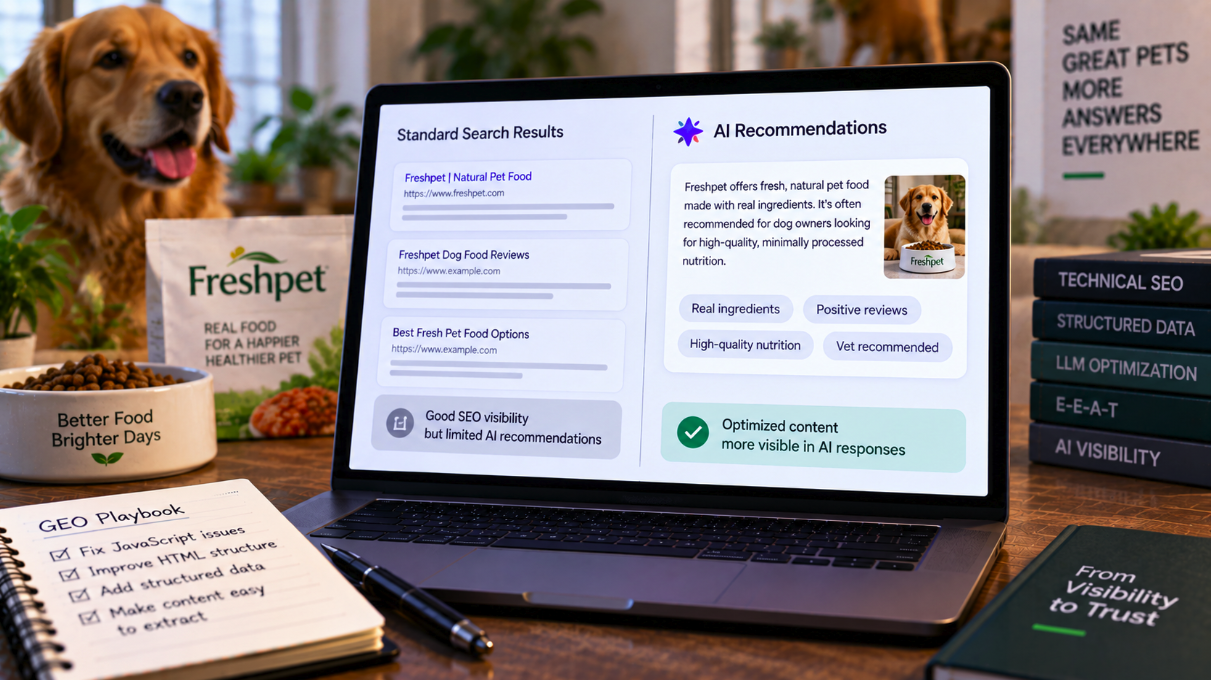
A page can rank well in Google and still fail a much newer test: can an AI system reach the evidence on the page, understand it in isolation and reuse it confidently in an answer? Freshpet’s recent GEO work offers a useful case because the brand reportedly began with solid traditional search visibility while remaining surprisingly weak in AI recommendations.
In a September 10 Search Engine Journal webinar recap, Freshpet and Intero Digital describe an audit built around 475 prompts rather than a conventional keyword list. The exercise exposed gaps that ordinary rank tracking did not: important proof points were difficult for AI systems to access, some reviews and Q&A content depended on JavaScript rendering, and editorial pages written like continuous magazine features were not always organized into self-contained passages that could easily support a generated answer.
The case is commercially presented—Freshpet’s agency is explaining the GEO process it implemented—and the recap does not provide a controlled before-and-after experiment with quantitative final lifts. That makes it more useful as a technical playbook than as proof that any individual change causes a particular citation increase. Its strongest lesson is simpler: SEO visibility and AI visibility overlap, but they are not interchangeable, especially when the information an answer engine needs is technically present yet difficult to retrieve or extract.
The audit started with prompts because rankings were not showing the problem
The original webinar was built around a question many established brands now face: why can a company perform strongly for relevant search terms while AI answers name only two or three competitors? Freshpet and Intero Digital approached the problem by testing hundreds of natural-language prompts and examining whether the brand appeared, how it was described and which sources supported the answers. That changes the unit of analysis from “Where does this page rank?” to “What evidence does the system assemble when a buyer asks this question?”
That distinction matters because generative search can decompose prompts into related information needs and retrieve passages that do not map neatly to one target keyword. A pet owner asking for a recommendation may implicitly need information about ingredients, preparation, storage, veterinary considerations, reviews and product differences. Strong rankings for a broad category term do not guarantee that an AI system can find credible Freshpet evidence for every sub-question it tries to answer.
The 475-prompt audit therefore functioned as a visibility map. Instead of assuming existing SEO success would carry into AI answers, the team looked for the places where Freshpet’s public information failed to travel through the new retrieval and citation path. That diagnostic approach is more transferable than any single optimization tactic because it begins with observed answer gaps rather than a generic GEO checklist.
JavaScript exposed the difference between content that exists and content that is reachable
One of the most practical findings concerned reviews and Q&A content loaded through JavaScript. To a human visitor using a modern browser, that material can appear perfectly normal. But AI crawlers, retrieval systems and model-connected search tools do not all render websites in the same way, and some may operate primarily on server-delivered HTML or other simplified representations. In Freshpet’s audit, content the team considered important was not reliably reaching the systems it wanted to influence.
The right conclusion is not that “LLMs cannot read JavaScript.” Some AI systems use sophisticated browser rendering, while others depend on search indexes, third-party retrieval or crawler architectures with different capabilities. The operational problem is uncertainty. If essential product evidence, reviews or answers exist only after client-side execution, a brand is relying on every relevant retrieval path to render that experience correctly. Making critical information available in clean server-visible HTML reduces that dependency and gives conventional search crawlers, AI agents and accessibility tools a common source they can process.
Intero Digital’s remediation therefore included cleaning HTML and templates rather than simply adding more copy. This is an important shift in technical GEO thinking: the question is not only whether a page is indexable, but whether its meaningful content survives the path from server response to crawler, retrieval layer and extracted passage. A website can pass a traditional visual QA check while still delivering a poor machine-readable representation of its most persuasive evidence.
Freshpet also changed how editorial content was packaged
The second major intervention was structural. Freshpet had editorial material written in a magazine-like style, where context and conclusions developed naturally across a long narrative. That format can work well for a human reading from beginning to end, but an answer engine may retrieve only one passage and expect it to stand on its own. If a section depends heavily on paragraphs several screens earlier, the extracted fragment can lose the subject, qualification or evidence that makes it useful.
The team responded by turning important ideas into more autonomous sections with clearer headings, direct explanations and enough local context to remain understandable when separated from the rest of the article. That does not mean every sentence should become a miniature FAQ or that long-form journalism is incompatible with AI search. It means pages serving high-value recommendation and educational queries benefit when their major sections can function both as part of a coherent article and as individually retrievable units.
This is where GEO and good information architecture converge. A section about a feeding transition, ingredient choice or storage question should identify what it is answering, contain the necessary facts and avoid forcing the reader—or retrieval system—to reconstruct meaning from distant paragraphs. The result can improve scanning for humans at the same time that it gives AI systems cleaner passages to extract.
Schema and semantic structure supported meaning, not a guaranteed ranking boost
Freshpet’s work also included structured data and stronger page organization. Schema can explicitly identify entities and relationships that might otherwise need to be inferred from prose: this is a product, this is an organization, this content answers a question, and these attributes belong to a particular item. Clean headings and semantic HTML similarly help preserve the hierarchy of a document when visual styling is removed.
Those improvements should not be sold as guaranteed AI citation factors. There is no universal public formula saying that adding a particular schema type earns an AI Overview or ChatGPT recommendation, and different platforms use different retrieval systems. Structured data is better understood as reducing ambiguity. When the same fact is clearly expressed in visible copy, semantic HTML and machine-readable markup, downstream systems have more consistent signals about what the page means.
The Freshpet case is valuable precisely because the changes were combined. Technical delivery, content structure and semantic clarity addressed different failure points in the information chain. Trying to isolate one of them as “the GEO ranking factor” would oversimplify the work the team describes.
Traditional SEO strength can coexist with an AI evidence gap
Search rankings are evidence that a search engine considers a page relevant and competitive for a query, but generative systems add another decision: which sources or passages should support the synthesized answer? Search Engine Journal’s earlier Freshpet webinar preview framed the problem directly: a brand can hold a strong organic position while the AI Overview above it names competitors instead.
That gap can emerge for several reasons. The generated answer may need evidence from subtopics not covered strongly on the ranking page; relevant proof may be trapped in a rendering path the retrieval system does not use; third-party sources may describe competitors more explicitly; or the brand’s own content may be difficult to quote without surrounding context. None of those problems necessarily causes an ordinary ranking collapse, which is why a traditional SEO dashboard can remain healthy while AI visibility is weak.
For established brands, this changes the audit sequence. Before publishing a large volume of new “AI optimized” articles, teams should inspect what information they already possess and whether machines can actually access, understand and extract it. Freshpet’s JavaScript-hidden reviews and Q&A are a useful example: the content investment had already been made, but its delivery limited its usefulness to some AI retrieval paths.
The case is a playbook, not a quantified causal study
The commercial context deserves emphasis. Freshpet participated alongside Intero Digital, the agency responsible for the GEO work, in a webinar designed to demonstrate a repeatable methodology. The September recap explains the diagnosis and interventions but does not publish a controlled prompt-level dataset showing how many citations each technical or editorial change added. That prevents readers from assigning a numerical ROI to server-rendering reviews, restructuring sections or adding schema based on this material alone.
Intero Digital separately publishes a Freshpet marketing case study with large six-month performance claims, but those figures are not a substitute for the missing intervention-level data in this webinar recap. Different reporting windows, measurement definitions and bundles of work can produce very different narratives. For evaluating the September methodology, the defensible approach is to focus on what was discovered and changed rather than attaching separate agency headline percentages to individual tactics.
That limitation does not make the case unhelpful. Commercial case studies often reveal operational problems that controlled research has not yet examined at scale. Here, the practical insight is that AI visibility audits need to inspect the rendered and server-side versions of a site, test real prompts, compare machine access to human-visible content and identify whether important claims can survive extraction as standalone evidence.
The GEO audit should follow the information all the way to the answer
Freshpet’s experience suggests a more rigorous workflow for brands that already perform well in SEO. Start by identifying the prompts that matter commercially and recording which brands, pages and claims appear. Then trace missing answers backward: does the brand have the required evidence, is that evidence available in accessible HTML, is its meaning explicit, and can a useful passage be extracted without losing essential context? Only after that diagnosis should the team decide whether it needs technical remediation, content restructuring, new material or stronger third-party corroboration.
This avoids treating GEO as a formatting exercise. Cleaner HTML cannot solve a missing fact, schema cannot manufacture authority, and chunked sections cannot compensate for weak evidence. Conversely, excellent research cannot influence an answer engine that cannot reliably retrieve it. AI visibility emerges from the whole path between information creation and machine consumption.
That is the durable lesson behind Freshpet’s case. The brand did not begin from an SEO failure; it began from a mismatch between a website optimized to rank and an information environment increasingly expected to supply fragments of evidence to generative systems. The remediation was not to abandon SEO but to make the existing foundation more explicit, accessible and extractable.
As more brands discover the same gap, “we rank well” will become less useful as a complete visibility diagnosis. The next question is whether the information behind those rankings can travel into the answer itself. Freshpet’s 475-prompt audit suggests that sometimes the obstacle is not reputation or content volume at all—it is that some of the best evidence never reaches the machine in a form it can reliably use.