
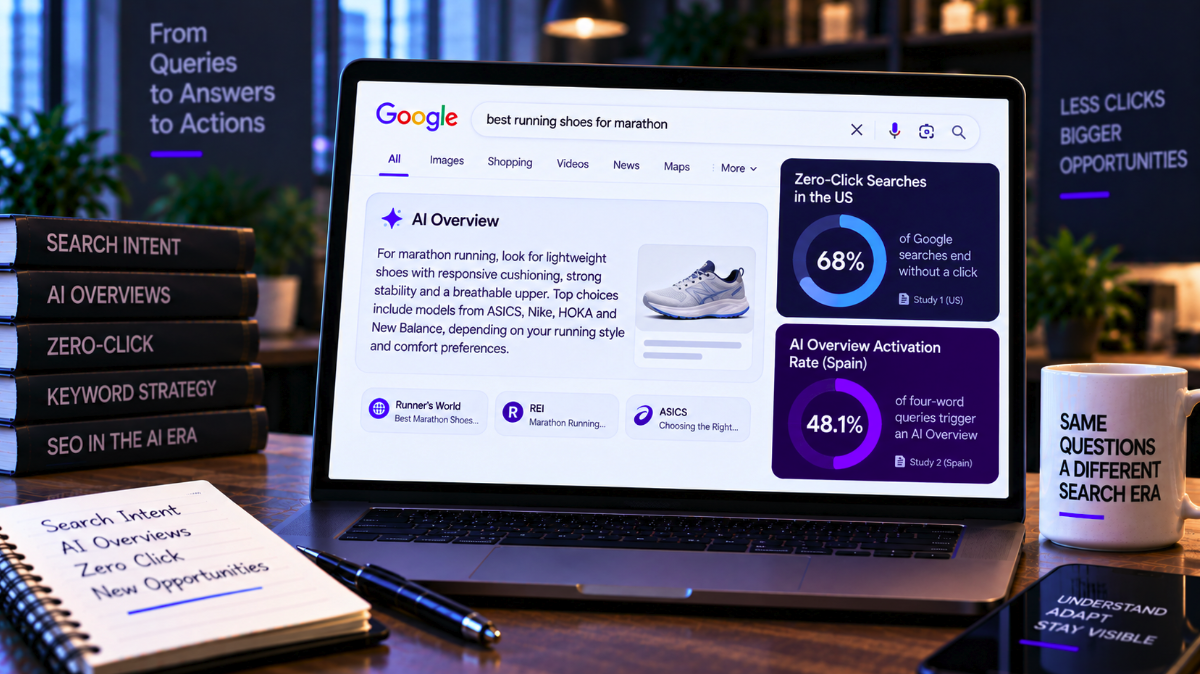
SEO has spent years treating query length as a rough proxy for specificity: short searches are broad, longer searches reveal more of what the user actually wants. Google’s AI Overviews may be giving that old distinction a new consequence. In a Spanish publisher study summarized by Search Engine Journal, four-word queries triggered an AI Overview in 48.1% of the tested searches, making that length the highest activation point reported in the dataset.
The finding arrives against a much larger shift in click behavior. Separate SparkToro research using Similarweb clickstream data found that 68.01% of U.S. Google searches between January and April 2026 ended without a click. The two studies measure different countries, periods and phenomena, so they should not be combined into a claim that AI Overviews caused a 68% zero-click rate. Together, however, they show why intent now matters at two stages: the form of a query can influence whether Google generates an answer, and an increasingly large share of searches already end without an outbound visit.
Four words look like an activation zone, not a universal threshold
The Spanish research by Clara Soteras, Maria-José Cachón, Carlos Lopezosa and Mari Vállez analyzed 2,699 unique keywords in September 2025 using DataForSEO, Sistrix and Google Trends. Conducted within the University of Barcelona’s CUVICOM project, the study focused on searches relevant to five major Spanish publishers and found AI Overviews on 29.8% of the analyzed queries overall. Query length produced one of its clearest patterns: four-word searches triggered an AIO 48.1% of the time, while queries containing five or more words did so at 42.5%.
That does not establish a four-word Google rule. The sample was constructed around Spanish media and publisher-relevant searches, and query length is entangled with intent, topic, wording and informational complexity. A four-word query may simply be more likely than a short keyword to express the kind of explanatory task for which Google chooses synthesis. The useful insight is therefore not to pad every target keyword to four words, but to recognize a transition from terse lookup language toward queries that contain enough context to invite a generated answer.
The study makes another distinction that is easy to lose in summaries. Three-word queries represented 37.5% of keywords where an AIO appeared, while four-word queries represented 29.8%, meaning those two groups together accounted for almost 70% of AIO-containing searches. That is a distribution measure. The 48.1% figure is different: it describes the probability that a tested four-word query produced an AIO. Mixing the two would overstate what the data shows.
Intent appears to matter more than length alone
The interrogative results make the intent relationship clearer. Within the Spanish sample, queries containing “why” triggered an AI Overview 92.3% of the time, followed by “what” at 85.7% and “who” at 68.4%; how, where and when were around 60%. At the same time, 75.2% of keywords that generated AI Overviews were evergreen. Google’s generative layer therefore appeared most comfortable where a search asked for an explanation that could be synthesized from relatively stable information.
Breaking news behaved almost oppositely. AI Overviews appeared in 34.6% of evergreen searches but only 1.1% of immediate breaking-news queries, and AIOs co-occurred with Top Stories just 1.4% of the time. Another 43.6% of the analyzed SERPs displayed neither feature, leaving a substantial part of the sample where conventional organic results remained the primary search experience. These findings are particularly important for publishers because they suggest that “Will this query trigger AI?” cannot be answered from keyword length alone; freshness and the type of information being requested materially change the pattern.
For content strategy, this creates a more useful segmentation than simply informational versus transactional. An evergreen explainer framed around why something happens may face a much higher probability of generated synthesis than a live report about an event unfolding minutes ago. Both can be informational searches, yet the SERP architecture—and therefore the click opportunity—can be radically different.
The 68% zero-click figure describes Google broadly, not AI Overviews specifically
The U.S. zero-click research provides the wider context but requires equally careful boundaries. SparkToro analyzed Similarweb’s desktop and mobile browser clickstream for January through April 2026 and found 68.01% of Google searches ended without a click. That is up from 60.45% in SparkToro’s 2024 U.S. analysis and far above the roughly 49% reported in its historic 2019 work, although SparkToro explicitly warns that the underlying panels and providers differ across years and are not perfectly comparable.
The 68% figure cannot be assigned entirely to generative search. Google has spent years answering queries directly through featured snippets, knowledge panels, maps, calculators, weather modules and other SERP features, while users can also refine a search without leaving Google. SparkToro argues that AI Overviews are contributing to the acceleration, but its own data shows AI Mode represented only 0.34% of searches during the January-April measurement period. The methodology also excludes searches made inside Google’s mobile app, estimates the mobile/desktop weighting and uses a ten-second inactivity cutoff for mobile sessions.
The strategic point survives those caveats: outbound clicks are increasingly scarce, and generative answers are entering an ecosystem that was already moving toward on-SERP satisfaction. AIO activation therefore matters not only because it changes rankings visually, but because it can change whether a ranking has an opportunity to earn a visit at all.
SEO should map activation probability before assuming every ranking has the same value
The combined lesson is to add SERP behavior to intent research. Keyword tools traditionally group queries by volume, difficulty and broad intent categories. In an AI-heavy search environment, teams also need to know whether a query class routinely produces an AI Overview, whether the subject is evergreen or time-sensitive, and whether the generated answer is likely to satisfy the task without a click. A four-word explanatory query may deserve a different content and measurement strategy from a four-word breaking-news query even if their search volumes are identical.
This does not mean avoiding queries likely to trigger AI Overviews. Being cited in a generated answer can reinforce authority and brand visibility, and the source material still needs to exist for Google to synthesize useful information. But publishers and brands should be realistic about the expected return. Content aimed at high-AIO, high-zero-click intents may need to justify itself through citations, brand exposure, downstream branded search or influence rather than direct sessions alone, while queries where traditional results dominate can still be evaluated more conventionally on rankings and clicks.
Four words are therefore best understood as a warning light, not a magic number. In one substantial Spanish publisher sample, that was where AI Overview activation peaked at 48.1%, but the deeper pattern was conversational complexity, evergreen information and question-led intent. As Google moves from retrieving pages toward synthesizing answers, the most important keyword question may no longer be only “Can we rank for this?” It may be “What kind of search experience does this intent activate before the user ever reaches our result?”