
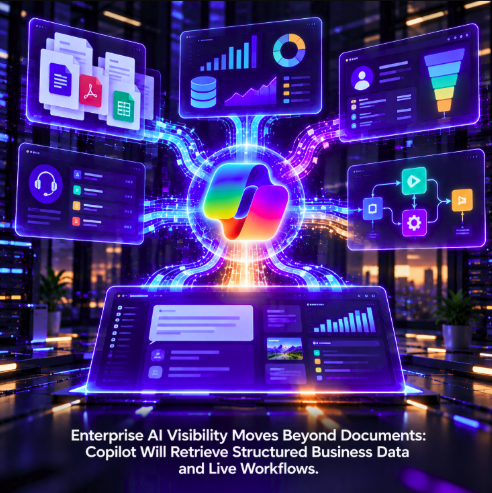
Enterprise AI retrieval is moving beyond the document repository. Microsoft is expanding the business context available to Copilot so that an answer or delegated task can be grounded not only in files and conversations, but also in governed analytics models, commercial history, support records and operational workflows.
Microsoft detailed the expansion in its September 25 announcement of the new Copilot. Fabric IQ is already generally available as a grounding layer for Chat and Cowork, bringing trusted data context—including more than 20 million Power BI semantic models, according to Microsoft—into those experiences. Over the next month, Microsoft says Copilot grounding in Dynamics 365 and Power Platform data and workflows will enter public preview. citeturn0search0
The shift changes what “AI visibility” can mean inside an enterprise. A useful source no longer has to be a page that can be searched and quoted. It can be a semantic model that defines a business metric, a CRM record that captures deal history, a support ticket that explains a customer problem or a workflow that describes how work moves through the organization.
Microsoft IQ is becoming the context layer beneath Copilot
Microsoft describes Microsoft IQ as a unified intelligence platform connecting how a business operates with the knowledge it holds. The objective is to give Copilot and agents a real-time, governed view across the Microsoft stack rather than forcing each AI interaction to reconstruct context from disconnected applications. citeturn0search0
That architecture matters because enterprise knowledge has historically been split across two broad categories. Unstructured knowledge lives in documents, email, chats and presentations. Operational knowledge lives in databases, CRM systems, semantic models, tickets, process automation and application state.
Generative AI initially made the first category highly visible because retrieval-augmented generation was naturally demonstrated through documents. Microsoft’s new grounding layer makes the second category increasingly addressable through the same Copilot interface.
Fabric IQ gives Copilot governed analytical meaning, not merely raw tables
Fabric IQ is important because Microsoft is not describing the integration simply as access to rows in a database. It specifically highlights trusted context from enterprise data, including the large installed base of semantic models in Power BI. citeturn0search0
A semantic model can encode relationships, measures, hierarchies and business definitions that sit between raw data and a decision. That means an AI system can potentially work from an organization’s established definition of a metric rather than improvising one from column names.
This is a major distinction for enterprise grounding. Retrieval quality is not only about locating the correct object. The system also needs enough context to interpret what the object means inside that organization.
Chat and Cowork already share Fabric IQ grounding
Microsoft says Fabric IQ grounding is generally available in both Chat and Cowork today, while integration with Copilot Code is coming through the Frontier program. citeturn0search0
The same governed data context can therefore support two different forms of AI work. Chat can use it while answering or analyzing interactively. Cowork can use it while executing a delegated task end-to-end.
That distinction matters because grounding is no longer only about improving an answer. In an agentic environment, retrieved context can influence the actions, documents and decisions produced during a longer workflow.
Dynamics 365 brings customer and commercial state into retrieval
The Dynamics 365 expansion adds another class of information: operational customer and business records. Microsoft’s example is a salesperson preparing a proposal. Copilot can incorporate deal history and support tickets directly into the document instead of requiring the user to switch applications and manually collect the information. citeturn0search0
That example is more consequential than simple convenience. Deal history is not a conventional knowledge article. A support ticket is not necessarily content designed for broad discovery. Both are pieces of live business state that can become relevant evidence for a task.
The enterprise retrieval problem therefore expands from “Which document answers this question?” to “Which combination of documents, records, models and process state is relevant to the job being performed?”
Power Platform adds workflows to the context graph
Microsoft also says Copilot will be grounded in data and workflows from Power Platform as the public preview rolls out over the next month. citeturn0search0
Workflow context is especially interesting because it describes how information becomes action. A document can say what a policy requires; a workflow can encode the operational path through which that policy is executed. A CRM record can say that an opportunity exists; a workflow can reveal what should happen when the opportunity reaches a particular state.
For agents, that procedural context can be as valuable as descriptive content. Enterprise AI needs to understand not only what the organization knows, but how the organization expects work to proceed.
Retrieval visibility becomes broader than content visibility
Search professionals are accustomed to thinking about visibility at the level of pages. A page is indexed, ranked, retrieved or cited. Enterprise AI makes that mental model incomplete.
A Power BI semantic model can be highly influential without ever resembling a web page. A CRM field can alter a generated proposal. A support record can change the recommendation an employee receives. A workflow can determine the next action an agent proposes.
NetContentSEO has already examined the related distinction between visible citations and hidden retrieval in “Your Page Can Influence an AI Answer Without Receiving a Citation”. Microsoft’s enterprise architecture pushes the idea further: the influential object may not be a page at all.
Semantic governance becomes part of AI optimization
If Copilot is grounded in semantic models, the quality of those models becomes part of the quality of the AI system. An organization with conflicting definitions of revenue, customer status or product availability can expose those conflicts through generated answers and agentic workflows.
The same applies to CRM hygiene. Duplicate accounts, stale opportunity stages, inconsistent support classifications and poorly maintained metadata are not merely reporting problems when AI retrieves those records directly. They become grounding problems.
Enterprise AI optimization therefore extends into data governance. Better prompts cannot reliably compensate for business context whose definitions are ambiguous or whose underlying state is wrong.
Freshness becomes more important when the source represents live state
A document can remain useful for months or years. Operational records can become obsolete in minutes. A support ticket may close, a deal stage may change, an inventory condition may disappear and a workflow may be revised.
As Copilot retrieves live business context, freshness becomes a first-class quality property. The relevant question is not only whether the system can retrieve the correct source, but whether that source still represents the current state of the business.
This is one reason Microsoft’s “real-time view” language around Microsoft IQ is strategically important, although organizations will still need to evaluate the actual latency and synchronization characteristics of the systems they connect. citeturn0search0
Permissions become part of relevance
Public web search generally asks which sources are relevant and accessible to the crawler. Enterprise retrieval adds another constraint: which sources this particular employee or agent is authorized to use.
Microsoft repeatedly frames Microsoft IQ as governed and secure. That means two users can have different effective evidence pools because their permissions differ. The most relevant record in the organization may correctly remain invisible to an employee who is not authorized to access it. citeturn0search0
Visibility inside enterprise AI is therefore permission-aware. Organizations cannot assess it solely by asking whether information exists in the connected system.
Grounding now feeds generated software as well as answers
The expansion also connects directly to Copilot Code. Microsoft says Code will be grounded in the context of a user’s work through Microsoft IQ, with Fabric IQ integration coming through Frontier. citeturn0search0
NetContentSEO covered that shift in “Copilot Turns Business Knowledge Into Executable Software”. Once enterprise context can feed generated dashboards, trackers, automations and applications, retrieval becomes an input to software behavior rather than only language generation.
That raises the stakes for authoritative data. An incorrect fact in a summary is harmful; an incorrect business definition embedded into a generated application can be repeatedly operationalized.
Agentic grounding changes the unit of optimization
In classic SEO, teams optimize a page so that a search engine can understand and surface it. In enterprise AI, the unit that needs improvement may instead be a field definition, semantic model, workflow, entity relationship, support taxonomy or permission structure.
This does not make documents unimportant. Microsoft’s architecture is additive. Documents, chats and files remain part of the knowledge environment, but they now sit alongside structured and operational context.
The practical consequence is that “content strategy” and “data strategy” become harder to separate when both can supply evidence to the same AI workflow.
The retrieval layer is becoming a representation of the business itself
Microsoft’s September announcement is not merely another connector release. Fabric IQ already grounds Chat and Cowork; Dynamics 365 and Power Platform grounding are scheduled to enter public preview over the following month; Code integration with Fabric IQ is coming through Frontier. citeturn0search0
Together, those changes point toward a Copilot that can reason across what employees wrote, what analytics models define, what customers have done and what operational processes are currently running.
That makes enterprise AI visibility a broader discipline than document retrieval. The objects competing to influence an answer or workflow now include semantic models, records, tickets and processes. Their authority depends on accuracy, freshness, permissions and the quality of the relationships connecting them.
For organizations, the strategic question is no longer simply whether Copilot can find their knowledge. It is whether the underlying representation of the business is coherent enough for an AI system to retrieve it, combine it and safely use it while work is happening.