

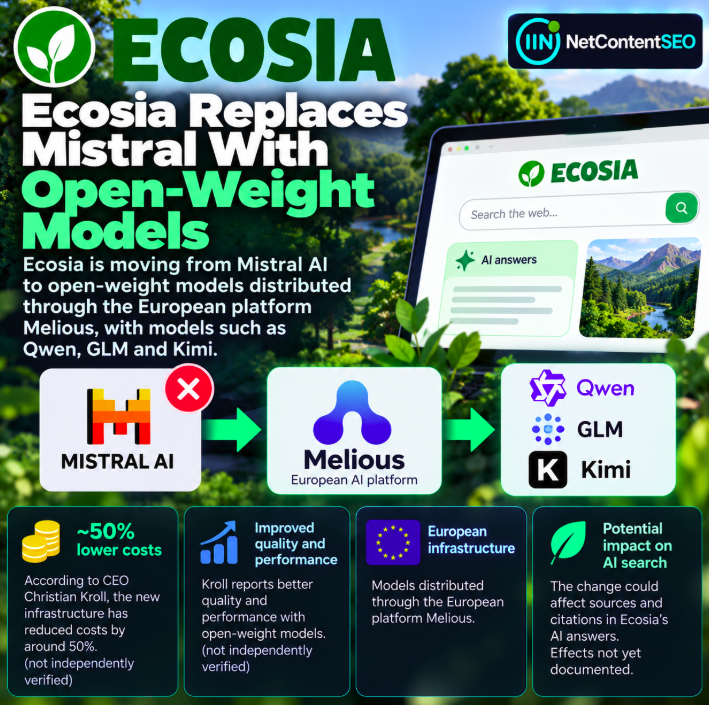

Ecosia is changing the model infrastructure behind its AI-powered search answers, moving away from Mistral AI toward open-weight models delivered through the European platform Melious. Ecosia founder Christian Kroll confirmed the direction in an interview with Politico, according to reporting published October 6, 2026, with further details on October 8. Model families discussed include Qwen, GLM and Kimi.
Kroll reportedly says the new setup has reduced costs by approximately 50% while improving quality and performance. That cost reduction and the performance claims are company-reported, not independently verified benchmarks. Crucially for SEO and GEO researchers, the available reporting does not yet document how the transition affects source selection or citations in Ecosia's AI answers.
Source: PPC Land — Ecosia Drops Mistral AI for Open Models, reporting on comments by Christian Kroll.
What is Ecosia changing?
Ecosia's reported migration concerns the models used to generate AI-assisted search answers. Rather than continuing with Mistral as its model provider for this experience, Ecosia is moving toward open-weight model families deployed through Melious.
This is an infrastructure and model-selection change. It should not automatically be interpreted as a complete replacement of Ecosia's conventional web search infrastructure, a change to every result on the site, or a confirmed new indexing policy.
Key facts and important caveats
| Topic | Reported detail |
|---|---|
| Search product | Ecosia AI-generated search answers |
| Previous model provider | Mistral AI |
| New deployment platform | Melious |
| Model families discussed | Qwen, GLM and Kimi |
| Reported savings | Approximately 50%, according to Christian Kroll |
| Reported quality | Improved, according to Kroll |
| Citation impact | Not documented in the available reporting |
| Timing | October 2026 reporting; exact per-user rollout details not established |
Why open-weight models are attractive for search services
Open-weight models give deployers more options for choosing hosting environments, configuring inference systems and evaluating model families. A search company can potentially adjust its deployment choices without depending on a single proprietary model endpoint.
However, open-weight does not automatically mean unrestricted open-source licensing, zero infrastructure costs or better search quality. Actual economics depend on compute, engineering, licensing terms, throughput and operational requirements.
What role does Melious play?
The reporting describes Melious as the European platform through which Ecosia is distributing or deploying the new model setup. That makes Melious part of the infrastructure story, but the supplied information does not establish the exact hardware, hosting topology, data flows or all models currently active for every Ecosia user.
Researchers should distinguish the platform that serves a model from the model family itself. Those are separate layers and can evolve independently.
Qwen, GLM and Kimi: named families, not necessarily a fixed production lineup
Qwen, GLM and Kimi are among the open-weight model families mentioned in the reporting. That does not prove that all three are simultaneously serving every Ecosia AI query or that each has a permanent role in production.
Until Ecosia publishes exact deployment details, the responsible description is that these families are part of the models considered or discussed in connection with the migration.
What does the claimed 50% cost reduction mean?
Kroll reportedly estimates that the new infrastructure has lowered costs by roughly half. This is commercially significant if it holds across comparable workloads, but the public summary does not provide a full independently audited cost model.
It is not clear from the supplied information which expenses are included, which period is compared or whether the estimate accounts for all operational costs. The figure should therefore be attributed directly to Kroll rather than presented as a verified industry benchmark.
Could the change affect Ecosia's AI citations?
Potentially, but no measured effect has been established. Model changes can motivate tests of answer wording, source use and attribution, yet the model generating an answer is only one part of a search system. Retrieval pipelines, source indexes, prompts and citation-rendering logic can also shape the result.
It would be premature to claim that replacing Mistral will make Ecosia cite more websites, favor particular domains or reduce referral traffic. Those outcomes require controlled before-and-after evidence.
How SEO and GEO teams should test the migration
- Record timing. Save the date, locale and any available rollout information for each test.
- Use consistent queries. Compare a stable set of informational, commercial and navigational prompts.
- Capture full answers. Preserve answer text, source links and screenshots when appropriate.
- Track source overlap. Compare cited domains and URLs across repeated observations.
- Separate ranking from generation. Do not assume a change in AI answers means conventional organic rankings changed.
- Repeat tests. Account for normal variation and changes in live web content.
- Flag unknown model versions. Do not invent model identifiers when Ecosia does not disclose them.
Why this matters beyond Ecosia
The migration illustrates a wider architectural question in AI search: search providers can change the models used to synthesize answers while keeping much of the surrounding product experience familiar to users. For analysts, that means a brand visibility trend may be affected by a model or infrastructure change even when the search engine's name remains the same.
That possibility makes version tracking, source attribution monitoring and clear research methodology increasingly important.
What the announcement does not prove
- It does not establish that Ecosia has changed its entire conventional web search index.
- It does not verify the claimed 50% savings independently.
- It does not identify one confirmed model serving all Ecosia users.
- It does not demonstrate a measurable change in AI citations or source selection.
- It does not show that open-weight models inherently produce better SEO visibility.
FAQ
Is Ecosia replacing Mistral AI?
Yes, according to reporting citing direct confirmation from founder Christian Kroll, Ecosia is moving its AI-answer model infrastructure away from Mistral.
What is replacing Mistral?
Open-weight models served through Melious, with Qwen, GLM and Kimi among the model families discussed.
Has Ecosia reduced AI costs by 50%?
Christian Kroll reportedly claims savings of approximately 50%, but the figure has not been independently verified in the available reporting.
Will Ecosia's AI answers cite different websites?
That remains an open research question. No before-and-after citation study is established by the announcement.
Does this mean Ecosia's traditional search rankings changed?
No such change is established by the reported AI model migration.
NetContentSEO analysis
Ecosia's migration is an important reminder that an AI search product's model layer can change independently of its brand or user interface. The economics reported by Kroll may help explain the move, but SEO professionals should focus on what can actually be measured: whether source selection, citation frequency and answer consistency change across a documented transition. Until those tests exist, citation impacts remain hypotheses rather than findings.
Reported source: PPC Land — Ecosia Drops Mistral AI for Open Models, October 2026.