

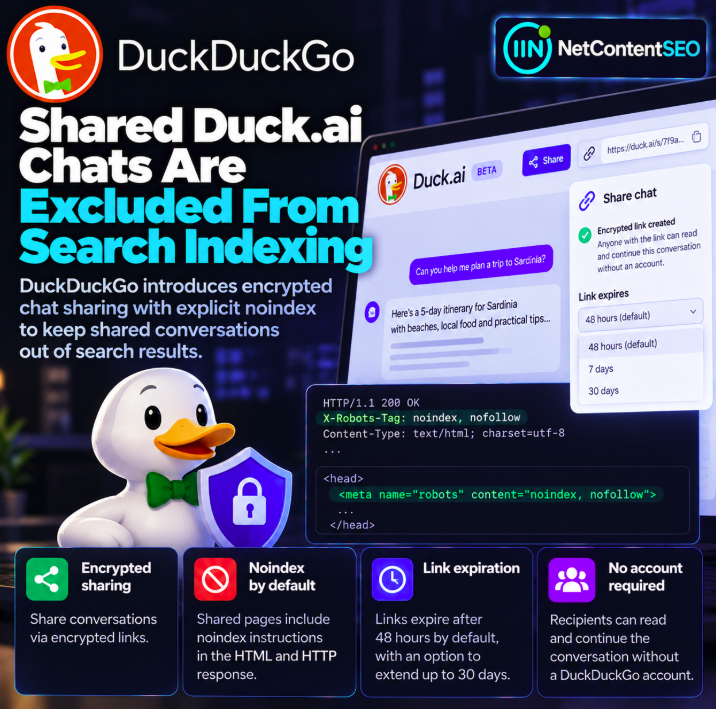

DuckDuckGo has introduced encrypted-link sharing for Duck.ai conversations, allowing recipients to read and continue a shared chat without creating an account. The October 7, 2026 announcement includes an unusually explicit search-engine privacy measure: shared conversation pages carry noindex instructions in the page and in the HTTP response, signaling to search engines that those pages should not appear in search results.
Shared links expire after 48 hours by default, with an option to extend their validity to 30 days. The new capability is described in DuckDuckGo's official Private Chat Sharing announcement.
For technical SEO teams, the key lesson is the distinction between sharing a page with someone who has its link and making that page eligible for search indexing. Those are separate product decisions, and DuckDuckGo has chosen to explicitly discourage indexing of shared AI chats.
How Duck.ai conversation sharing works
A user can create a link to a Duck.ai conversation and send it to another person. According to the announcement, the link uses encryption and the recipient can read and continue the conversation without a DuckDuckGo account. The exact encryption design, key handling and threat model are not specified in the supplied release summary, so they should not be inferred from the word 'encrypted' alone.
Importantly, a valid share link still provides access to the shared material. The feature should not be described as making a conversation inaccessible to anyone who receives or obtains the link. Users should consider the contents of a chat before sharing it, regardless of the indexing protections.
The SEO detail: noindex in HTML and HTTP
DuckDuckGo states that shared conversation pages include noindex directives both in the page and in the HTTP response. These two forms communicate the same broad instruction to compatible search crawlers through different mechanisms.
HTML robots meta tag
A conventional HTML implementation looks like this:
<meta name="robots" content="noindex">Placed in the document head, this tells search engines that respect the directive not to include the page in their search index.
HTTP X-Robots-Tag header
An equivalent HTTP-level instruction can be expressed as:
HTTP/1.1 200 OK
X-Robots-Tag: noindex
Content-Type: text/html; charset=utf-8
This is an illustrative HTTP example of the mechanism, not a packet capture of a Duck.ai share page. HTTP-level robots directives are particularly useful because they are delivered with the response rather than depending solely on an HTML parser.
Using both forms is a defense-in-depth approach to communicating the intended indexing policy. It does not make the page secret, encrypted from the recipient or impossible for every crawler to fetch.
Why noindex matters for shared AI conversations
AI conversations may contain personal context, drafts, questions, private planning details or sensitive information. A sharing feature can be useful for collaboration, but public search indexing would create a different level of exposure: a chat URL could potentially become discoverable through search queries long after it was originally sent to a specific recipient.
Explicit noindex directives reduce that risk for search engines that honor them. The instructions are especially relevant because the page is accessible to a recipient with a valid link without an account.
Link expiration: 48 hours to 30 days
DuckDuckGo says shared links expire after 48 hours unless the user selects a longer period, up to 30 days. Expiration adds a time limit to the access mechanism, separate from search-engine indexing instructions.
The two controls serve different purposes:
- Link expiration determines how long the shared URL remains valid under the product's access rules.
- Noindex tells compatible search engines not to include the shared page in search results.
Neither control should be confused with a guarantee that recipients cannot copy, screenshot or separately republish the contents while the link is valid.
Noindex is not the same as robots.txt disallow
Technical SEOs should distinguish between preventing indexing and preventing crawling. A robots.txt disallow directive generally restricts crawler access to a URL path. A noindex instruction, by contrast, must be discovered by the crawler through an accessible page or response to be applied reliably.
If a URL is blocked from crawling, a search engine may be unable to see its noindex directive. That is why the design and interaction of robots directives matter for sites that want to keep accessible pages out of search results.
DuckDuckGo's announcement describes explicit noindex instructions; it does not establish that the feature relies solely on robots.txt.
Does noindex guarantee complete privacy?
No. The directive is an instruction to search engines, not an access-control mechanism. A person who has the valid link can access the shared conversation according to the feature's rules. Search engines or other automated clients that ignore robots directives may behave differently, and content can be copied elsewhere.
Privacy therefore depends on several layers: what is shared, who receives the link, how the link is handled, how long it remains valid and which indexing instructions are respected. The product's encryption and expiration features should be assessed alongside—not replaced by—its robots directives.
How this compares with publicly discoverable AI chat pages
AI conversation sharing systems can take different approaches. Some products may allow public pages intended for broad discovery; others may prioritize temporary sharing and discourage indexing. DuckDuckGo's design explicitly chooses the latter for Duck.ai shared conversations.
It would be inaccurate to assert that every ChatGPT shared conversation is indexed or publicly searchable. Indexing behavior varies by product, configuration and time. The meaningful comparison is between search-indexable publication and temporary link sharing with noindex, not a blanket claim about every competing AI service.
Lessons for publishers and product teams
- Decide whether shared content should be discoverable. A public URL is not automatically a public-search landing page.
- Use appropriate indexing controls. For content intended to remain outside search results, return valid
noindexinstructions where crawlers can observe them. - Separate privacy from SEO. Indexing directives cannot replace authentication, access control or careful handling of shareable links.
- Provide sensible expiration options. Temporary links can reduce the duration of accidental exposure.
- Test the HTTP response. Verify that expected headers and page-level directives are present for real shared URLs.
- Communicate limitations clearly. Recipients may still preserve or redistribute information they can view.
How to verify noindex technically
For a URL that you own or are authorized to test, inspect its HTTP headers with a command such as:
curl -I 'https://example.com/shared-chat/example'Look for an X-Robots-Tag header carrying noindex. Then inspect the HTML document head for a robots meta directive. Remember that some servers handle HEAD and GET differently; a full response check may be needed.
Do not publish or share real private chat URLs while testing. The example URL above is fictional and is included solely to demonstrate the inspection method.
FAQ
Can recipients continue a Duck.ai conversation without an account?
Yes, according to DuckDuckGo's October 7 announcement.
Are Duck.ai shared chats meant to appear in Google search results?
No. DuckDuckGo says the shared pages include noindex directives in both HTML and HTTP responses to discourage indexing.
How long does a shared Duck.ai link last?
48 hours by default, with an option to extend validity up to 30 days.
Does noindex prevent people with the link from opening the conversation?
No. Search indexing controls and link access are separate.
Is noindex the same as encrypting a chat?
No. Encryption, link validity and search indexing are different mechanisms with different security and privacy purposes.
Does this prove that competing AI chat services index every shared conversation?
No. Indexing policies vary across services and should be evaluated individually.
NetContentSEO analysis
DuckDuckGo's shared-chat design is a useful reminder that shareability does not have to mean search discoverability. The combination of encrypted links, time-limited access and explicit noindex instructions reflects a privacy-first approach to collaboration. For technical SEO professionals, the most actionable detail is the dual delivery of indexing instructions in HTML and HTTP—paired with the recognition that noindex is not a substitute for actual access control.
Primary source: DuckDuckGo — Private Chat Sharing, October 7, 2026.