

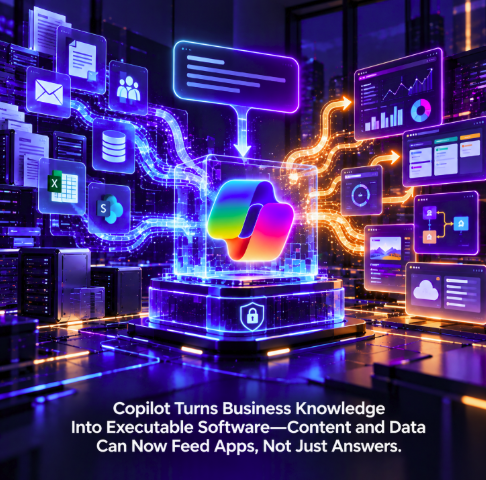

Microsoft is expanding the unit of AI-generated knowledge work beyond text, spreadsheets and presentations. With Copilot Code, a business user can describe an app, tracker, dashboard, automation or workflow in natural language and ask Copilot to build the working software rather than merely explain how it could be built.
The capability was announced September 25 as part of Microsoft’s new Copilot architecture. Code is scheduled to begin rolling out through the Frontier program at the end of September, with broader availability in the following weeks and a preview for Microsoft 365 Premium and Pro subscribers later in 2026. Microsoft says it is powered by the same underlying technology as GitHub Copilot, runs in a sandboxed environment and can be hosted securely inside an organization’s tenant. citeturn0search0
The important shift is not simply that non-developers can generate software. Copilot Code is designed to connect generated software to enterprise context through Microsoft IQ. That turns internal knowledge, semantic models, documents and governed business data into potential inputs for executable interfaces rather than sources used only to compose an AI answer.
Microsoft calls software a new unit of knowledge work
Microsoft frames Code around a deliberately simple idea. The traditional unit of office work has been the file: a document, spreadsheet or presentation. Code adds what Microsoft calls a fourth unit—small, purpose-built software solutions that employees can create to complete a job. citeturn0search0
That framing matters because it moves AI generation one layer closer to execution. A model summarizing a sales dataset produces information. A generated dashboard connected to the dataset creates an interface through which people can continue exploring and acting on that information. A model explaining an approval process produces guidance. A generated workflow can operationalize the process.
Microsoft is effectively betting that creating lightweight internal software can become a routine workplace activity rather than a specialized development project.
Natural language becomes a software specification
Microsoft says users can describe the desired solution in ordinary language and Copilot will choose an approach and build it. The examples span persistent desktop widgets, interactive dashboards for exploring data and testing outcomes, automations, workflows and cloud-hosted internal applications that can be shared with a team. citeturn0search0
This makes the prompt qualitatively different from a request for generated prose. A useful instruction now has to describe what the software should accomplish, what information it should use and how people are expected to interact with it.
The prompt becomes closer to a lightweight product brief. Ambiguous requirements can become ambiguous software, which means domain expertise remains important even as the implementation barrier falls.
Microsoft IQ is what turns generic generation into enterprise software
Copilot Code would be much less interesting if it could only generate isolated applications from a blank prompt. Microsoft positions Microsoft IQ as the context layer that connects Copilot and agents to how an organization actually operates and to the knowledge it holds.
Microsoft says everything created in Code can be grounded in the context of the user’s work through Microsoft IQ, while plugins synchronize automatically. Fabric IQ already grounds Chat and Cowork, and Microsoft says Code integration is coming through Frontier. Fabric IQ brings governed data context including more than 20 million semantic models in Power BI, according to Microsoft. citeturn0search0
That changes what enterprise content can become. A semantic model does not have to terminate in a chart someone manually builds. Documents and business context do not have to terminate in a generated summary. They can contribute to an application whose interface and behavior are produced for a specific task.
Content can become an application dependency
For content strategists, this is the most interesting consequence. Enterprise knowledge has traditionally been optimized for people to read or for search systems to retrieve. Generative AI added another consumption pattern: content can be retrieved as evidence and synthesized into an answer.
Copilot Code introduces a further possibility. Business knowledge can help define or populate executable software. A policy can inform a workflow. A semantic model can feed a dashboard. Product information can become part of a tracker. Operational documentation can help shape an internal tool.
This does not mean Microsoft has announced that arbitrary documents are automatically compiled into applications. The stronger and defensible interpretation is that Microsoft is connecting natural-language software generation with governed enterprise context, allowing that context to ground what Code creates. citeturn0search0
The generated software runs inside a sandbox
Lowering the barrier to software creation creates an obvious governance problem: more people can generate code that might interact with organizational data and workflows. Microsoft’s answer begins with isolation.
The company says Code runs in a sandboxed environment and can be securely hosted within the organization’s tenant. It is also introducing Copilot Managed Runtime, hosting infrastructure designed to run generated code safely inside the Microsoft 365 environment. The runtime is governed by IT while allowing employees to share applications, connect them to live data and access them from different locations. citeturn0search0
Managed Runtime is currently in preview and will be accessible inside Code. Microsoft says the same foundation supports applications built in Cowork, Code and Copilot Studio and is being opened to third-party and professional developers as well. citeturn0search0
Sandboxing contains execution, but it does not make generated logic correct
A secure runtime solves a different problem from application correctness. A generated dashboard can run safely and still calculate the wrong metric. An automation can be technically contained and still encode an incorrect business rule. A tracker can faithfully display data while misleading users about what the data means.
This distinction becomes increasingly important as natural-language software generation reaches non-developers. Traditional software development contains review practices precisely because requirements, logic and implementation can all fail independently.
AI reduces the implementation cost. It does not remove the need to validate the specification, permissions, data sources, calculations and downstream consequences.
Generated software inherits the quality of enterprise context
Grounding Code in Microsoft IQ creates leverage, but it also makes enterprise information quality more consequential. If an organization has inconsistent definitions of revenue, customer status or product availability, generated applications can reproduce those inconsistencies at software speed.
Semantic models become especially important here because they encode business meaning rather than merely storing raw values. Microsoft’s emphasis on Fabric IQ suggests that Code is intended to build on governed context instead of forcing each generated application to reconstruct definitions independently. citeturn0search0
For organizations, that creates a new incentive to treat taxonomies, semantic layers, documentation and data governance as AI infrastructure. Better context can improve not only generated answers but also the software assembled on top of that context.
Plugins extend generated applications toward actions
Microsoft is also rolling out a unified plugin registry bringing Microsoft, partner and custom plugins into one catalog. IT can approve and manage those plugins centrally, while developers can publish capabilities across supported Copilot surfaces. citeturn0search0
For Code, this matters because an internal application becomes more useful when it can interact with the systems where work actually happens. The combination of generated UI, enterprise context and governed plugins can turn a static dashboard into an operational tool.
It also raises the stakes for permissions. The more capable a generated application becomes, the more carefully organizations need to distinguish access to information from authority to change business state.
Copilot Code is not a replacement announcement for GitHub Copilot
Microsoft explicitly separates the audiences. Code uses the same underlying technology as GitHub Copilot, but professional software developers continue using GitHub Copilot for day-to-day development, with deeper connectivity into the broader Copilot platform. citeturn0search0
Copilot Code is aimed at moving solution-building beyond developers alone. Its core proposition is that an employee who understands the business problem should be able to produce a purpose-built tool without first translating the entire requirement into a conventional development project.
That does not eliminate professional engineering. As generated applications become more critical, complex or externally exposed, conventional engineering practices become more—not less—important.
Code sits inside a broader Copilot routing architecture
Microsoft is not launching Code as an isolated destination. It is part of the new Copilot Home alongside Chat and Cowork, and Microsoft says that a future update will automatically route requests to Chat, Cowork or Code according to the job. citeturn0search0
NetContentSEO examined that orchestration shift in “Microsoft Copilot Will Choose the Agent for You”. The implication for Code is significant: users may eventually ask for an outcome without explicitly deciding that software should be the output. Copilot itself can determine that the appropriate response is an application rather than an answer.
That makes software generation part of a general work router. A request can become conversation, delegated execution or code depending on how Copilot interprets the task.
Generated apps introduce a new cost model
Microsoft classifies Cowork, Code and Autopilot as long-running agentic capabilities that use usage-based billing rather than the fixed-cost user subscription model applied to everyday Copilot tasks such as drafts, summaries and analysis. citeturn0search0
The company is consequently expanding its FinOps controls. Agent 365 cost management is adding Code and Copilot Managed Runtime, while administrators can establish spending policies, manage model availability and route credit requests through organizational approval workflows. citeturn0search0
That gives generated software an economic dimension that simple prompting often hides. If employees can create and run applications on demand, organizations need to understand not only whether the applications work but whether their ongoing execution justifies the resources they consume.
AI discovery is moving from retrieving knowledge to operationalizing it
The broader search and discovery implications are easy to miss because Copilot Code is presented as a workplace product. For years, the central question for content visibility has been whether information can be crawled, indexed, retrieved and cited. Agentic systems add another question: can the retrieved information be used to perform work?
A policy page that an AI can retrieve may guide an approval workflow. A product catalog can feed a comparison tool. Structured enterprise data can populate an application generated for one decision. The value of machine-readable information therefore extends beyond whether it earns a citation.
This resembles a wider shift NetContentSEO has been tracking in AI search. Google’s generative UI can turn retrieved information into custom interactive interfaces. Copilot Code brings a related idea into enterprise work: information becomes raw material for software, not merely prose returned to a user.
Machine-readable business knowledge becomes more valuable
When AI only summarizes documents, ambiguity is inconvenient. When AI uses organizational context to create applications, ambiguity can become executable.
Companies therefore have a stronger reason to maintain explicit definitions, reliable semantic models, well-governed data sources and current documentation. The objective is not to write content for a robot at the expense of human readers. It is to ensure that the business concepts a generated system depends on are sufficiently clear and authoritative to be reused safely.
This is where content operations, data governance and software governance begin to overlap. The same enterprise knowledge can serve employees, retrieval systems, agents and generated applications.
The new question is whether your knowledge is ready to become software
Copilot Code lowers the distance between an idea and an executable tool. A business user can describe a tracker, dashboard, workflow or internal application, while Copilot chooses an approach and builds it inside a governed environment. Microsoft IQ supplies organizational context, plugins extend capabilities and Managed Runtime provides a hosting layer for the resulting software. citeturn0search0
The rollout is only beginning, so claims about how reliably Code handles complex production applications will need evidence from real deployments. Microsoft’s announcement establishes the architecture and intended capabilities, not a guarantee that every natural-language specification will produce correct software.
But the strategic direction is already clear. Enterprise AI is moving beyond answering questions about business knowledge. It can increasingly use that knowledge to construct the interface, workflow or application through which the next piece of work gets done.
For content and data teams, that creates a new standard for usefulness. The question is no longer only whether information can be found and understood by an AI system. It is whether the information is trustworthy, structured and governed well enough to become a dependency of something the AI builds.