

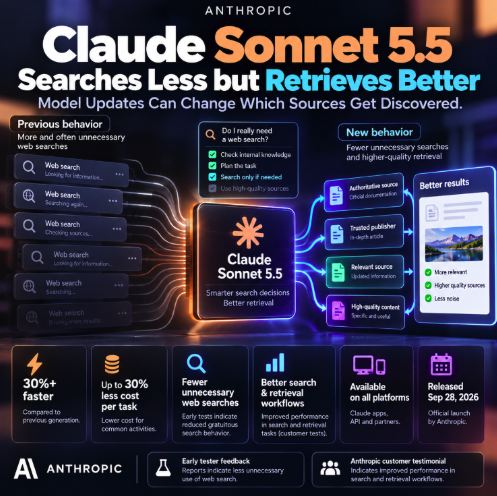

Anthropic's new Claude Sonnet 5.5 is not only faster and more efficient than Sonnet 5. Early customer testing also points to a potentially important change for AI visibility: the model appears more selective about when it uses web search while performing better on search and retrieval workflows.
Anthropic released Sonnet 5.5 on September 28, 2026. The company says it generates output more than 30% faster than Sonnet 5 and can cost up to 30% less per task because it typically needs fewer tokens to complete the same work.
Sonnet 5.5 appears less eager to search the web
One of the most interesting observations comes from Anthropic's early customer feedback. A tester reported that Sonnet 5's tendency to reach for web search too often had disappeared in the new model, alongside a reduction in token usage.
This does not mean Claude has stopped searching the web. It suggests the model may make different decisions about when external retrieval is necessary.
Search and retrieval quality also improved in testing
Balyasny Asset Management reported that Sonnet 5.5 performed better than Sonnet 5 in almost every way on its analyst search and retrieval workflows. Its private evaluation covered 2,441 finance tasks spanning Q&A, extraction, analysis and forecasting.
The company also reported a large efficiency difference: Sonnet 5.5 used about 121,000 tokens per answer in that evaluation, compared with roughly 497,000 for Sonnet 5.
Why fewer searches can change AI visibility
For publishers, the number of web searches an AI performs is not merely an infrastructure detail. Every retrieval decision creates — or removes — an opportunity for an external source to be discovered, selected and potentially cited.
If a newer model can answer more requests from existing context or internal knowledge, some prompts may trigger fewer external searches. At the same time, stronger retrieval decisions could concentrate attention on a smaller set of sources when web access is used.
Model upgrades can reshape source discovery without a ranking update
This is an important distinction for GEO and AI visibility monitoring. A publisher's citation frequency can change even when the underlying search index or source itself has not changed.
A new model can alter query planning, tool selection, the number of retrieval steps and how retrieved documents are evaluated. Any of those changes can affect which publishers ultimately appear in an AI-generated answer.
30%+ faster and up to 30% cheaper per task
Anthropic says Sonnet 5.5 is its fastest Sonnet model to date, generating outputs more than 30% faster than Sonnet 5. Pricing remains $2 per million input tokens and $10 per million output tokens, but reduced token usage means typical tasks can cost up to 30% less.
The model is available across Anthropic's platforms and through Amazon Web Services, Google Cloud and Microsoft Azure.
The NetContentSEO view
Sonnet 5.5 is a useful example of why AI visibility cannot be monitored only at the search-engine level. The model itself is part of the discovery system.
If a model becomes more selective about calling web search, while simultaneously becoming better at retrieval when it does search, the pool of sources exposed to the model can change substantially. For publishers, a model release can therefore behave like a visibility update even when no conventional search ranking algorithm has changed.