

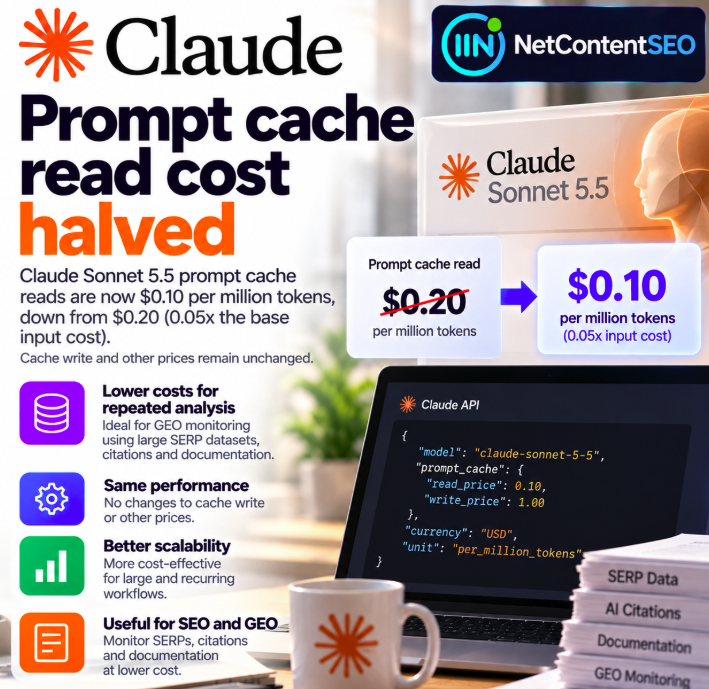

October 7, 2026 — Anthropic has reduced the price of prompt cache reads for Claude Sonnet 5.5 by 50%, from $0.20 to $0.10 per million tokens. The new rate is equivalent to 0.05 times the model's base input-token price, according to the update described in Claude Platform release notes. Cache write charges and other model pricing remain unchanged.
The change matters most to API users who repeatedly reuse the same large blocks of context, including documentation, research corpora and recurring analytical instructions. It does not mean all Claude input tokens are now half-price.
What changed in Claude Sonnet 5.5 pricing?
| Charge | Before | After |
|---|---|---|
| Prompt cache read (per 1M tokens) | $0.20 | $0.10 |
| Relative to base input price | 0.10× | 0.05× |
| Cache writes and other charges | Unchanged | Unchanged |
The reduction applies specifically to eligible cache-read tokens. Regular input tokens, output tokens and cache creation have their own billing treatment.
How prompt caching works
Prompt caching lets applications reuse previously processed prompt content when subsequent requests share an eligible cached prefix. A first request may incur cache creation or normal input costs. Later requests that hit the cache can reuse that content at the cache-read rate, subject to the model's caching rules, cache lifetime and request structure.
A lower read price helps only when a workflow actually produces cache hits. Changing a large portion of the shared context between calls, or missing the applicable caching window, can reduce the savings.
Why this matters for GEO monitoring
Generative Engine Optimization (GEO) monitoring often involves running recurring analyses against large, stable bodies of information: query sets, SERP snapshots, citation inventories, brand guidelines and source documentation. When the same reference material is reused across many requests, prompt caching can reduce the cost of processing that shared context.
For example, a team might keep its evaluation rubric and a reference corpus stable while varying only the query or latest observation. With a valid cache hit, the reused prefix is billed at the reduced cache-read rate. The benefit depends on implementation and actual usage—not simply on the existence of a large dataset.
A simple cost example
Consider a workflow that records 100 million eligible cache-read tokens over a billing period. At the previous $0.20 per million rate, that portion would cost $20. At $0.10 per million, the same cache reads would cost $10, a saving of $10 or 50% on that billing component. This illustration excludes cache writes, uncached input, output tokens and any other charges; it is not a prediction of the total API bill.
How to make the most of the lower rate
- Identify repeated context: locate stable instructions, documents and evaluation criteria shared across calls.
- Structure prompts consistently: keep cacheable prefixes stable and place frequently changing material after them where supported.
- Check cache metrics: measure actual cache-read and cache-creation tokens rather than estimating hits.
- Account for expiration: schedule recurring tasks with the cache's applicable lifetime in mind.
- Track total cost: include uncached input, output and cache-write charges when calculating savings.
- Benchmark quality: verify that prompt restructuring does not compromise analysis accuracy.
What the price cut does not change
Anthropic's announcement does not indicate that model capabilities, response quality or inference speed changed because of this price adjustment. Nor does it reduce the cost of every token in a typical request. The economic advantage is concentrated in applications that reliably reuse cached prompt content.
NetContentSEO analysis: repeated AI research gets cheaper
For SEO and AI visibility teams, the main opportunity is operational: large, repeatable research workflows can become less expensive when designed around stable context and measurable cache hits. This is especially relevant to scheduled citation audits, repeated SERP analysis and document-heavy agent pipelines. The next optimization step is to measure the proportion of tokens served from cache—not to assume that a 50% cache-read reduction translates into a 50% reduction in total monitoring cost.
Official source
Claude Platform Docs — Release notes (October 7, 2026).