

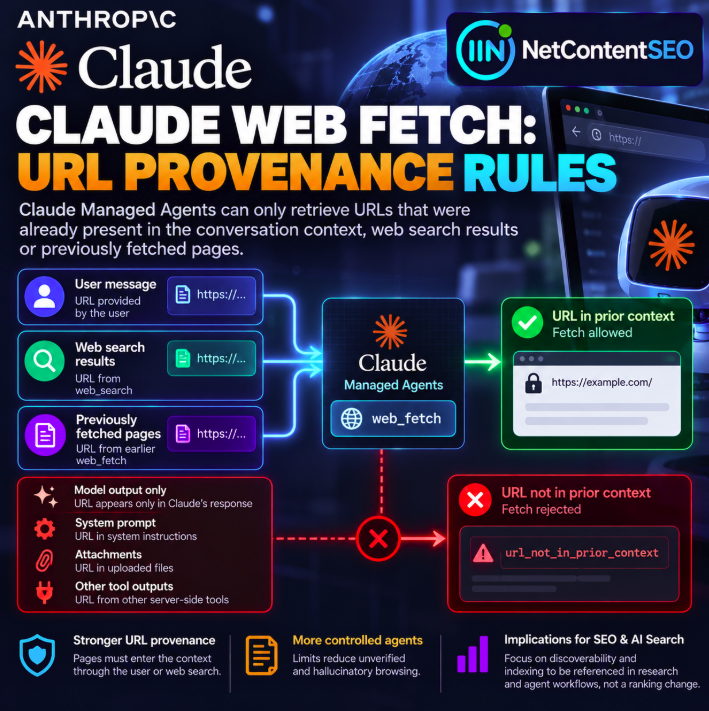

October 7, 2026 — Anthropic updated Claude Managed Agents so its web_fetch tool can retrieve only URLs already introduced through approved session context. The change is designed to reduce data-exfiltration risks by preventing an agent from freely following arbitrary addresses that appear only in model-generated text or certain tool outputs.
The rule has a potentially important implication for AI-assisted research: where an URL enters an agent's context now matters. But it does not establish a new Google ranking factor, nor does it prove that Claude or other AI Search products can cite only pages that pass this particular Managed Agents restriction.
What changed on October 7?
Anthropic's official release notes say Managed Agents web_fetch can now fetch URLs previously present in the session, including those supplied in a user message, returned by web_search or found in an earlier web_fetch response. A URL appearing only in Claude's own response, the system prompt, an attachment, or outputs from server-side tools such as bash, read or MCP tools is not sufficient.
When an attempted URL lacks qualifying prior context, the tool returns url_not_in_prior_context to the agent.
Allowed and rejected URL sources
| Where the URL appeared | Managed Agents web_fetch |
|---|---|
| User message text | Allowed as prior context |
web_search result | Allowed as prior context |
| Previously fetched page | Allowed as prior context |
| Claude's generated response only | Not sufficient |
| System prompt only | Not sufficient |
| Attached document only | Not sufficient |
Server-side bash, read or MCP output only | Not sufficient |
Being present in an allowed source is a necessary condition for these Managed Agents fetches, not a guarantee of access. Domain restrictions, networking configuration, unsupported formats and other access controls can still prevent retrieval.
Why Anthropic introduced URL provenance controls
An AI agent that can access sensitive information and arbitrary network destinations creates an exfiltration risk: malicious content might induce it to send data to an attacker-controlled URL. Requiring a qualifying URL source makes certain prompt-injection paths harder, because a model cannot simply invent a destination in its own output and then fetch it. The restriction is one defense layer, not complete protection against malicious URLs already present in user input or search results.
Separate but related: allowed_hosts and limited networking
The same release notes also describe additional controls for Managed Agents running in cloud environments with limited networking. In those environments, allowed_hosts now applies to web_search and web_fetch. A fetch to an unapproved host returns url_not_allowed, while search omits disallowed hosts. This is a distinct restriction from url_not_in_prior_context: one checks the host policy; the other checks whether the URL has a valid provenance.
What this means for SEO and GEO
For researchers building agents that audit web sources, the update underscores the operational value of discoverable, verifiable URLs. A page surfaced by an approved search result can become eligible for retrieval in that agent session, whereas a URL invented in a model answer cannot. This can make search results an important entry point for research workflows.
However, it would be misleading to say that Anthropic has introduced a universal 'citation eligibility' rule. The documented change applies to a particular fetch tool and environment. Whether an AI product cites a page depends on its own retrieval and attribution architecture, which may differ from Managed Agents.
Practical implications for AI Search monitoring tools
- Log URL provenance: store whether a target was supplied by a user, found in search or discovered on a fetched page.
- Handle distinct errors: treat
url_not_in_prior_contextseparately fromurl_not_allowed, HTTP failures and blocked content. - Design explicit discovery steps: use approved search or user input before requesting a new URL.
- Do not trust generated links automatically: validate domains and content before relying on them as evidence.
- Review network allowlists: ensure needed research domains are permitted in limited-network environments.
- Distinguish retrieval from citation: a successfully fetched page is not necessarily cited, ranked or used in the final answer.
Does this affect indexing or rankings?
No indexing or ranking changes were announced. This is an Anthropic agent-tool security update, not a change to Google Search, Bing, Claude's entire product family or other AI search engines. The SEO implication is a workflow-level insight: source discovery and traceability are increasingly important for trustworthy agentic research.
NetContentSEO analysis: provenance becomes a technical requirement
AI visibility research has long focused on which domains appear in generated answers. Anthropic's update highlights an earlier stage in the process: how a URL becomes eligible for a tool to inspect it. For teams building their own GEO monitors, recording that provenance can improve reproducibility and make failures easier to diagnose. It is a strong argument for auditable discovery pipelines, not evidence that links alone determine AI citations.
Official sources
Claude Platform release notes — October 7, 2026. Claude web fetch documentation. Managed Agents web tool restrictions.