

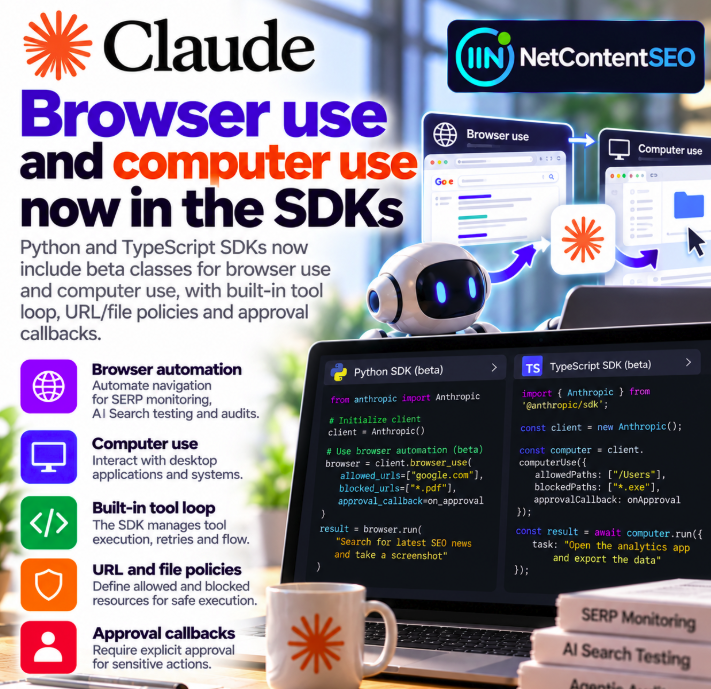

October 7, 2026 — Anthropic has documented beta browser-use and computer-use classes for its Python and TypeScript SDKs. The update brings higher-level components for agents that interact with web pages and computer interfaces, including handling tool-execution loops, setting policies for URLs and files, and requesting explicit approval through callbacks.
For teams building SEO and AI visibility tooling, the announcement suggests a more structured way to implement supervised browser workflows. The features are in beta, and they should not be treated as a guarantee of unrestricted web access or production-ready automation for every environment.
What has been added to the SDKs?
According to the Claude Platform release notes, both Python and TypeScript SDKs now include beta classes for browser use and computer use. Browser use focuses on web interaction, while computer use covers broader interactions with graphical applications or desktop environments. The SDK-level abstractions are intended to reduce the amount of custom orchestration developers must write.
Tool loops: managing multi-step actions
Agentic browser tasks involve repeated cycles: the model requests an action, a tool executes it, and the result is returned to the model for the next step. The SDK's tool-loop support helps manage that cycle. Developers must still implement appropriate monitoring, error handling and task boundaries, especially when workflows touch external websites or business systems.
URL and file policies
Explicit policies for URLs and files help define which resources an agent may access. Such controls are particularly important when a task involves internal files, third-party sites or sensitive business information. Teams should prefer narrow allowlists and least-privilege access over broad, open-ended permissions.
Approval callbacks and human oversight
Approval callbacks provide a way to require human confirmation before selected actions proceed. For example, a workflow might permit reading a public page but require approval before downloading an unknown file, submitting a form or modifying local content. Exact approval behavior and available policy settings should be implemented according to the current SDK documentation.
Potential uses in SEO and GEO research
- SERP monitoring: navigate approved search interfaces and capture observable changes for manual or automated review, subject to provider terms and access rules.
- AI Search interface testing: repeat controlled queries and document visible answer or citation differences over time.
- Technical audits: inspect website behavior and browser-rendered content where traditional HTTP-only checks are insufficient.
- Editorial quality assurance: test content-management interfaces and review pages before publication.
- Agentic workflow testing: verify that automation requests approval at the intended checkpoints.
Browser automation is not a search API
A browser agent interacts with the interface presented to it. It does not inherently provide authoritative ranking datasets, full indexing coverage or unrestricted access to search providers' backend systems. Automated measurements may also vary by personalization, location, session state and product experiments. Researchers should record their test environment and comply with applicable website policies.
Implementation and safety checklist
- Review the release notes and beta SDK documentation for the correct classes and method signatures.
- Start in a test environment with non-sensitive data.
- Restrict URL access and file paths to approved resources.
- Require human approval for consequential or irreversible actions.
- Log tool calls, decisions, failures and user approvals.
- Set time, cost and action limits to prevent runaway loops.
- Validate repeatability before using results in SEO or GEO reporting.
NetContentSEO analysis: governed agents for visibility research
The significance is not simply that AI agents can click through a browser. It is that developers can build those interactions into SDK-based workflows with clearer boundaries, execution handling and human oversight. For SEO and GEO teams, that could make controlled UI tests and technical audits easier to reproduce, while leaving accuracy, compliance and measurement methodology firmly in the developer's hands.
Official source
Claude Platform Docs — Release notes (October 7, 2026).