

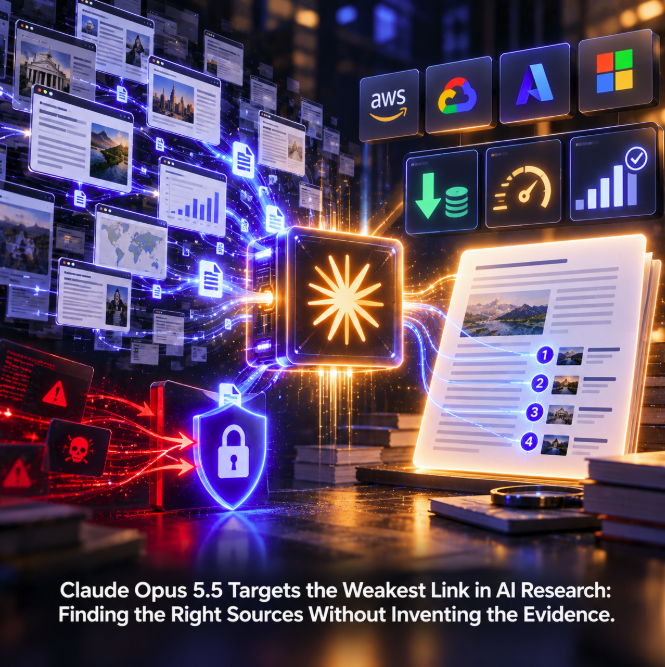

Anthropic is positioning Claude Opus 5.5 around a problem that becomes more important as AI systems perform longer, more autonomous research: finding the right evidence and preserving the connection between a generated claim and the source that actually supports it. The company’s newest Opus model launched on September 22 with claimed improvements in web research, citation retrieval, cost efficiency and resistance to prompt injection during tool-assisted work.
In its official launch announcement, Anthropic says Opus 5.5 costs 40% less to run than Opus 5 on typical workloads at default settings and generates output more than 30% faster. The model is available through the Claude Platform and across major cloud providers including Amazon Web Services, Google Cloud and Microsoft Azure. Anthropic’s official release notes document the broader Claude product rollout.
The most interesting claims for publishers, analysts and AI-search teams are not the headline benchmark scores. They concern research reliability. Anthropic says Opus 5.5 performed dramatically better than earlier Claude models in an internal test designed to punish invented numbers and quotations, while early-access partner Hebbia reported its highest citation-recall result to date. Those are vendor and partner evaluations rather than independent validation, but they point directly at one of the hardest unresolved problems in AI research systems: retrieval can fail even when the final prose sounds completely convincing.
Anthropic tested whether the model could find hard-to-locate evidence
Anthropic describes an internal research test in which Opus 5.5, Fable 5.1 and Opus 5 were asked to produce a report on a company’s quarterly performance using a copy of the web where the relevant earnings release was deliberately difficult to locate. An automated grader then checked every figure and quotation against the underlying sources.
The quality bar was strict: according to Anthropic, any invented figure or quote caused the report to fail. Across different effort settings, 16 of 18 reports produced by Opus 5.5 passed. Anthropic says neither Fable 5.1 nor Opus 5 passed in any attempt.
That result should be interpreted carefully. It is an internal evaluation created and reported by the model vendor, not an independent benchmark establishing that Opus 5.5 will achieve the same reliability across the open web. The test nevertheless targets a useful failure mode. A research agent does not merely need to generate plausible prose; it needs to locate the relevant primary evidence, extract the correct details and keep those details attached to verifiable sources.
Citation recall is becoming a model capability of its own
Hebbia, an AI platform used for research-heavy professional workflows, provides another data point in Anthropic’s launch materials. The company says Opus 5.5 covered 86.6% of the elements in its expert-graded end-to-end finance workflows, compared with 60.3% for Opus 5. More relevant to research retrieval, Hebbia says the new model achieved the best citation recall it has recorded while using tokens more efficiently than Opus 5.
Again, this is a partner-reported evaluation rather than an independently reproduced result. But the metric matters because citation quality has several dimensions that are often collapsed into one number. An AI system can cite real webpages while missing the most relevant sources. It can retrieve the correct document but attach it to the wrong statement. It can provide a source list that looks credible without grounding every important factual claim.
NetContentSEO recently covered a clinical-research comparison showing how dramatically retrieval can vary between AI assistants: different systems retrieved very different shares of expert-selected studies. That kind of result illustrates why citation recall deserves separate attention from whether an answer contains citations at all.
A citation can be real and still fail to support the answer
The broader AI-search ecosystem has already demonstrated that the presence of citations is not a sufficient quality guarantee. A model may cite a legitimate page that only partially supports the adjacent claim, select secondary coverage when a primary source exists, or retrieve a source that contains the right topic but not the specific evidence needed.
There is also a difference between citation selection and citation influence. NetContentSEO recently examined research arguing that a source can appear in an AI answer without substantially shaping what the answer says. That distinction is useful here: better citation recall helps the system find relevant evidence, but research quality still depends on whether the generated claims accurately absorb and represent that evidence.
Anthropic’s internal evaluation tries to address part of this problem by checking figures and quotations against sources rather than simply rewarding the model for producing links. If that behavior generalizes, it could make Opus 5.5 more useful for workflows where an analyst must be able to audit the factual chain behind a report.
The economics of research agents matter almost as much as accuracy
Anthropic is also emphasizing efficiency. At default settings, the company says typical workloads cost 40% less with Opus 5.5 than with Opus 5. Input tokens are priced at $4 per million and output tokens at $20 per million, both 20% below Opus 5, while cache reads fall from $0.50 to $0.20 per million tokens. Anthropic says the new model also uses fewer tokens per task, which contributes to the claimed reduction in total task cost.
Output generation is more than 30% faster, according to Anthropic. A separate fast mode is available in Claude Code and the Claude Platform with up to 2.5 times the speed, at higher per-token pricing.
These improvements are especially relevant to web research because research agents can be expensive in ways that ordinary chat is not. A single assignment may require many searches, page fetches, tool calls, long context windows and repeated verification passes. Lower token use and faster generation can therefore change whether an organization can afford to run a deep research workflow occasionally or continuously.
Prompt injection is a research-integrity problem, not only a security problem
Anthropic also says Opus 5.5 is more resistant to prompt injection than Opus 5. The company reports that the model matches or beats its predecessor in every tested setting, including coding, tool use, computer use and web browsing. In an evaluation run by AI security company Gray Swan, Anthropic says Opus 5.5 tied Fable 5.1 for the lowest prompt-injection success rate among the tested models.
That matters directly to research quality. An agent browsing the web does not encounter only trustworthy documents. It can encounter pages containing hidden or visible instructions designed to manipulate an AI system, redirect its behavior, extract data or make it privilege particular sources. A research agent that follows hostile instructions embedded in retrieved content can compromise both security and the integrity of the final report.
Anthropic says Opus 5.5 also includes a classifier that screens actions before execution and an auditable open-source sandbox as part of its agent-security architecture. These protections do not make web research risk-free; Anthropic itself acknowledges limits in its safety evaluations. They do indicate that source retrieval and tool use are increasingly being treated as security boundaries rather than neutral extensions of text generation.
Research reliability cannot be reduced to hallucination rates
The usual discussion of AI research quality focuses on hallucination: did the model invent a fact? That remains important, but retrieval creates a wider set of failure modes. The model can fail to find a crucial document, retrieve an outdated version, overlook contradictory evidence, quote a real source incorrectly or select a low-quality derivative page when authoritative material is available.
Source provenance can also become recursive. A separate audit covered by NetContentSEO found that generative search systems sometimes cited sources classified as AI-generated. A perfectly accurate quotation from a synthetic source can still create a weak evidence chain if the underlying source itself is unreliable.
For professional research, the useful standard is therefore stronger than “the model did not hallucinate.” A good system should retrieve the right evidence, prefer authoritative sources where appropriate, represent them faithfully, expose enough provenance for checking and recognize when the available evidence is insufficient to support a confident conclusion.
Availability across the major clouds makes the upgrade operational
Opus 5.5 is available through Anthropic’s Claude Platform under the model identifier claude-opus-5-5. Anthropic also says the model is available across Amazon Web Services, Google Cloud and Microsoft Azure, giving enterprise teams multiple deployment routes depending on their existing cloud and compliance architecture.
The broad availability matters because research agents are rarely standalone chatbots in enterprise environments. They are increasingly embedded in document systems, coding environments, legal platforms, financial-analysis tools and internal knowledge workflows. Anthropic’s launch page includes early-access feedback from companies including LexisNexis Legal & Professional, Thomson Reuters Labs, Hebbia, Hex and Walleye Capital, although those testimonials should be read as partner-reported experience rather than neutral comparative testing.
For developers, the combination of lower cost, faster generation and stronger retrieval claims could make it practical to add more verification steps rather than simply producing answers faster. If a research task becomes cheaper, teams can spend part of that efficiency gain on cross-checking, source validation and repeated retrieval instead of treating raw response speed as the only objective.
The real test is whether citation gains survive outside Anthropic’s evaluations
Anthropic’s launch case for Opus 5.5 is unusually relevant to AI research because it focuses on the full chain between retrieval and evidence. The internal 16-of-18 result suggests a large improvement under one controlled setup, and Hebbia’s citation-recall claim points in the same direction from an early-access partner. Neither establishes how the model will behave across journalism, law, science, market research or arbitrary open-web questions.
Independent testing will need to examine more than headline accuracy. It should measure whether Opus 5.5 retrieves expert-relevant sources, whether citations support the claims they accompany, how often primary sources are preferred, how the model handles conflicting evidence and whether prompt-injection resistance holds on hostile real-world pages.
That is the larger significance of this release. Frontier models are increasingly good at producing polished research reports. The harder problem is making sure the polished report is built from the right evidence and remains auditable after an agent has searched dozens or hundreds of sources on its own.
Claude Opus 5.5 is Anthropic’s latest attempt to strengthen that evidence layer. The company’s numbers are promising, but they are still claims from Anthropic and its partners. If independent evaluations confirm the same pattern, the most important upgrade may not be that the model writes a better research report. It may be that researchers spend less time discovering that the impressive-looking evidence underneath it was incomplete, misplaced or invented.