

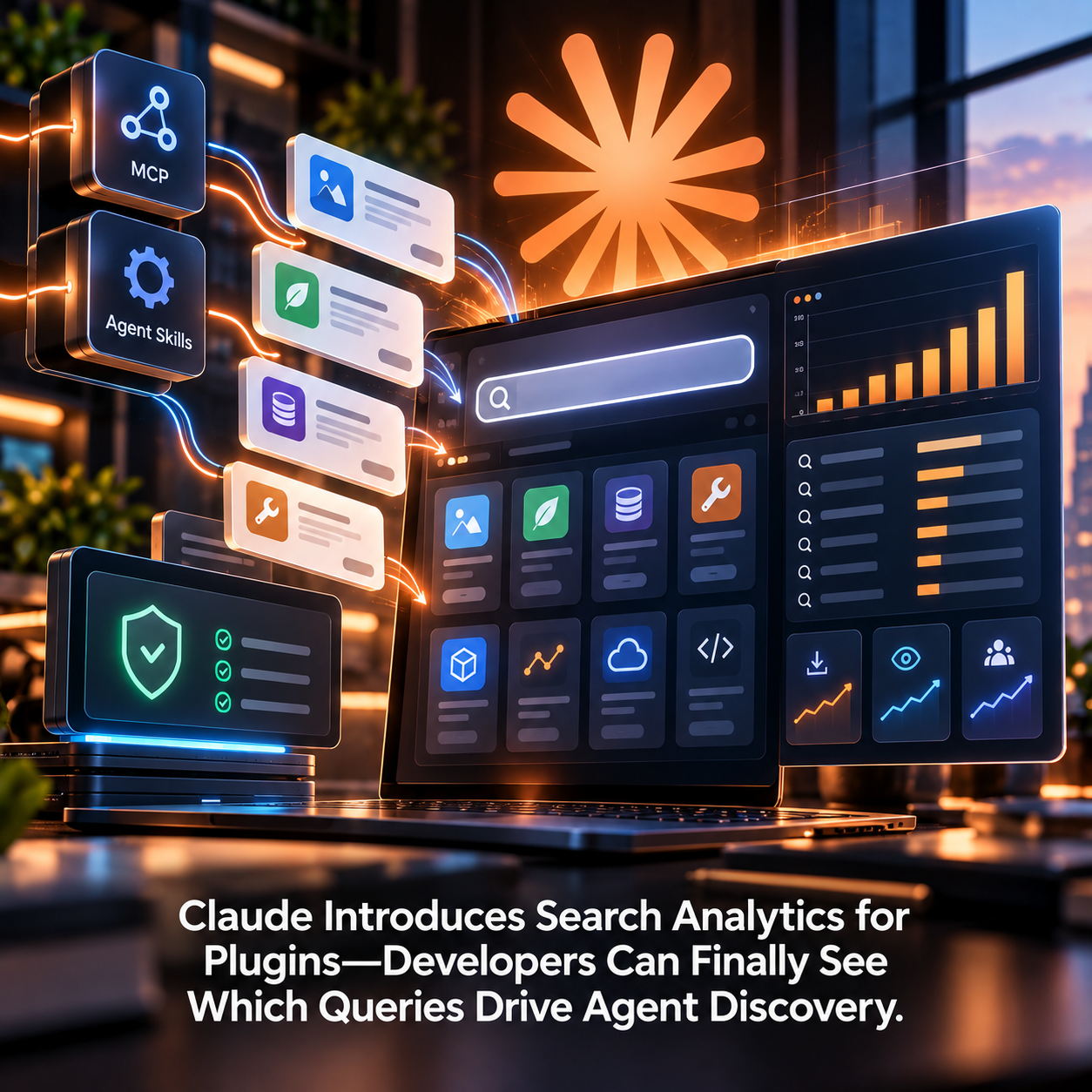

Anthropic has given developers something that looks increasingly like search analytics for the agent ecosystem. With a new Claude directory submission portal launched on September 25, plugin creators can publish extensions, follow them through review and security scanning, and—once a plugin is live—see not only installations and listing views but which searches led users to discover it.
That final metric is the strategically important one. In its official announcement, Anthropic says developers will be able to see how often their plugin listing is viewed and the searches that lead people to it, explicitly positioning the data as a way to refine a listing and reach new users. For developers building on Claude, discovery is therefore becoming measurable at the query level rather than remaining a black box.
Claude plugins now have a submission and analytics pipeline
The new portal is available to developers on paid Claude plans. Anthropic offers two submission paths: developers can point Claude to a single remote MCP server, or submit a plugin bundle that combines MCP servers and Agent Skills through a GitHub repository. Within Claude Code, plugin packages can also include components such as LSPs, commands, hooks and agents.
Submissions are automatically validated and safety-scanned, giving developers an opportunity to identify problems before publication. The portal then exposes review status, safety-scan results, feedback and recommended changes. Approval does not force immediate publication: Anthropic says developers decide when to make an approved plugin live in the Claude directory.
Once published, the workflow changes from compliance to measurement. Usage analytics break out installations by product surface and version, while discovery analytics expose listing views and the searches that brought users to the plugin. Together, those metrics connect three stages that extension developers have often had to infer separately: whether a plugin can be published, whether users can find it and whether they actually install it.
Query data creates an optimization loop for agent discovery
Search-query visibility introduces a familiar optimization problem into a new environment. If developers can see which searches lead to their plugin, they can compare the language users employ with the language used in the plugin’s listing. A plugin described primarily in technical implementation terms may discover that users search by job-to-be-done instead; another may find that a use case it treated as secondary is actually a major discovery path.
This is not conventional web SEO. Anthropic has not published a ranking formula for the Claude directory, nor does query reporting establish that keywords can be manipulated into guaranteed visibility. But it does create a feedback loop recognizable from search marketing: observe demand, understand the queries associated with discovery, improve how the product is described, then measure whether visibility and installs change.
The difference is what the user is trying to discover. In a traditional search engine, the destination might be a webpage, product or local business. Inside Claude, the destination can be a capability that changes what the agent is able to do. Discovery is therefore moving from finding information toward finding executable functionality.
MCP and Agent Skills become discoverable products
Anthropic describes plugins as the primary way third-party developers build extensions for Claude. A plugin can package MCP connectors, Agent Skills or both. That packaging matters because MCP provides access to external systems and data, while skills can encode repeatable procedures and domain-specific workflows. The directory gives those building blocks a consumer-facing discovery layer.
For developers, this means technical quality alone may not determine adoption. A capable MCP server that users cannot find has a distribution problem; a well-described plugin that attracts listing views but few installations may have a conversion or trust problem. The new analytics begin separating those stages. Search terms indicate discovery demand, listing views indicate exposure, and installations provide a downstream adoption signal.
This resembles the evolution of app stores and search marketplaces, but the agent context creates a distinctive layer. Users may search for an outcome—working with a CRM, querying a database, automating a workflow or accessing specialized knowledge—without knowing which protocol, connector or skill supplies it. Plugin publishers therefore need to describe capabilities in the language of user intent, not only in the language of their implementation.
Claude Code will join the same discovery experience
Anthropic says a unified discovery experience will roll out across Claude and Claude Code over the coming weeks. Existing skills and MCP connectors remain building blocks, and the Claude directory will continue listing them. Developers with an existing skill, connector or plugin in the directory do not need to make changes, while existing connector listings will eventually be convertible into plugins.
This is particularly relevant for developer tools because Claude Code has historically been a distinct environment with its own extension patterns. A shared discovery layer means a plugin can increasingly be understood as part of a broader Claude ecosystem rather than as something users need to locate separately for each product surface. Installation analytics segmented by surface should then help developers understand where actual adoption occurs.
Security review becomes part of distribution
The submission portal also formalizes an issue that becomes more important as agents gain access to external services. Anthropic automatically validates and safety-scans submissions and exposes the results to developers during review. Plugins can connect Claude to data and tools, so directory distribution requires a stronger trust layer than simply indexing a public webpage.
This creates another dimension of agent discovery optimization: eligibility. Before a plugin can compete for search visibility and installations, it must satisfy the platform’s publication and safety requirements. Developers therefore face a pipeline in which technical packaging, security, listing quality, discoverability and adoption are increasingly connected inside one system.
Search analytics are spreading beyond websites
The broader significance is that search analytics are appearing inside AI ecosystems themselves. For decades, publishers optimized pages around queries entered into search engines. As assistants become platforms for tools and agents, developers now face a parallel question: what does a user ask when they are looking for a capability rather than a document?
Anthropic’s portal provides unusually direct evidence because it does not stop at aggregate plugin traffic. The company specifically says publishers can see which searches led people to their listing. That turns query demand into product intelligence. Developers can use it to identify terminology, unmet use cases and potentially new functionality, while still needing to avoid assuming that correlation with a query reveals Claude’s underlying ranking logic.
The same dynamic is likely to matter as AI assistants accumulate larger catalogs of connectors, agents, skills and applications. A marketplace with thousands of capabilities creates its own discovery problem. Once that happens, listing quality, relevance, trust and measurable search demand become strategic concerns even though no conventional web SERP is involved.
Agent discovery is becoming an optimization discipline
Claude’s new portal is therefore more than a publishing interface. It establishes the beginnings of a measurable distribution funnel for agent capabilities: submit a plugin, pass review, publish it, appear in discovery, understand the searches that generated visibility and track whether that visibility converts into installations.
For developers, the important shift is that they no longer have to guess entirely at how users describe the problems their plugins solve. Search-query analytics provide direct evidence from inside Claude’s own discovery environment. As the unified experience expands into Claude Code, that data could become the foundation of a new optimization discipline—one concerned not with ranking webpages for humans to read, but with making tools and capabilities discoverable to people working through AI agents.