

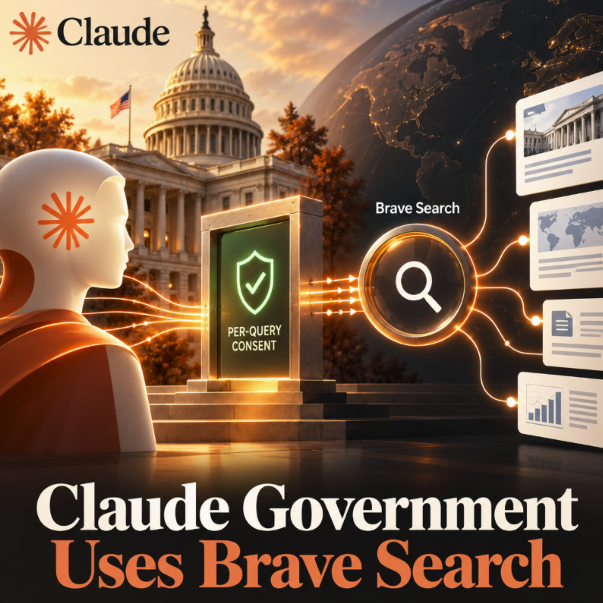

Anthropic’s Government search documentation identifies Brave Search as the external provider behind its Web Search MCP connector. It also describes a mandatory approval step and a reformulated query. For SEO and generative engine optimization, the significance is the separation between the assistant, its retrieval provider and the information that ultimately reaches an answer.
What Anthropic documents
The official MCP: Web Search guide says native web search is disabled in Claude for Government and replaced by an MCP connector. The connector operates inside the FedRAMP High boundary but calls the Brave Search API outside it.
Claude reformulates the request into a generic, de-identified query and displays its exact text. Every search requires fresh approval; blanket consent is unavailable. Only the query string goes to Brave, without conversation history, user or organization identity, or attachments. Anthropic says Brave does not persistently store the queries or responses.
The page also states that organizations will move to the updated Government Desktop offering by October 4, 2026 and directs migrated agencies to current administrator documentation. The October 2 observation time is not an established launch date. These details concern Government; they should not be generalized to every Claude product.
The provider is one layer in discovery
Our editorial interpretation is that knowing the retrieval provider makes the discovery pathway more concrete. The user’s question, the outgoing search query, the returned results and the assistant’s final explanation are different stages. A brand can be relevant to one stage without necessarily appearing in the final answer.
The documentation does not specify a complete citation-selection algorithm or establish a guaranteed way for publishers to be selected. A provider result is evidence of retrieval visibility, while a source link in an answer is evidence of presentation. Neither automatically demonstrates a referred visit.
Query reformulation changes what should be measured
A research request may contain organizational context that is removed or generalized before search. Teams studying visibility should therefore avoid assuming that the user’s original words are the exact query sent to the provider.
Where an authorized evaluation exposes both, record them separately along with the returned evidence. A result difference may reflect the query wording rather than a change in the publisher’s underlying visibility. This is a measurement recommendation, not proof that reformulation systematically helps or harms particular brands.
Consent affects whether retrieval happens
The approval step means an available search capability does not imply that a search ran. A declined query can leave an answer without the external evidence that an approved query might have provided. That distinction is useful when reviewing why a response contains particular information.
For GEO analysis, separate sessions where retrieval occurred from those where it did not. Otherwise, a missing citation could be misread as a source-selection failure when the search was never authorized.
Public information must stand on its own
Our recommendation for publishers is to make important claims clear enough to understand without a user’s private organizational context. Explain product capabilities, scope and supporting evidence on the page itself. That can make material more useful to human and automated research alike, without promising inclusion.
For teams using Government search, source links are a starting point for verification. Check whether the cited material actually supports the claim and whether its date and scope fit the research question. A confident summary does not eliminate that editorial work.
A documented stack, not a universal ranking rule
The official guide reveals a specific architecture: a Government assistant, an MCP search connector, Brave retrieval and mandatory consent. It offers a useful example of why “visibility in Claude” needs product and workflow context. Search-provider exposure, query formulation and final citations should be evaluated separately before drawing conclusions about brand discovery.