

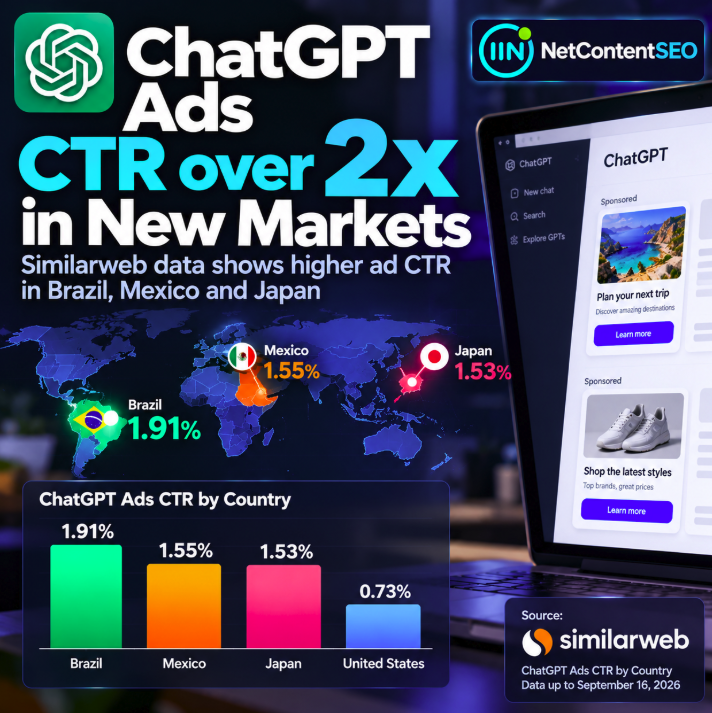

ChatGPT advertising is showing substantially higher observed click-through rates in several newer markets than in the United States, according to an analysis published October 8, 2026 by Similarweb and Graphite. The reported aggregated CTR reaches 1.91% in Brazil, 1.55% in Mexico and 1.53% in Japan, compared with 0.73% in the US.
The finding is striking, but it needs context. The figures are observational aggregates based on data through September 16, 2026. Newer markets have shorter measurement histories, and a higher CTR does not by itself establish better conversion rates, lower acquisition costs, more advertising reach or a lasting advantage.
Source: Similarweb — ChatGPT Ads CTR by Country. This article summarizes the figures in the supplied research brief; the source page could not be independently retrieved during preparation, so editorial verification against the live report is recommended before publication.
ChatGPT ads CTR by country: the reported figures
| Market | Observed ad CTR | Relative to US |
|---|---|---|
| Brazil | 1.91% | About 2.62× |
| Mexico | 1.55% | About 2.12× |
| Japan | 1.53% | About 2.10× |
| United States | 0.73% | Baseline |
Calculations: relative multiples compare each country's reported CTR with 0.73% in the United States. Rounding can affect the last decimal. Data are aggregated through September 16, 2026, according to the research summary.
Brazil's 1.91% is more than two and a half times the reported US rate. Mexico and Japan also exceed twice the US benchmark. These differences are descriptive comparisons, not causal estimates of market effectiveness.
What CTR measures—and what it does not
Click-through rate is the proportion of ad impressions that result in clicks: CTR = clicks ÷ impressions × 100. For example, a 1.91% CTR corresponds to approximately 19.1 clicks per 1,000 impressions, while 0.73% corresponds to about 7.3 clicks per 1,000 impressions, assuming the same measurement definition.
CTR is useful for understanding engagement with served ads, but it says nothing on its own about how many people actually saw the ads in each country, how many converted, or how much advertisers paid. A market with a higher CTR and much smaller inventory can generate fewer total clicks than a lower-CTR market with far greater reach.
Why newer markets might show higher CTR
Several explanations are plausible, but the reported percentages alone do not identify which ones are responsible.
1. Different advertiser and campaign mixes
If early campaigns in a newly launched market concentrate on a narrower group of products, categories or highly relevant offers, the aggregate CTR may differ from that of a more mature advertising market. Without comparable campaign-level data, this remains a hypothesis.
2. Different placement exposure and user behavior
Users may encounter advertising in different conversational contexts or interact with sponsored units differently across markets. Device mix, placement, user intent and creative language can influence engagement. The country-level aggregates supplied here do not isolate these factors.
3. Shorter measurement histories
This is the most important caution highlighted in the brief: newer markets have shorter histories. Early observations may be affected by launch timing, limited advertiser participation and changing inventory. The data do not yet establish that the apparent CTR advantage is stable over time.
4. Reach and scale can tell a different story
A CTR comparison should be paired with reach, total impressions, click volume and campaign eligibility. A mature market may have a lower percentage but still provide greater absolute opportunity. The supplied brief does not provide comparable reach figures, so no country-level reach ranking is claimed here.
Brazil leads the observed comparison at 1.91%
Brazil's reported CTR of 1.91% is the highest of the four markets highlighted. Compared with the US figure of 0.73%, the gap is 1.18 percentage points. That is a meaningful descriptive difference, but it should not be interpreted as evidence that Brazilian users are inherently more receptive to AI advertising or that every advertiser will achieve the same result.
Campaign mix, sample size, ad relevance and measurement window all matter. Marketers considering Brazil should evaluate actual available inventory and their own conversion performance rather than extrapolating directly from a country aggregate.
Mexico and Japan also exceed twice the US benchmark
Mexico's 1.55% CTR is 0.82 percentage points above the US figure, while Japan's 1.53% is 0.80 percentage points higher. The two reported values are close, and no statistical significance or confidence interval is provided in the supplied summary. It would be inappropriate to conclude that Mexico definitively outperforms Japan from this small difference alone.
Why the United States' 0.73% is not necessarily a weak result
The US is the comparison baseline in this report, but lower CTR does not automatically mean poor campaign quality. A broader or more mature inventory mix may include more awareness-oriented campaigns, different user intents and more varied advertisers. Without conversion rates, costs, reach and campaign composition, the business value of each market cannot be determined.
How advertisers should interpret these early benchmarks
- Separate CTR from conversions. Measure leads, sales or other outcomes rather than optimizing for clicks alone.
- Inspect reach and inventory. Understand available impressions, campaign eligibility and audience scale in each market.
- Compare equivalent campaigns. Avoid treating different creative formats, languages and objectives as directly interchangeable.
- Use consistent date windows. Newer markets may have a much shorter history than the US.
- Watch trends rather than snapshots. Reassess whether CTR differences persist as markets mature.
- Validate tracking. Ensure attribution and landing-page measurement are configured consistently across countries.
What does this mean for SEO, GEO and AI visibility?
The findings matter to search and AI visibility professionals because they show how paid discovery inside a conversational environment can differ from familiar search advertising benchmarks. But paid ad CTR is not the same as organic AI citation frequency, brand mentions or referral traffic from unpaid answers.
A higher ChatGPT ad CTR in a country does not demonstrate that publishers in that country receive more organic citations, that ranking algorithms have changed or that advertising improves inclusion in unpaid AI answers. Those are separate questions requiring different datasets.
For teams working across paid and organic channels, the practical recommendation is to report the two separately: advertising impressions, clicks and conversions on one side; organic AI visibility, attributable referrals and citations on the other. Combining them into one 'AI visibility' score can obscure important differences.
Limitations of the Similarweb–Graphite comparison
Based on the supplied research summary, the most important limitations are:
- The figures are observational, not the result of a controlled experiment.
- The data are aggregated only through September 16, 2026, despite the October 8 publication date.
- Newer markets have shorter observation periods, complicating direct comparisons.
- Country-level CTR does not establish advertiser ROI or conversion quality.
- The supplied summary does not specify comparable reach, sample sizes, confidence intervals or all segmentation details.
These constraints do not make the findings unimportant; they define what the numbers can responsibly support.
FAQ
Which country has the highest reported ChatGPT ads CTR?
Among the four markets highlighted in the supplied Similarweb–Graphite analysis, Brazil leads at 1.91%.
What is the reported ChatGPT ads CTR in the US?
0.73% in the supplied comparison.
Are ChatGPT ads performing more than twice as well in Brazil, Mexico and Japan?
They show more than twice the US click-through rate in the reported aggregate. That does not prove more than twice the conversions, profitability or overall performance.
What date do the figures cover?
The supplied research summary says the aggregated data run through September 16, 2026.
Does higher CTR mean more ad reach?
No. CTR is a ratio, while reach and impressions describe scale. A higher ratio can coexist with lower total volume.
Does this change organic ChatGPT visibility or citations?
No such effect is established by this advertising CTR study.
NetContentSEO analysis: the rate is not the whole story
ChatGPT ads CTR reaching 1.91% in Brazil is a noteworthy early market signal, not a final verdict on international advertising efficiency. Mexico and Japan also show CTRs more than twice the reported US level, but the shorter history of newer markets makes durability an open question. For advertisers and AI visibility analysts, the next data points to demand are reach, impression volume, conversions, campaign mix and trends over time. Until then, higher engagement should be described precisely as higher observed CTR—not as proof of superior business outcomes.
Research source: Similarweb — ChatGPT Ads CTR by Country (Similarweb and Graphite; published October 8, 2026, according to the supplied brief).