

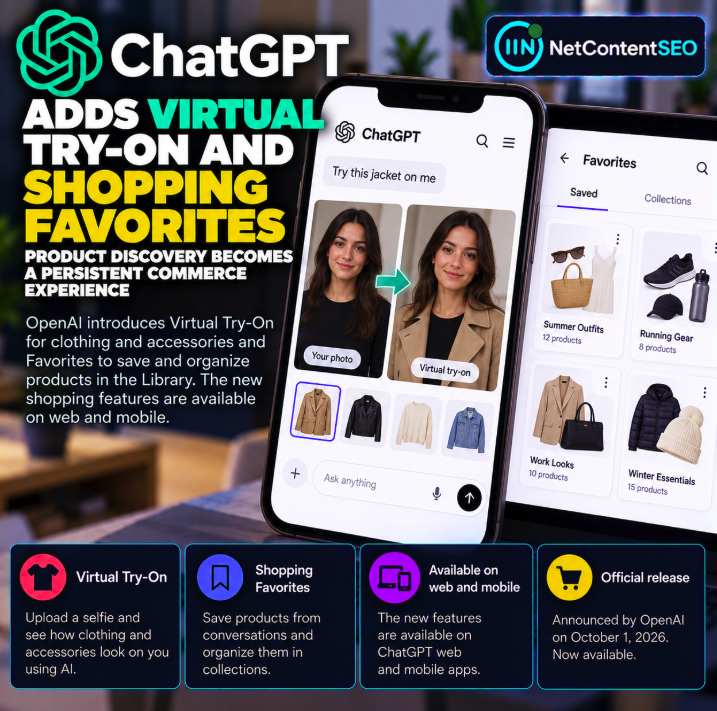

OpenAI introduced two shopping features in ChatGPT on October 1, 2026: Virtual Try-On for eligible apparel and accessories, and Favorites for saving and organizing products discovered during conversations. The capabilities are described in ChatGPT's official release notes and are available through supported web and mobile experiences.
Together, the updates illustrate a broader product direction: shopping in an AI assistant can extend beyond receiving a one-time recommendation. Users may be able to visualize how an eligible item looks on them, keep track of products that interest them and return to organized collections later.
Primary source: OpenAI — ChatGPT Release Notes, October 1, 2026.
What OpenAI announced
The release notes describe two distinct additions to ChatGPT's shopping experience. Virtual Try-On lets users upload a selfie and see an AI-generated simulation of themselves wearing eligible clothing or accessories. Favorites lets users save products encountered in conversations and organize them into folders in the Library.
These are consumer shopping tools, not an announced change to the ranking of products in ChatGPT's recommendations or a new guaranteed sales channel for retailers.
Virtual Try-On: from product image to personal visualization
Online apparel shopping has a familiar limitation: a product photograph shows how an item looks on a model or in a studio, not necessarily how it might appear on a particular shopper. Virtual Try-On is designed to provide a personalized visual preview using a selfie.
For eligible products, users can upload an image and request a simulation of the item being worn. The resulting picture is an AI-generated visualization rather than a physical fitting session. It should not be treated as proof of exact sizing, material behavior, garment dimensions or real-world appearance.
What a virtual try-on can and cannot establish
| Capability | Important limitation |
|---|---|
| Visualize eligible clothing or accessories on a user image | The result is a simulation, not a verified photograph of the actual fit |
| Explore how a product may look with an outfit | Colors, texture and proportions may not perfectly match the physical product |
| Support shopping consideration within ChatGPT | It does not replace accurate size charts, return policies or merchant information |
The availability of Virtual Try-On depends on product eligibility and supported experiences. The October announcement should not be interpreted as universal support for every garment, accessory or merchant listing.
Favorites: product discovery no longer has to end with a conversation
Favorites addresses a different shopping problem: remembering and comparing products found during research. Rather than losing track of an interesting item after a conversation moves on, users can save it and organize products into folders in the Library.
This creates a more persistent shopping workflow. Someone researching travel clothing, home-office accessories or gifts can potentially maintain themed collections and revisit them when making a decision.
The feature should not be confused with a merchant-controlled storefront, a universal inventory reservation system or a guarantee that saved prices and availability remain unchanged.
How the two features complement each other
Virtual Try-On supports product evaluation, while Favorites supports continuity. A shopper may discover several items in a conversation, preview an eligible product and save promising options for later consideration.
That combination is strategically different from a conventional answer-only interaction. The assistant becomes a place where some shopping research can be organized over time.
What changed on October 1, 2026?
| Feature | Announced function | Availability described |
|---|---|---|
| Virtual Try-On | Selfie-based AI visualization of eligible clothing and accessories | Supported ChatGPT web and mobile experiences |
| Favorites | Save products from conversations and organize them in Library folders | ChatGPT web and mobile |
Users should consult current release notes and their own ChatGPT interface for any account-specific eligibility, regional restrictions or phased availability.
Why this matters for ecommerce SEO
Search professionals have traditionally measured product discovery through search impressions, organic clicks, product pages and purchases. AI-assisted shopping introduces additional moments in the journey: recommendation, visual evaluation, saving and later reconsideration.
For retailers, accurate product information remains important. Clear titles, relevant images, correct variants, pricing, availability and product descriptions help shoppers make informed decisions wherever they encounter a listing.
However, OpenAI's release notes do not establish that adding a particular type of structured data will guarantee Virtual Try-On eligibility, Favorites inclusion or more frequent product recommendations.
From one-off recommendations to saved consideration sets
A traditional search session often involves opening multiple tabs and bookmarking pages. Favorites suggests that at least some of this comparison process can happen inside ChatGPT's shopping environment.
For AI visibility researchers, that raises new questions: Which products are discovered, which are saved, how frequently are they revisited, and what ultimately leads to a purchase? Those are meaningful research questions, but the October announcement does not publish metrics answering them.
What merchants can reasonably do today
- Keep product details accurate. Maintain reliable names, variants, sizes, prices and availability across sales channels.
- Invest in useful imagery. Provide clear product photographs and honest descriptions of materials and fit.
- Explain sizing and returns. AI visualization cannot substitute for precise sizing guidance or a transparent return policy.
- Monitor actual AI referrals. Track traffic and sales that can be reliably attributed without assuming every recommendation produces a click.
- Watch official merchant guidance. Confirm eligibility requirements for any commerce integration instead of extrapolating from a consumer feature announcement.
- Respect user privacy. Treat selfie-based shopping as a context involving personal images and review the applicable platform privacy information.
Privacy and expectations for selfie-based shopping
Uploading a selfie involves sharing a personal image with the service. Users should review the relevant privacy and data controls before using image-based features. The announcement of Virtual Try-On alone does not establish universal retention periods or data-processing rules for every account and region.
Retailers should also avoid presenting AI-generated try-on images as precise evidence of how a physical item will fit. Accurate product measurements and real-world photography remain useful.
Do Favorites guarantee a product will remain available?
No such guarantee is established by the feature announcement. Saving a product is an organizational action; it does not necessarily reserve inventory, lock in a price or ensure a listing remains purchasable.
Shoppers should confirm current product details with the seller before buying.
Will ChatGPT now rank products differently?
No ranking change is documented by these two feature announcements. The release notes describe tools for consumers to visualize and organize products. They do not publish a new recommendation algorithm, product ranking formula or guaranteed placement mechanism for merchants.
It would be premature to claim that products compatible with Virtual Try-On will automatically receive higher visibility or that being saved in Favorites is an official ranking signal.
Could this reduce traffic to ecommerce websites?
It is possible that richer in-assistant shopping experiences could change when users visit merchant websites, but the announcement does not provide evidence of a specific traffic decline or increase.
Some users may spend more time evaluating products in ChatGPT; others may be more ready to purchase when they leave. Measuring the actual effect requires referral, conversion and behavioral data that the release notes do not supply.
FAQ
What is ChatGPT Virtual Try-On?
A feature for eligible apparel and accessories that uses an uploaded selfie to generate a visual simulation of the product being worn.
Is Virtual Try-On an accurate sizing tool?
It is a visual simulation, not a guarantee of physical fit or exact garment dimensions.
What are Shopping Favorites?
A way to save products found during ChatGPT conversations and organize them into Library folders.
Are the features available on web and mobile?
OpenAI's October 1 release notes describe availability across supported web and mobile experiences.
Can any retailer guarantee its products appear in Virtual Try-On?
The announcement does not establish universal merchant eligibility or guaranteed inclusion.
Do saved Favorites reserve inventory or prices?
No such reservation or price guarantee is documented.
Does OpenAI say these features change product recommendation rankings?
No. The release notes do not announce a new product ranking factor.
NetContentSEO analysis
Virtual Try-On and Favorites suggest that ChatGPT shopping is becoming a more persistent consideration environment rather than a sequence of isolated product answers. For ecommerce teams, the practical priorities remain accurate catalog information, trustworthy visuals and careful measurement. For AI visibility research, the next challenge is understanding how product discovery, saving, evaluation and eventual purchases connect—without confusing new interface capabilities with proven ranking or sales effects.
Primary source: OpenAI ChatGPT Release Notes, October 1, 2026.