
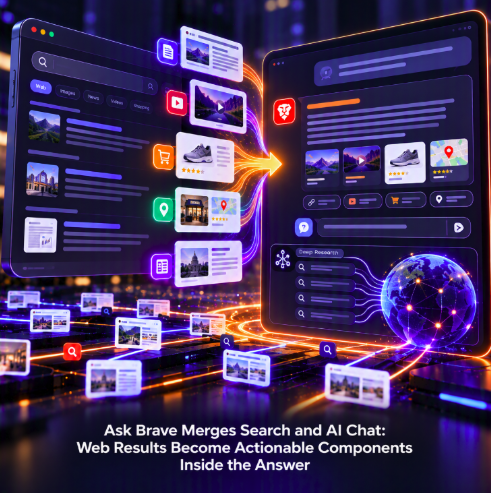
Brave is collapsing a boundary that search products have spent the past few years trying to manage: the separation between finding webpages and asking an AI to synthesize them. Ask Brave, introduced by Brave Search, places conventional search and AI chat inside one interface, allowing a user to move from a normal query into a longer conversational answer without leaving the search environment. Brave’s official Ask Brave announcement describes the product as a combination of direct web search and LLM-generated responses, with contextual elements such as webpages, videos, news, products, businesses and shopping embedded around the answer.
The feature is available from the Brave Search homepage and from an Ask tab on the search results page, and Brave says it is free and works on any browser or platform. Users can also invoke it by ending a query with two question marks when Brave Search is their default search engine, or go directly to Brave’s Ask interface.
For publishers and search marketers, the strategically important part is not simply that Brave now has an AI chatbot. Ask Brave treats web results as ingredients and interactive components inside a conversational search journey. That moves visibility beyond the familiar question of whether a page ranks in a list and toward a second question: whether Brave’s retrieval and synthesis layer selects that page as useful evidence or an actionable destination.
Ask Brave is an extension of search, not a separate chatbot
Brave already had generative answers before Ask Brave. Its first AI summarization feature arrived in March 2023 as Summarizer, and the later AI Answers product—previously called Answer with AI—was serving more than 15 million answers per day when Ask Brave was announced. Brave positions AI Answers and Ask Brave as complementary: AI Answers handles quicker summaries, while Ask Brave is designed for more extensive answers and conversational follow-ups.
This distinction matters because Ask Brave is not presented as an isolated assistant that happens to have web access. Search is the retrieval foundation. Brave says Ask Brave answers are grounded in information found on the web and that the system limits itself to search results relevant to the question.
In Brave Search chief Josep M. Pujol’s description of the product, search supplies the information and LLMs connect it into a coherent experience. That architecture makes the search index—not only the language model—a central part of the answer pipeline.
Search results are becoming components inside the answer
A conventional SERP largely separates information retrieval from user action. The engine presents links, images, maps or shopping results, and the user decides which result to open. Ask Brave tries to preserve those actionable objects while adding a conversational synthesis layer.
Brave says the system can place contextually relevant enrichments such as videos, news articles, products, businesses and shopping elements into the experience. The result is neither simply a page of links nor simply a wall of generated text. It is a composed interface in which the generated answer can sit alongside objects the user can immediately act on.
For search visibility, this changes the unit of competition. A webpage can potentially function as supporting evidence, a cited destination or part of a richer actionable module. A product can appear as something to evaluate rather than merely as a blue link. A local business can become an object inside the answer flow.
Ask Brave chooses how much answer a query needs
Brave says users can enter anything from simple navigational searches to detailed exploratory questions, and Ask Brave determines an appropriate level of resolution. That is a subtle but important interface decision: the user does not necessarily have to choose between “search mode” and “research mode” before asking the question.
The system can provide an answer and then offer follow-up actions associated with the query. A simple intent can remain relatively direct, while a complex topic can expand into a deeper conversational session.
This model makes query interpretation responsible not only for ranking documents but also for selecting the shape of the interface. The engine decides how much synthesis, how many supporting elements and what type of follow-up experience are appropriate.
Deep Research adds an iterative retrieval layer
For questions that require more exhaustive investigation, Ask Brave includes Deep Research. Brave says this capability uses multiple rounds of search against its independent index of more than 35 billion webpages, issuing dozens of queries and analyzing thousands of pages in an attempt to cover blind spots.
Brave also says the grounding technology behind Ask Brave’s Search API achieved 94.9% accuracy on the SimpleQA factual benchmark. That is a company-reported benchmark for the grounding technology and should not be interpreted as a 94.9% accuracy guarantee for every Ask Brave answer.
The more important publishing implication is the iterative retrieval pattern. A Deep Research answer can expand the initial query into many searches, which means a source may become relevant to a sub-question even if it would not rank for the user’s original wording.
AI search visibility is becoming multi-query visibility
Traditional SEO often begins with a direct mapping between one target query and one results page. An iterative research agent complicates that relationship. If Ask Brave decomposes a question into dozens of searches, the eventual answer can depend on pages retrieved for concepts the user never typed.
That favors content with clearly expressed entities, relationships, evidence and subtopics. A page that precisely answers one component of a larger problem may become useful during the research process even when it is not the most obvious destination for the initial query.
This does not make conventional ranking irrelevant. Ask Brave is grounded in Brave Search results. It instead creates an additional retrieval layer in which the engine can search repeatedly before assembling the final response.
The independent Brave index is strategically important
Brave says its search index contains more than 35 billion webpages and describes Brave Search as an independent search engine rather than a front end that simply republishes another major engine’s result set. At the time of the Ask Brave announcement, Brave reported more than 1.5 billion monthly Search queries.
For GEO, that means Brave visibility can have its own retrieval dynamics. A page’s visibility in Google or Bing does not automatically establish how Brave’s independent index will retrieve it for Ask Brave.
The emergence of AI search therefore reinforces a broader fragmentation problem: publishers increasingly need to understand not only how different models synthesize content, but which search and retrieval systems sit underneath those models.
Brave Search is also infrastructure for other AI applications
Brave’s relevance extends beyond its consumer search interface. The company offers a Search API for applications that need current web information, including agentic search and search-enabled AI software. Brave says its Search API is the sole real-time data source for some major AI LLMs, although the Ask Brave announcement does not identify those customers.
That creates an important distinction for publishers. Visibility in Brave’s index may matter directly inside Brave Search and Ask Brave, and it can also matter indirectly where third-party AI products use Brave’s retrieval infrastructure.
The announcement does not provide enough information to trace a particular third-party AI citation back to Brave Search, so that relationship should not be assumed for individual answers. The broader infrastructure role, however, is explicitly part of Brave’s positioning.
Privacy is part of the product differentiation
Brave says Ask Brave conversations are encrypted and ephemeral, expire by default after 24 hours of inactivity and are not used for model training. It also says it does not retain users’ IP addresses for the experience.
That privacy model is not merely an ancillary browser feature. It is part of Brave’s attempt to differentiate an AI search experience from assistants whose value proposition may depend more heavily on persistent accounts, personalization or long-lived conversational history.
The trade-off is architectural: Ask Brave emphasizes web-grounded retrieval and temporary conversation rather than making persistent personal memory the center of the product.
The double-question-mark shortcut reveals Brave’s product philosophy
One of Ask Brave’s more unusual entry points is syntactic. If Brave Search is the default search engine, adding “??” to the end of a browser query sends it directly to Ask Brave. Users can also click Ask beside the standard Search control or switch to the Ask tab from a conventional SERP.
Those entry points make AI optional rather than forcing every query through an LLM. Brave explicitly describes its approach as using AI “when you need” it, noting that LLMs can be useful but also wasteful or distracting.
This differs from a design in which generative synthesis becomes an unavoidable layer on every search. Brave retains the distinction between direct retrieval and AI-assisted exploration while making the transition between them extremely small.
For publishers, being useful to the answer can matter as much as being the destination
Ask Brave reinforces a pattern already visible across AI search products: the search engine increasingly assembles the user experience before the click. A publisher can supply a fact, explanation, comparison or evidence that helps construct the answer while another source supplies the final actionable destination.
That makes citation analysis more complicated. Being retrieved, influencing the generated answer, appearing visibly as a source and receiving an outbound click are separate events. NetContentSEO has examined this distinction in its analysis of citation versus actual answer influence. Ask Brave’s combination of synthesized text and actionable web objects makes that separation especially relevant.
Products and businesses enter the conversational layer
Brave specifically lists products, businesses and shopping among the contextual enrichments Ask Brave can surface. That means the system is not limited to informational publishing. Commercial and local entities can become interactive elements in the AI response.
For ecommerce and local SEO, this suggests a familiar but increasingly important requirement: machine-readable product and entity information needs to remain accurate beyond the conventional SERP. When search and chat converge, structured commercial information can be pulled into a conversational decision process.
The announcement does not disclose a separate Ask Brave merchant optimization program or special ranking mechanism for these enrichments. Merchants should therefore avoid assuming there is a new feed or markup requirement beyond Brave’s documented search ecosystem unless the company publishes one.
Ask Brave makes the SERP a starting state rather than an endpoint
The most consequential interface change may be the Ask tab at the top of a normal Brave results page. A user can begin with conventional search and then expand that same information need into chat. The SERP is no longer necessarily the final format of the query; it can be the first state of a longer research session.
That creates continuity between ranking and synthesis. The user does not have to copy a question into another chatbot or start a new session elsewhere. Brave keeps the search context inside its own retrieval and answer environment.
From a search-engine perspective, that reduces leakage to standalone AI assistants. From a publisher perspective, it means the same query can expose content through several layers: traditional result, generated answer, follow-up retrieval and contextual enrichment.
Search and chat are converging, but retrieval remains the foundation
Ask Brave is best understood not as Brave replacing search with a chatbot, but as Brave making search programmable by conversation. Direct results remain available, AI Answers continue to provide quick summaries and Ask Brave expands the experience when a user wants synthesis, follow-ups or deeper research.
The architecture preserves an important role for the open web because Brave says the answers remain grounded in its search results. The LLM organizes and synthesizes; the search engine supplies the current web evidence.
For GEO and SEO teams, that means the optimization target is becoming broader than a ranked link. Pages need to be discoverable by the underlying index, useful to iterative retrieval, clear enough to support synthesis and compelling enough to remain an actionable destination when the AI has already answered part of the question. Ask Brave packages all four stages into one interface—and makes the transition from search result to AI conversation almost invisible.