

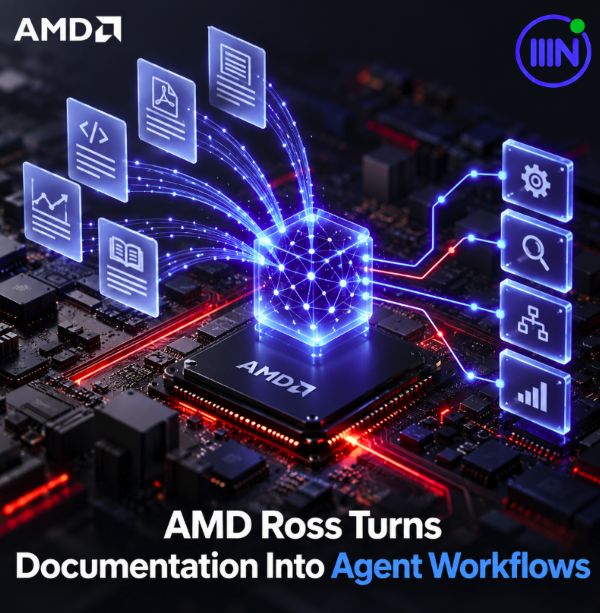

AMD has introduced Ross, an agentic assistant that connects technical documentation with embedded-development tools and reusable engineering workflows. The official announcement is dated 30 September 2026, rather than 1 October. AMD says Ross is available now, with further tool and workflow capabilities planned on a monthly cadence. For SEO and AI Search teams, the noteworthy development is a specialised discovery experience built around a vendor’s own knowledge and development environment.
Ross illustrates a route from a technical question to an action. A developer can seek documentation, investigate an error and work toward a design change through a compatible client. The commercial implication is that documentation can support discovery inside an engineering workflow, even when the user does not begin with a general web search.
Retrieval, tools and reusable methodology
AMD describes four components: MCP servers, its knowledge base, expert-authored agent skills and design examples. The knowledge base contains materials such as guides, white papers and application notes. Skills capture repeatable methods for engineering tasks, while examples help demonstrate those methods in practice. This combines access to information with procedural guidance rather than presenting every task as an isolated question.
The Ross product page documents retrieval-augmented generation and cited answers. It lists clients including Claude Code, Codex CLI, Copilot CLI and Cursor, while describing compatibility in terms of support for the MCP servers. Developers still need the applicable AMD tools and access to a suitable model; Ross is not a replacement for those prerequisites.
The same page describes an air-gapped option requiring local deployment of the database, embedding model and MCP server, with an answer-generation model appropriate to the environment. Offline operation is therefore a configuration choice, not a promise that every cloud-backed client works without connectivity. AMD also notes that HLS skills can operate through standard command-line tools without MCP.
What technical content teams should take from it
The editorial implication is that a documentation page has more than one audience: the engineer reading it directly and the retrieval system selecting evidence for an answer. Content teams should make product scope, software versions, prerequisites and exceptions explicit. A technically correct instruction can still cause confusion if its applicable release is difficult to identify.
This also favours clear connections between explanations and procedures. A troubleshooting page should establish the symptom, relevant environment and evidence supporting the proposed fix. A workflow guide should explain what success looks like and when the procedure should stop. Those are practical documentation-quality priorities, not newly disclosed ranking signals in Ross.
Portable skills add another distribution format for technical expertise. AMD’s public Ross repository gives developers a place to access the project’s shared resources. For another vendor considering this approach, a useful first step would be to identify procedures that experts already repeat reliably, then document their boundaries and expected outputs before encoding them for agents.
That does not establish a route for an unrelated publisher to enter AMD’s knowledge base. Ross is a vendor-focused system, and its existence provides no evidence that general web authority or Google ranking determines inclusion. Technical discovery teams need to understand each system’s actual source coverage before claiming visibility within it.
Citations are evidence to inspect
A citation makes verification possible; it does not complete verification. Teams evaluating a technical assistant should check whether the cited passage supports the claim, applies to the right version and justifies the suggested action. For tool-driven workflows, inspect the resulting reports or artifacts as well as the explanation. AMD explicitly leaves users responsible for reviewing generated outputs and proposed actions.
Measure source relevance and task completion separately from conventional search traffic. A useful answer inside a development client may have operational value without producing a website session, but that value needs evidence. Ross offers a concrete example of technical knowledge becoming both retrievable and executable. The opportunity for content teams is to build documentation that remains accurate and useful across those two roles.