
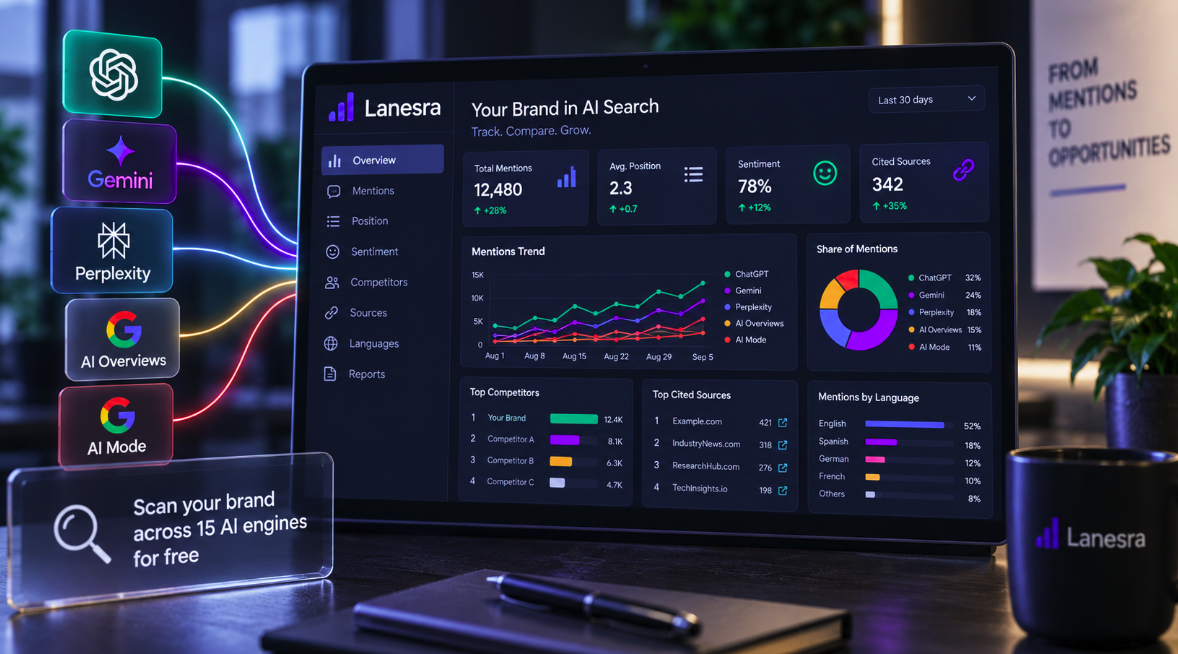
AI-search analytics is rapidly moving beyond the simplest question of whether a brand was mentioned. Lanesra, a new platform positioning itself as an analytics layer for AI search, is built around a more demanding idea: a mention only becomes useful when marketers can see where the brand appeared in the answer, how the model framed it, which competitors appeared alongside it and what sources influenced the response.
That distinction matters as brands begin treating ChatGPT, Gemini, Perplexity, Google AI Overviews and other answer engines as measurable discovery channels rather than experimental interfaces. According to the official Lanesra website, the platform tracks visibility, position, sentiment, competitors, prompts, sources and citations, with results segmented across models, markets and languages. Its launch positioning therefore reflects a broader shift in Generative Engine Optimization: measuring presence is becoming less useful than understanding the context of that presence.
A mention can hide a weak result
Traditional rank tracking gives marketers a relatively intuitive metric: a page occupies a position on a search results page. Generative answers complicate that model. Two brands can both be mentioned in the same response while receiving dramatically different treatment. One may appear first as the recommended option, while another is introduced later with qualifications or only appears incidentally in a comparison.
Lanesra attempts to make those differences measurable. Its public product materials define visibility as how often a brand appears for relevant questions, position as where the brand lands inside an AI-generated answer, and sentiment as the way the model frames it. The platform’s FAQ expands that model with AI share of voice, citations, retrievals, competitor performance and changes over time.
This creates a more useful diagnostic layer than a binary mention counter. A company can have strong visibility but poor prominence, or appear frequently while being framed less positively than a competitor. Conversely, a brand with fewer mentions may occupy stronger positions on the high-intent prompts that actually influence consideration and purchasing decisions.
Lanesra connects visibility to the evidence behind the answer
The platform also separates brand mentions from citations and source use. Lanesra defines a mention as an answer explicitly naming the brand, while a citation refers to a source URL named or linked by the AI system. It additionally distinguishes source use, where content informs an answer even when the URL is not explicitly shown.
That source layer can be particularly important for AEO and GEO work because it gives teams something closer to an actionable path. If competitors dominate an answer, the useful question is not only how often they appear but which documents, publisher sites, forums, documentation pages or other sources are feeding that visibility. Lanesra says users can inspect cited domains and individual URLs to identify which sources repeatedly shape answers in their category.
In practical terms, that can change an optimization brief. A visibility gap may point toward improving an owned product page, but it may instead reveal that an AI engine repeatedly relies on third-party comparison sites, developer communities or editorial coverage where the brand has little presence. The appropriate response could therefore involve content, digital PR, documentation, community participation or clearer factual signals rather than simply rewriting a landing page.
Competitors turn raw tracking into a relative metric
Lanesra also benchmarks brands against competitors inside the same AI answers. Its dashboard materials show visibility and share-of-voice comparisons alongside sentiment and position, while the FAQ describes multi-brand tracking designed to show where rivals are winning prompts that a monitored brand is missing.
This relative view is increasingly necessary because AI visibility has no universal benchmark. A 30% mention rate may look weak in isolation, but it could represent category leadership if every competitor appears less often. The same number could be a serious gap if the leading rival appears in 80% of commercially important answers. Competitive context turns a percentage into a market signal.
Prompt-level analysis adds another dimension. Rather than treating all queries as equal, Lanesra lets teams track the questions buyers ask while discovering, comparing and choosing products. Its public materials describe prompt segmentation and filtering by factors such as model, country, language, persona, funnel stage and market, which can expose visibility gaps that disappear inside a global average.
One brand can look different across models and languages
The multi-model component is central to the product’s premise. Lanesra publicly lists ChatGPT, Gemini, Google AI Overviews, Google AI Mode, Perplexity and Microsoft Copilot among its core model choices, with additional models such as Claude, Grok, DeepSeek, Qwen, Moonshot AI and Mistral available in broader configurations. Its canonical product reference also describes regional model coverage and emphasizes segmentation by market and language.
That matters because AI visibility is not a single global state. Different engines can retrieve different sources, generate different recommendations and respond differently to the same category question. Geography and language can introduce another layer of variation as local sources, terminology and market context change. A brand that looks dominant in English on one model can therefore be poorly represented in another market or another answer engine.
Lanesra says tracked prompt configurations can be rerun on a scheduled basis so teams can compare movement over time rather than relying on one-off screenshots. This is important because generative responses are variable. A single answer can be informative, but repeated measurements are needed before marketers can distinguish a persistent visibility shift from normal model variation.
From monitoring to an optimization workflow
The larger ambition behind Lanesra is to move AI-search measurement closer to an optimization loop. The platform’s public workflow starts with defining the brand, competitors and commercially relevant prompts, then measuring those prompts across selected models and markets. It subsequently connects weak visibility to source and citation evidence and produces prioritized areas for improvement.
That approach reflects where the AI-search analytics category is heading. Early tools could create value simply by proving that a brand appeared in ChatGPT. As the market matures, marketers need to know whether that appearance was prominent, favorable, competitive and supported by sources they can influence. They also need enough historical data to determine whether an intervention actually changed the result.
Lanesra’s initial public positioning has a strong Web3 focus, covering protocols, chains, wallets, exchanges, DeFi and related categories, although the company describes the underlying platform as relevant to brands and agencies more broadly. That vertical-first approach may give it a tighter benchmarking environment during its early rollout while the product expands to additional industries.
AI visibility is becoming multidimensional
The important idea behind Lanesra’s launch is bigger than any individual dashboard. AI-search visibility cannot be reduced cleanly to a single mention count. Brands increasingly need to measure frequency, prominence, framing, competitive share and source influence together, then break those signals down by prompt, model, language and market.
That makes AI-search analytics less like checking whether a company exists in a chatbot and more like measuring an emerging media and discovery environment. The brands that understand not just whether they appear, but where, how and why they appear, will have a much clearer view of what to improve next.