
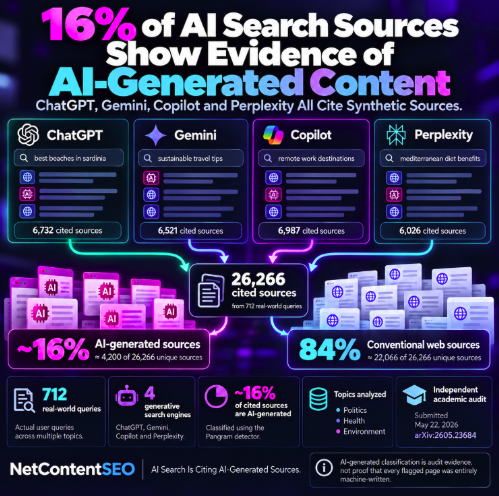
Generative search engines are increasingly citing a web that is itself being generated by AI. An independent academic audit of ChatGPT, Gemini, Microsoft Copilot and Perplexity found evidence of AI-generated content across all four systems, accounting for roughly 16% of cited sources.
The study, Synthetic Sources?: Auditing Generative Search Engine Citations for Evidence of AI-Generated Sources, was submitted to arXiv on May 22, 2026 by Mowafak Allaham and Nicholas Diakopoulos.
712 real-world queries across four AI search engines
The researchers audited the four generative search systems using 712 real-world, human-generated queries covering areas of public importance including politics, health and the environment.
The resulting citation dataset allowed the researchers to examine whether AI search engines were directing users toward sources showing evidence of synthetic content rather than consistently filtering such material out.
About 16% of cited sources showed evidence of AI generation
The central result is striking: approximately 16% of cited sources were classified as showing evidence of AI-generated content. The phenomenon was observed across ChatGPT, Copilot, Gemini and Perplexity rather than being isolated to one system.
This does not mean every flagged page can be proven to be entirely machine-written. The audit relies on detection methodology, including the Pangram classifier, so the result should be interpreted as evidence of synthetic content within the cited-source population rather than perfect authorship attribution.
AI search can create a synthetic information loop
The finding exposes a structural problem for generative search. Large language models synthesize information from web sources, but an increasing share of that web may itself have been produced or heavily assisted by other language models.
When AI-generated pages become sources for new AI-generated answers, information can move through multiple generations of synthesis before reaching the user. Errors, unsupported claims or subtle distortions can therefore be reproduced or amplified even when the final answer includes citations.
Citations alone are not a quality guarantee
Generative search interfaces often use citations as a trust signal. But the study demonstrates why the presence of a source link cannot by itself establish provenance or editorial quality.
A citation can identify where an AI system retrieved information without establishing whether that source was independently researched, professionally edited, copied, synthesized from other pages or generated by another AI system.
A narrow core of domains sits beside a long citation tail
The researchers also observed that generative search engines repeatedly cite a relatively narrow set of domains while simultaneously surfacing a large number of domains that appear only minimally across responses.
This combination suggests an AI citation ecosystem with both highly recurrent sources and a broad long tail — including synthetic sources capable of entering retrieval even without becoming dominant citation domains.
The NetContentSEO view
This audit adds another dimension to AI visibility: source provenance matters alongside citation frequency. Monitoring which domains receive citations is no longer enough; publishers and researchers increasingly need to understand how the cited content was produced and whether it represents an independent information source.
For GEO, the 16% figure also raises a deeper question about recognizable authorship. As synthetic content becomes easier to publish at scale, systems that can distinguish original reporting, accountable expertise and traceable human authorship from recursively generated material may become increasingly important to the quality of AI retrieval.