

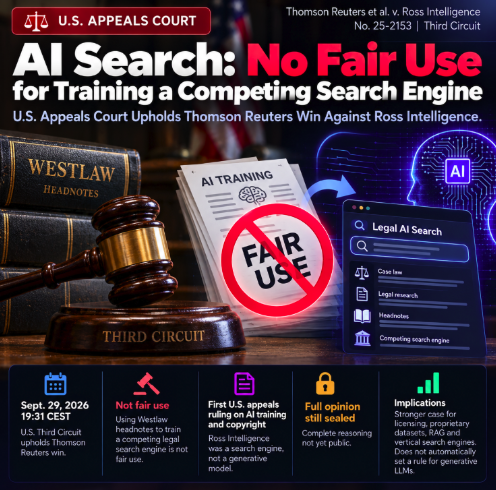
A U.S. federal appeals court has upheld Thomson Reuters' landmark copyright victory against Ross Intelligence, reinforcing a major legal limit on using protected content to build a directly competing AI-powered search product.
On September 29, 2026, the U.S. Court of Appeals for the Third Circuit affirmed the ruling against Ross, which had used Westlaw headnotes as part of the process for training its competing legal research system.
The appeals court upheld the rejection of fair use
The dispute centers on Westlaw headnotes — editorial summaries of legal decisions created by Thomson Reuters. Ross Intelligence obtained access to headnote-derived material while developing a legal search engine intended to compete with Westlaw.
The lower court concluded that this use was not protected by the U.S. fair-use doctrine. The Third Circuit has now upheld Thomson Reuters' victory.
A landmark appellate decision for AI training copyright
Reuters describes the case as the first U.S. federal appellate court decision addressing copyright and AI training. That makes the ruling especially important for companies building search, retrieval and AI products from proprietary datasets.
But the scope needs to be stated carefully: Ross Intelligence was not a generative AI system. It was developing a legal search engine, so the decision does not automatically establish a universal rule for training modern generative LLMs.
The direct-competitor relationship matters
The commercial context is central to the case. Ross was not merely analyzing Westlaw material for research or an unrelated application; it was using protected editorial content while developing a product competing in the same legal-research market.
For AI companies, that distinction puts particular pressure on workflows where proprietary material from one publisher or database is collected to create a substitute search or retrieval product.
The complete appellate reasoning is not yet public
The Third Circuit docket identifies the proceeding as Thomson Reuters et al. v. Ross Intelligence, No. 25-2153. At the time of reporting, the court's full reasoning remained under seal.
That limitation matters. Until the complete opinion becomes public, broader conclusions about precisely how the appellate court analyzed the fair-use factors should be treated cautiously.
Implications for proprietary datasets and RAG
The ruling strengthens the incentive for AI search companies to establish clear licensing rights when using proprietary editorial datasets, especially where the resulting product competes directly with the content owner.
The same issue can arise in vertical search and retrieval-augmented generation systems. A RAG architecture does not itself answer the copyright question: teams still need to consider where the indexed material came from, what rights govern its use and whether the product substitutes for the original commercial service.
The NetContentSEO view
This decision matters less as a blanket verdict on “AI training” and more as a warning about competitive substitution. Proprietary datasets can carry value precisely because of the editorial work required to create, organize and structure them.
As AI search moves deeper into specialized verticals, licensing, provenance and contractual access to high-value corpora may become strategic infrastructure. The ruling does not settle every generative-AI copyright dispute, but it makes clear that calling a system “AI” does not automatically turn protected competitor content into fair-use training material.