

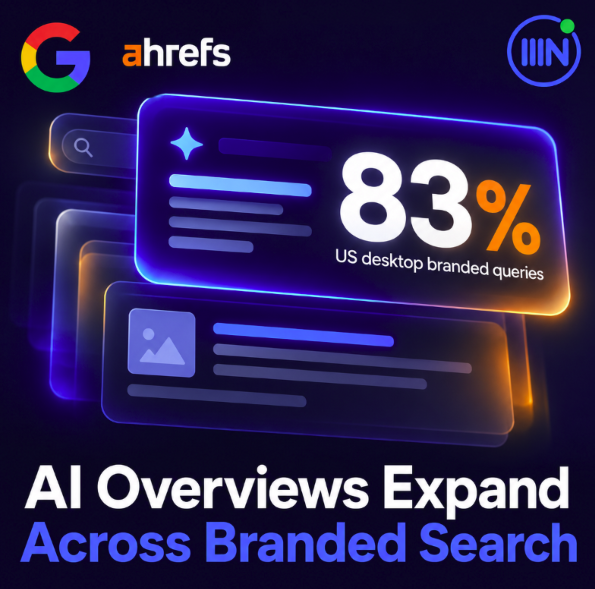
Ahrefs reports that AI Overviews appeared in 82.91% of branded US desktop search results at its September 29, 2026 checkpoint. Published October 2, the proprietary study examined 232.8 million Google SERP crawls from July through September, including 92.5 million branded-keyword crawls. The branded monthly average rose from 61.3% in July to 73.3% in September.
A separate panel tracked exact-name queries for 100 brands. At the September 30 checkpoint, 63 had an AI Overview; 48 of those answers occupied position one, giving the reported 76.2%. Among 57 available source lists, Wikipedia appeared in 41, or 71.9%. YouTube and LinkedIn followed among external domains. These figures describe different samples and denominators, not a universal rate for every brand or market.
A brand query can become an answer experience
The study is an independent observation of US desktop results, not a Google rollout announcement. Repeated crawls are not counts of unique searches or users, and AI Overview appearances can change. The 83% headline is a dated snapshot, distinct from the September monthly average. It also does not establish a corresponding loss of clicks or revenue for any particular brand.
For a company monitoring its own name, the practical implication is that a website ranking alone may no longer describe the complete search experience. A prominent answer can explain the company before a visitor reaches its official page. The content of that explanation, its sources and the order of the page deserve attention alongside the familiar organic result.
Our interpretation is that branded SEO now needs a more detailed observation process. A stable first-place website result can coexist with a changing summary above it. Conversely, an answer may appear below the official result and have a different practical effect. Teams should record the actual layout instead of treating every AI Overview appearance as equivalent.
Audit what the answer says and where it comes from
Start with a defined set of searches: the exact brand name, product names and relevant navigational or commercial modifiers. Keep those groups separate so a change in the tracked query mix does not masquerade as a change in visibility. Record the location, device, date and available account context for each observation.
For each answer, inspect factual claims, cited pages and the freshness of the information. A useful audit entry describes the issue precisely: an outdated product name, a discontinued service presented as current or a source that supports only part of the answer. Save enough evidence to distinguish a repeated pattern from a single transient result.
External sources require appropriate responses. Correct an owned profile or video when it contains obsolete information. Where an independent page is wrong, pursue its normal correction process with evidence. Accurate third-party coverage can be useful; the objective should be factual consistency rather than an expectation of complete control over editorial narratives.
Measure visibility and traffic separately
An answer’s appearance, a brand mention, a citation and a visit are different outcomes. Our recommendation is to report them separately, then compare the observations with branded website traffic and relevant business results. A screenshot can establish what appeared in one result, but it cannot demonstrate how many people saw it or how their behaviour changed.
For SEO and GEO teams, the immediate task is to expand the brand SERP audit without overstating the evidence. Maintain clear official information, watch the sources that describe the business and investigate recurring inaccuracies. The Ahrefs findings provide a reason to examine that work more closely; they do not provide a guaranteed method for securing citations or replacing independent narratives.