
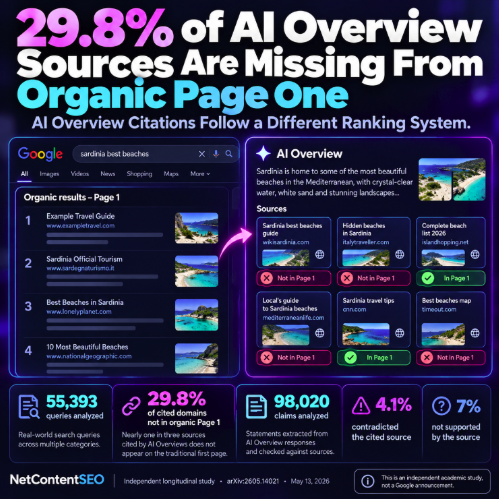
Google's AI Overviews appear to select sources differently from the traditional organic ranking system. A large longitudinal study analyzing 55,393 trending queries found that 29.8% of domains cited by AI Overviews did not appear among the co-displayed first-page organic results.
The study, Measuring Google AI Overviews: Activation, Source Quality, Claim Fidelity, and Publisher Impact, was submitted to arXiv on May 13, 2026 and tracked queries across 19 topical categories during a 40-day period from March 13 to April 21.
Nearly one in three AIO sources came from outside page one
The finding challenges the assumption that AI Overview citations are simply extracted from Google's highest-ranking organic results. Almost 30% of cited domains were absent from the traditional first page shown alongside the AI Overview.
The researchers describe this as evidence of a source-selection mechanism that is distinct from Google's conventional ranking algorithm.
AI visibility can exist without top-10 organic visibility
For publishers, the practical implication is significant. A domain does not necessarily need to occupy a traditional page-one position to become a source for an AI-generated answer.
This creates a separate visibility layer in which source selection, retrieval and citation can diverge from the familiar organic ranking order. Traditional rankings remain important, but they no longer fully describe which sources Google may expose through generative search.
The study analyzed 98,020 individual claims
The researchers also decomposed AI Overview responses into 98,020 atomic claims and checked whether the cited pages actually supported those statements. The paper reports that 11% of claims were unsupported by the cited pages overall.
The detailed analysis reported that 4.1% contradicted the cited source while a further 7% were not supported by it, showing that source selection and claim fidelity are separate problems.
Credible sources do not automatically guarantee faithful claims
Interestingly, the paper found that AIO-cited domains were generally more credible than the first-page results displayed alongside them. Yet source quality and claim fidelity were largely independent.
In other words, selecting a credible publisher does not by itself guarantee that every generated statement accurately reflects what that publisher actually says.
AIO activation also varies dramatically by query type
Across the full dataset, AI Overviews appeared for 13.7% of queries. For question-form searches, however, activation rose to 64.7%.
This reinforces the importance of analyzing AI visibility by intent rather than treating all search queries as equally exposed to generative results.
The NetContentSEO view
The 29.8% figure is strong evidence that organic ranking and AI citation visibility should be measured as related but distinct systems. Tracking only page-one rankings will miss a meaningful portion of the sources that Google actually surfaces inside AI Overviews.
For GEO, this means the competitive set is wider than the traditional top 10. Publishers need to monitor who is being retrieved and cited, not simply who ranks above them. AI source discovery is becoming its own visibility layer.