
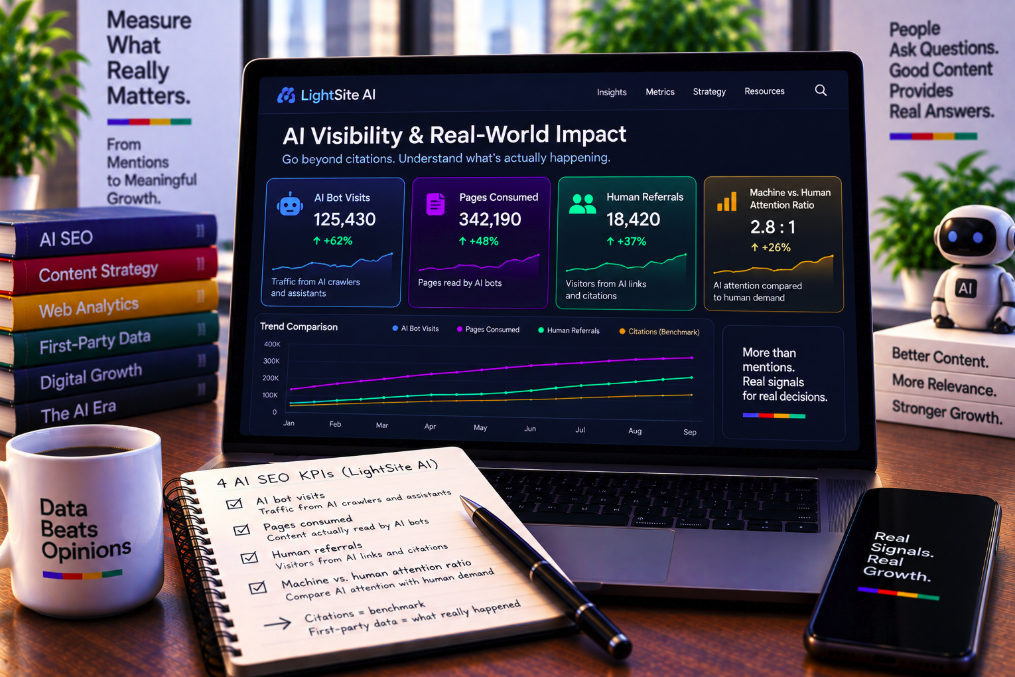
AI search measurement has become crowded with citation counts, simulated prompts, mention scores and share-of-voice charts. A new framework presented by LightSite AI argues that those metrics are useful for benchmarking but are too indirect to answer the question marketers eventually have to defend: what actually happened on the website?
In a Search Engine Journal on-demand webinar sponsored in partnership with LightSite AI, founder Stas Levitan proposes four site-level signals: AI bot traffic, pages consumed by AI bots, human visits referred by AI assistants and a ratio comparing machine attention with human demand.
The framework is attractive because it moves measurement closer to first-party evidence. A server can observe a verified crawler request. Analytics can record a referral visit from an AI assistant. Those events are more concrete than running a synthetic prompt and assuming that the resulting citation represents typical user behavior.
But first-party does not mean causal. An AI bot fetching a page does not prove that the page appeared in an answer, influenced a recommendation or caused a later human visit. LightSite itself makes that limitation explicit. The value of the framework is therefore not that it solves AI attribution, but that it separates several observable stages that are too often collapsed into one vague concept called “AI visibility.”
Citations are benchmarks, not complete performance metrics
Most AI visibility platforms begin from the outside. They run prompts against ChatGPT, Gemini, Claude, Perplexity or other systems, record the answers and calculate metrics such as mentions, citations, sentiment and share of voice.
Those measurements can be useful. They can show whether a brand appears more often than competitors, whether an assistant tends to cite a particular domain and whether visibility is changing over time.
The problem begins when a benchmark is treated as proof of business performance. AI answers are variable, prompt samples are necessarily incomplete and user context can change outputs. A citation observed in a monitoring platform proves that one sampled response cited a source; it does not reveal how many real users saw that citation or whether anyone clicked it.
LightSite's argument is that synthetic visibility should remain in the measurement stack, but it should be paired with events observed directly on the publisher's infrastructure.
The first KPI is AI bot traffic
The framework treats visits from identifiable AI-controlled systems as a top-of-funnel discovery signal.
The advertising analogy is deliberately provocative: an AI bot visit can be thought of as a new kind of impression. Something in the AI ecosystem accessed the content, creating an observable machine-attention event.
That analogy is useful only if its limitations travel with it. A conventional advertising impression means an ad was served into a defined placement. A crawler request does not mean content was displayed to a human in an AI answer.
LightSite's own AI CTR methodology says verified AI bot fetches are machine-access events rather than proof of answer-level impressions. There is currently no equivalent of Google Search Console that tells publishers every time ChatGPT, Gemini, Claude or Perplexity considered or displayed a particular page.
Different bots can represent different stages of machine activity
Not every automated request has the same meaning. Some crawlers collect material for model development, some support search indexing, some retrieve information in real time and some agentic systems interact with websites on behalf of users.
Combining all of those requests into one undifferentiated “AI traffic” number can therefore be misleading.
A training crawler visiting a documentation page is not equivalent to a user-triggered retrieval system fetching that page while answering a current question. Both are machine attention, but they sit at different distances from human demand.
Useful bot analytics should identify the platform and crawler class where possible rather than rewarding raw volume indiscriminately.
The second KPI is pages consumed by AI systems
Total bot traffic tells a site how much machine activity it receives. Page-level consumption tells marketers where that attention goes.
The webinar recommends looking at which resources AI bots fetch, which pages they ignore, which they revisit and where repeated attention becomes concentrated.
This is potentially more actionable than an account-level crawl chart. If bots repeatedly access product documentation, comparison pages or technical support content while largely ignoring generic thought-leadership posts, the content team has evidence about what machine systems are finding useful enough to retrieve.
That still does not prove that the retrieved pages were cited. It does provide a first-party map of machine behavior on the site.
LightSite says machine attention is highly concentrated
Search Engine Journal reports a vendor finding from the webinar that roughly 12% of pages in LightSite's dataset absorbed about half of AI bot impressions.
The presentation also describes a much smaller set of pages that were repeatedly reread during a four- to six-week period and accounted for a disproportionate amount of crawl activity.
These figures are interesting because they suggest AI discovery may behave like many other attention systems: a relatively small portion of the content portfolio attracts most activity.
They should not be treated as universal web benchmarks. The webinar says its observations draw on hundreds of websites, but the public landing page does not provide a complete sample frame, industry distribution or independently audited methodology that would justify assuming every site should reproduce the 12% pattern.
The third KPI is human referral traffic from AI assistants
Human referrals move measurement one step closer to demand. If a visitor arrives at a website from ChatGPT, Perplexity or another identifiable AI environment, that visit is a real site event rather than a simulated visibility estimate.
This is one reason AI referral traffic has become an important analytics segment even while its total volume remains small for many websites.
A referral can reveal which landing pages attract users, which assistants send traffic and whether those visitors convert differently from organic search, social or direct traffic.
It also exposes a fundamental gap between visibility and demand. A brand can receive many citations while earning little attributable referral traffic, or receive relatively few observable machine fetches while a small set of high-intent pages sends valuable visitors.
Referral tracking is still incomplete
Human AI referral data is harder than it sounds. Not every assistant passes a clean referrer, apps and browsers can obscure attribution, users can copy links or search for a brand later, and some AI answers may influence behavior without producing an immediate click.
Direct referral analytics therefore measures attributable visits, not the total business influence of AI answers.
A user might learn about a company in ChatGPT, open a new browser tab and type the brand name into Google. Standard analytics would probably credit that visit to search rather than to the AI conversation that created the demand.
First-party referral data is concrete, but it is still a lower-bound view of AI's influence.
The fourth KPI is the relationship between machine attention and human demand
LightSite calls this metric AI CTR. Its basic formula is AI-referred human clicks divided by verified AI bot activity or “AI impressions.”
The purpose is to compare the machine side of the funnel with the human side. If AI systems repeatedly access a page but almost no users arrive from AI assistants, the page has high machine attention and low attributable human demand.
If a page receives modest crawler activity but generates comparatively strong referral traffic, it may be converting machine visibility into human interest more efficiently.
This ratio creates a useful diagnostic lens, but the name “CTR” should not be confused with conventional search click-through rate. The denominator is not a count of visible answer impressions shown to users.
AI CTR does not establish a one-to-one funnel
LightSite explicitly warns that its ratio should be interpreted in aggregate. A particular bot request cannot normally be connected to a particular human visit.
The bot may have fetched the page for indexing or model-development purposes. The human may have clicked after an entirely different retrieval event. Time lags can vary, and an assistant may use cached or third-party information instead of fetching the publisher at the moment the answer is generated.
That makes AI CTR a relationship between two observed signals, not a causal conversion funnel in which every crawl is an impression and every referral is the resulting click.
The distinction is essential if teams plan to use the metric for budget allocation.
High bot traffic with low human referrals is not automatically failure
The webinar's decision framework encourages marketers to examine mismatches rather than judging each metric independently.
A heavily crawled page with little referral traffic could indicate weak positioning, insufficient authority, answer-without-click behavior or stronger competing sources. It could also simply be material that AI systems need for retrieval but users do not need to visit directly.
Technical documentation is an obvious example. An assistant may extract the exact specification needed to answer a question, leaving the user with no reason to click.
The marketer's next action should depend on page intent. Low referral yield is not inherently bad if the page's job is to supply factual information that supports brand inclusion elsewhere.
Low bot activity with strong referrals can identify unusually efficient pages
The opposite pattern can be even more interesting. A page may receive relatively little machine traffic yet generate a meaningful share of AI-referred visitors.
That suggests the page is punching above its weight in human demand and may deserve additional internal linking, promotion, updating or authority-building support.
It can also reveal high-intent content types that generic visibility dashboards overlook. Comparison pages, tools, templates, support resources and narrow answer pages can attract visitors with specific problems even if they do not dominate broad citation counts.
The framework's practical strength is that it asks teams to find these mismatches before commissioning another batch of generic content.
About one-third of sites reportedly blocked at least one major AI bot
Search Engine Journal says LightSite found that roughly one-third of websites in its dataset blocked at least one major AI bot, often because security, CDN and marketing decisions were not aligned.
This is a useful operational observation. A marketing team can invest heavily in GEO while infrastructure rules quietly deny access to the systems it hopes will discover the content.
However, bot access is not automatically desirable. Publishers may intentionally block training crawlers for licensing, copyright, cost, privacy or strategic reasons while allowing search-oriented or user-triggered retrieval systems.
The right audit question is not “Are all AI bots allowed?” It is “Does our actual bot policy match our business strategy?”
First-party data is closer to reality, but bot verification matters
Server-side evidence is only valuable if the automated traffic is classified accurately.
User agents can be spoofed. Requests may travel through proxies or cloud infrastructure. Some AI products use third-party retrieval systems, and crawler identities can evolve.
LightSite says it works with verified bot activity, but any organization building its own analytics should validate crawler identity rather than accepting every request that contains “GPT,” “Claude” or another recognizable string.
A noisy bot dataset can create false confidence just as easily as a noisy prompt-monitoring dataset.
The webinar data is vendor research, not an independent census of AI search
The provenance of the framework matters. The Search Engine Journal page is a sponsored webinar presentation involving LightSite AI, a company that sells AI-search infrastructure and measurement products.
SEJ says the session draws on AI bot and human referral data from hundreds of websites. LightSite's July methodology article describes observations across more than 150 live sites and acknowledges that the dataset is not a clean laboratory experiment because the properties differ in industry, language, size, traffic and technical stack.
Those disclosures do not invalidate the observations. They determine how the numbers should be used.
Figures such as the concentration of bot impressions or the share of sites blocking crawlers are directional vendor benchmarks. They should not be treated as universal expectations without a complete sample methodology and independent replication.
Case-study gains need the same caution
LightSite's own webinar recap describes a customer example in which a company shifted investment toward support and documentation after examining AI consumption and referral data, followed by increases in AI visitors and on-site conversions.
That is useful as an illustration of how the framework can change a decision. It is not proof that applying the same method will produce comparable gains on another website.
Customer case studies combine product use, content changes, market conditions and other interventions that are difficult to isolate.
The editorially useful lesson is the decision process: examine where machine and human attention already exists before deciding what to build next.
Citations still answer questions first-party analytics cannot
The argument for site-level data should not become an argument against citation tracking.
Server logs can tell a publisher that an AI crawler fetched a page, but they cannot reveal every competitor cited alongside it. Referral analytics can show that a human arrived, but it cannot show all the answers where the brand was considered and omitted.
Synthetic prompt monitoring can answer competitive questions that first-party data cannot: which brands dominate a category, which third-party sources assistants prefer and how sentiment or recommendations change across model versions.
The two measurement layers are complementary. Benchmarking describes the external answer environment; first-party analytics describes what reaches the publisher's own infrastructure.
A better AI search dashboard separates four different questions
The framework becomes most useful when each signal is tied to a distinct business question rather than merged into a composite visibility score.
Bot activity asks whether AI-controlled systems are accessing the site. Page consumption asks what they appear interested in. Human referrals ask whether identifiable users are arriving from AI environments. The machine-to-human ratio asks how those two observable forms of attention compare.
Citations and share of voice then add a fifth layer: how the brand appears in sampled answer space relative to competitors.
Keeping these questions separate makes the dashboard less elegant but the decisions more defensible.
Page-level measurement is more actionable than sitewide averages
A sitewide AI traffic increase can hide radically different page behavior.
One documentation page may account for thousands of bot requests. A comparison page may generate most human referrals. The homepage may dominate brand citations while contributing little to either pattern.
Page-level analysis lets marketers match investment to the role each resource plays. A frequently crawled technical page may need clearer structured facts. A page generating AI referrals may deserve stronger conversion design. An important commercial page ignored by both bots and humans may need a deeper strategic rethink.
This is where first-party data becomes a prioritization tool rather than another reporting layer.
Time-series analysis matters more than isolated counts
A single week of crawler volume says little without context. AI systems crawl at different frequencies, products change retrieval infrastructure and off-site events can create temporary spikes.
Teams should establish baselines and watch how machine activity changes after content updates, PR campaigns, community discussions, technical changes or new product launches.
Human referrals should be examined over the same periods, while avoiding claims that co-movement proves causality.
The goal is to develop repeatable evidence: after a particular class of intervention, does the site consistently attract different machine behavior or different human demand?
Conversions remain more important than AI referrals
A referral is closer to business value than a crawler request, but it is still not the final outcome.
AI-referred visitors can subscribe, request demos, buy products, abandon immediately or consume information without converting. Their commercial value can differ significantly by assistant, landing page and query intent.
Publishers and brands should therefore extend the measurement chain beyond LightSite's four signals where their analytics allow it: AI referral, engagement, lead, revenue and retention.
A page with modest referral volume and high conversion value may deserve more investment than a page attracting thousands of low-intent AI visits.
The strongest claim is not that bot visits are the new impression
The phrase is useful because it forces marketers to recognize machine attention as a measurable stage before human traffic. Taken literally, however, it overstates what a crawl event can prove.
An advertising impression records exposure in a user-facing environment. An AI crawler visit records machine access. There may be a path between the two, but today's public data usually cannot observe every step.
The more durable insight is that AI search needs its own funnel vocabulary rather than borrowing old metrics without qualification.
Machine discovery, machine consumption, answer visibility, human referral and conversion are different events. Good measurement should preserve those differences.
AI search reporting should move from one score to an evidence stack
LightSite's four-signal framework is most convincing when treated as an addition to existing AI visibility measurement rather than a replacement for it.
Mentions, citations and share of voice provide competitive benchmarks. Verified bot requests show machine access. Page consumption reveals where that attention concentrates. AI referrals record attributable human visits. Conversion data shows whether those visitors matter commercially.
The machine-to-human ratio can then help teams investigate gaps between discovery and demand, as long as nobody mistakes the denominator for a literal count of visible AI answer impressions.
The sponsored webinar does not provide a complete independent sample that turns its reported patterns into universal benchmarks, and the vendor itself acknowledges that its live-site data is observational rather than laboratory evidence. That caution should remain attached to every headline statistic.
But the underlying measurement principle is sound: citations tell marketers what an AI system may say in a sampled answer; first-party logs tell them which machines actually reached the site and which humans actually came back. AI search strategy becomes more useful when teams stop asking one metric to prove all of those things at once.