

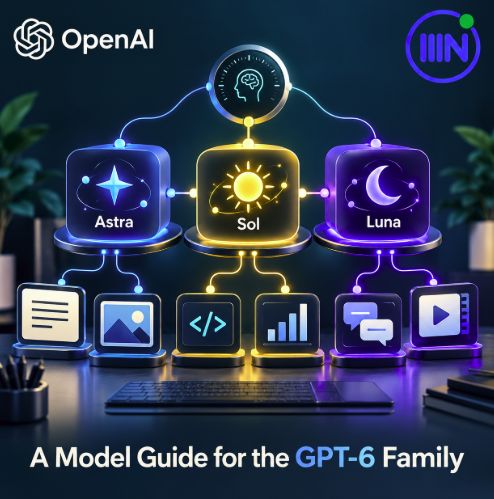

OpenAI’s October 2, 2026 model guide for the GPT-6 family frames model selection as a balance between capability, time and cost. It positions GPT-6 Astra for the hardest reasoning, GPT-6.1 Sol for complex coding, research and computer use, and GPT-6 Luna for focused, repeatable work at scale.
The guide recommends adjusting reasoning effort to the task and testing higher settings when the improvement justifies the extra resources. It also covers clear prompts, reusable skills, caching, compaction and tool coordination. Production evaluation should measure success, latency and cost per successful task.
For longer workflows, OpenAI describes asynchronous tools, mid-turn steering and delegation. GPT-6.1 Sol’s multi-agent support in the Responses API remains in beta. Steering updates do not cancel running tools or reverse completed actions. These features require application design, rather than making every workflow autonomous by default.
Choose a model against a concrete job
Our recommendation for startups is to begin with a small evaluation set drawn from the actual service they want to deliver. Include routine cases, ambiguous inputs and failures that would matter to a customer. Define the result that counts as successful before comparing models or reasoning settings.
For an SEO reporting product, a task might be to summarize a known dataset without inventing missing metrics. A harder task might compare competing explanations for a visibility change while separating observations from assumptions. Those tasks need different evaluation criteria, even if both end with a written report.
Compare the complete workflow, including retries, external calls and review time. A lower token bill is useful only when the resulting service meets the required standard. Conversely, a more capable model may add unnecessary expense to a narrowly defined extraction task. Routing should follow observed results rather than a blanket preference for one model.
Make prompts and skills easy to evaluate
A useful assignment states the intended reader, available evidence, output format and completion condition. For a citation audit, specify whether the output should record mentions, linked sources or both. Explain how to handle unavailable pages and unsupported claims so uncertainty does not disappear inside polished prose.
Our editorial recommendation is to use reusable skills for stable workflow guidance and keep changing task details in the request. Avoid conflicting instructions about autonomy or completion. A workflow that says “prepare a report” in one place and “publish automatically” elsewhere leaves an important operational choice unresolved.
Define decision boundaries around the service being built. Reading a dataset, proposing a monitoring configuration and modifying a customer account are separate activities. Document which actions are authorized and what evidence must be returned after they complete.
Coordinate tools around dependencies
In a proposed AI visibility research workflow, independent source checks could proceed together. Writing the final conclusion should wait for the evidence they return. The result of each check should preserve its source and limitations so combining findings does not turn several uncertain observations into a confident claim.
Use a direct data interface when it provides the required information reliably. Where a workflow must inspect a visible interface, record the conditions of the observation. An account-specific screen, location or device can materially affect what the agent sees. Tool access alone does not establish representative coverage.
Prepare the workflow for production
For startup teams, our suggested launch process is to version the model configuration, prompts and skills together, then rerun representative tasks after changes. Record errors, completion time and costs. Review what happens when a source is unavailable or a tool returns partial information.
For SEO and GEO products, correctness needs more than fluent writing. A production report should preserve metric definitions, distinguish a citation from a visit and identify which conclusions are interpretations. Build the service around those observable requirements, then choose the model and reasoning level that satisfy them consistently.