
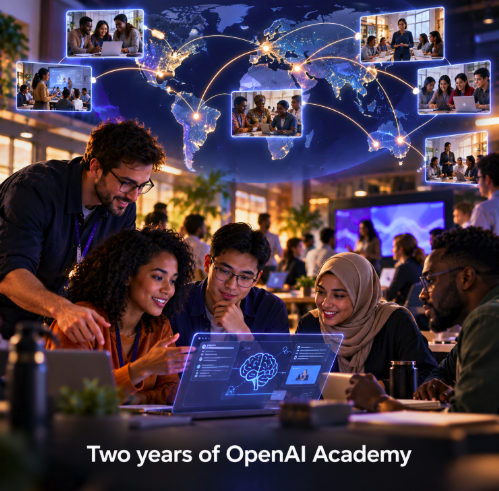
OpenAI Academy is entering its third year with a shift in emphasis: from directly delivering AI education to helping communities build the capacity to teach it themselves. Two years after launching in September 2024, OpenAI says the Academy has hosted more than 250 events and that more than 4 million people have engaged with its content.
The next phase centers on a new Community Trainer Program. Instead of relying only on OpenAI-led events, participating organizations will be able to nominate staff members, train them on Academy curriculum and facilitation methods, and ultimately run practical AI workshops for the communities they already serve.
That makes the anniversary more than a retrospective. OpenAI is beginning to turn Academy from a centralized education program into a distributed training network, with schools, workforce organizations, small-business networks and community groups positioned as local delivery partners.
OpenAI Academy has moved well beyond its original developer focus
OpenAI says it launched Academy to expand access to AI training, technical guidance and community, initially concentrating on developers and mission-driven organizations working on local problems. Over two years, the program expanded into self-paced courses, practical guides, in-person workshops and larger multi-site events called AI Skills Jams.
The audience has expanded with it. OpenAI says educators, small-business owners, developers, nonprofit leaders and other community members have participated in Academy programming.
The change reflects a broader transition in generative AI adoption. The skills needed to use systems such as ChatGPT and Codex are no longer confined to software teams. Teachers are adapting lessons, small businesses are building repeatable research workflows, and knowledge workers are learning to incorporate AI into everyday tasks.
Four million engagements is a reach metric, not four million graduates
The headline scale deserves careful interpretation. OpenAI says more than 4 million people have “engaged with Academy content” over the past two years. It does not say that four million people completed a course, passed an assessment or attended an Academy event.
That distinction matters when evaluating the program’s reach. The 250-plus events are a separate metric, while the four-million figure captures engagement with Academy content more broadly. OpenAI’s anniversary announcement does not provide a completion rate, unique learner count or longitudinal measurement of skills gained.
The figures still show that Academy has developed a sizable distribution footprint, but they should not be converted into stronger educational-outcome claims than OpenAI itself makes.
The new learning paths organize training around roles
OpenAI’s anniversary follows another Academy expansion announced this month: role-oriented learning paths for knowledge workers, developers, leaders, educators and college students. Learners can select coursework relevant to their work and earn Academy course badges after passing assessments.
This is a meaningful evolution from generic AI literacy. A developer learning how to plan and implement a change with Codex needs a different curriculum from an educator adapting classroom material or a business owner developing a repeatable customer-research process.
Role-based paths allow the Academy to teach workflows rather than merely features. The learning objective becomes applying AI to a recurring task while understanding where human judgment, review and control remain necessary.
OpenAI says hands-on practice is the most valuable part
After hundreds of events, OpenAI says its experience suggests the most valuable element of Academy training is giving participants dedicated time and space to try AI tools on work that matters to them. Peer learning, coaching and support from OpenAI mentors are part of that model.
This framing matters because AI education can become obsolete quickly when it is built around interface instructions or lists of prompts. Practical training has a better chance of surviving product changes because it begins with the learner’s actual problem and teaches a process for evaluating whether AI improves the work.
The Academy’s next phase attempts to preserve that hands-on model while moving delivery closer to local communities.
Community partners are becoming the distribution layer
OpenAI says national and local organizations have been central to Academy programming because they already have trusted relationships with the people the program wants to reach. Partners can convene participants and shape training around the work and problems specific to their communities.
The Academy has run recurring workshops for small-business owners, educators, veterans and nonprofit leaders, alongside larger multi-city programs. OpenAI points to its AI Skills Jam for K–12 Educators as one example: more than 1,600 teachers, administrators and district leaders participated across eight U.S. cities.
The strategy is straightforward. OpenAI can produce curriculum and tooling centrally, but community organizations provide context, trust and ongoing relationships that a technology company cannot reproduce everywhere itself.
The Community Trainer Program is the biggest structural change
The newly announced Community Trainer Program formalizes that approach. Participating organizations nominate staff members who learn Academy curriculum and how to facilitate practical workshops. The training covers demonstrating useful workflows, helping participants apply AI to their own tasks, encouraging peer learning and supporting participants as they evaluate the results.
Prospective trainers must complete training and a facilitation assessment before leading Academy sessions. OpenAI describes the initiative as a pilot rather than a universally available trainer certification program.
The immediate objective is more workshops. The longer-term objective is more consequential: OpenAI wants schools, workforce organizations, small-business networks and community groups to develop their own capacity to teach AI skills rather than depend indefinitely on OpenAI personnel.
The trainer model addresses a scaling problem that online courses cannot solve alone
Self-paced content scales cheaply, but it assumes learners already know what they need, can translate examples into their own context and can diagnose when the technology produces a poor result. Local facilitators can help close those gaps.
That is particularly important as AI tools become more capable and workflows become more complex. Learning how to ask ChatGPT for a draft is different from learning how to decide which work should be delegated, how to review the output, how to protect sensitive information and when a human needs to remain in control.
OpenAI’s stated long-term goal is for more people to have someone in their own community they can turn to as both their needs and AI tools evolve.
Academy is increasingly becoming infrastructure for sector-specific AI adoption
The broader Academy catalog already reflects this specialization. It includes dedicated tracks and communities for areas such as higher education, K–12 education, government and other professional groups, alongside events and resources designed for particular audiences.
OpenAI’s recent journalism initiative illustrates the same pattern. The company says its Academy for News Organizations provides newsroom-focused training, use cases, playbooks and practical examples as part of a wider effort involving journalism schools, nonprofit newsrooms and professional associations.
This suggests that Academy’s future may be less about one universal AI curriculum and more about a shared training framework that can be adapted to professions and communities with different needs.
Partnerships are also connecting AI skills with economic opportunity
OpenAI Academy’s community work increasingly overlaps with workforce development and economic mobility. Earlier this month, OpenAI and the GitLab Foundation held their second annual AI for Economic Opportunity Demo Day, showcasing 15 grantee projects using AI in areas including workforce training, career navigation, public benefits and community services.
Projects presented at the event ranged from personalized training systems to AI-assisted apprenticeship matching and career navigation. The examples demonstrate why practical AI education can no longer be separated cleanly from workforce policy: people are simultaneously learning to use AI and encountering AI inside the systems through which they train, search for work and access services.
The missing metric is what happens after the training
OpenAI’s anniversary announcement is strong on reach and program design but provides little evidence about long-term outcomes. It does not report how many Academy learners continue using AI after a course, whether participants become measurably more productive, whether training changes employment outcomes or how skills persist as products evolve.
Those questions will become more important as the program scales. Event counts and content engagement can show distribution. Trainer assessments can establish a minimum facilitation standard. Neither alone demonstrates that learners have developed durable skills.
The Community Trainer Program could eventually make that evaluation more complicated because delivery becomes distributed across partner organizations. It could also make measurement richer if those organizations are able to observe how participants apply AI over time.
The next phase turns AI literacy into a local capacity problem
OpenAI’s first two Academy years were largely about creating access to training, guidance and community. The third-year strategy adds another layer: creating people and organizations capable of sustaining that training without OpenAI leading every session.
That is a different scaling model from simply publishing more online courses. It treats AI literacy as something that needs local interpreters—people who understand the technology well enough to teach it but also understand the jobs, institutions and communities in which it will actually be used.
OpenAI says it will continue developing online courses, workshops and Academy Jams while learning from participants and partners. The Community Trainer Program is intended to expand the number of people who can lead that practical learning themselves.
After more than 250 events and more than 4 million content engagements, the Academy’s next test is therefore not simply whether it can reach a larger audience. It is whether OpenAI can turn a centralized education initiative into a durable network of local AI teaching capacity—and whether that network can keep pace as the technology it teaches continues to change.