
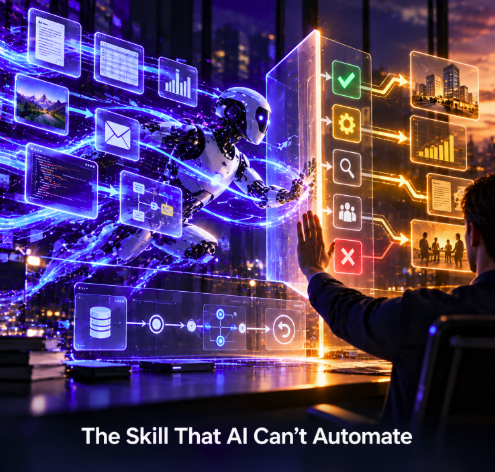
The workplace AI problem is changing. For the past several years, much of the conversation has focused on capability: can a model write the document, analyze the spreadsheet, answer the customer, generate the code or complete the workflow? As agents become capable of acting across software rather than merely recommending what a person should do, that question is becoming less distinctive. The harder question is what the system should be permitted to do without stopping for a human.
That is the central argument in Michal Balsianka’s July 13 essay “The Skill That AI Can’t Automate”. Balsianka argues that the durable workplace skill is not prompting but boundary design: deciding which actions can be delegated, which need verification, what evidence an agent must provide, who owns the decision and how an organization recovers when automation gets something wrong.
The distinction becomes more important as AI crosses the boundary from producing information to changing the world around it. A chatbot can draft a bank transfer instruction; an agent with credentials can initiate one. A model can suggest an account change; an operational agent can execute it. Capability removes manual friction, but it also compresses the interval in which a person can notice that the system is making the wrong decision.
Automation is no longer constrained mainly by whether the model can perform the task
Many workplace processes can now be decomposed into actions an AI system can execute: retrieve information, navigate interfaces, compare records, draft communications, update systems and call tools. Persistent agents make those capabilities more consequential because they can chain actions together without requiring a new prompt at every step.
The resulting management problem is not binary. Organizations do not have to choose between complete manual control and complete autonomy. They can decide that an agent may gather evidence independently but not publish it, prepare a transaction but not submit it, change low-risk records automatically while escalating high-impact exceptions, or continue working until a defined confidence or permission boundary is reached.
Those choices are not model capabilities. They are organizational decisions about risk, authority and accountability.
The most valuable instruction may be where the agent must stop
Prompt engineering is usually framed around getting a model to produce the desired result. Agent governance introduces the opposite problem: specifying the conditions under which the system should refuse to continue autonomously.
A well-designed workflow therefore needs stopping rules. The agent might be required to ask for approval before sending money, deleting production data, publishing externally, changing a contract, contacting a customer about a sensitive issue or taking an action that cannot easily be reversed. The exact boundary depends on the organization and the consequences of failure.
The principle is more durable than any particular model. As models become more capable, the set of tasks they can technically perform will expand. The organization still has to decide which of those capabilities should become permissions.
A capable agent is not the same thing as an authorized agent
This distinction is easy to lose when AI demonstrations emphasize successful task completion. If a model can navigate a financial system or compose a production database command, that demonstrates capability. It does not establish that the system should receive standing authority to perform those actions unattended.
Traditional enterprise systems already separate identity, authentication and authorization for a reason. Agentic AI makes that separation more important because the entity using the permission can interpret ambiguous instructions, react to untrusted content and construct new action sequences dynamically.
The correct permission set therefore cannot be inferred simply from what the agent is able to do. It has to be designed around what the agent needs to do, what can go wrong and what level of recovery is available.
Fast agents shrink the human reaction window
Balsianka’s essay connects operational autonomy with a second issue: speed. An AI system can execute a sequence of decisions much faster than a conventional human workflow. That is valuable when the sequence is correct and potentially dangerous when an early assumption is wrong.
Automation can turn a mistaken recommendation into a cascade before a person notices the first error. An agent can modify records, trigger downstream processes, send messages and make additional decisions based on the state it just changed.
This is why human oversight cannot simply mean that someone can review an audit log tomorrow. For high-impact workflows, organizations need to decide which actions require synchronous approval, which can be reviewed after execution and which should remain fully autonomous because the cost of error is sufficiently low.
The human role shifts from performing steps to designing decision rights
As AI absorbs repetitive execution, managers and domain experts can spend less time telling software exactly how to perform every step. But that does not eliminate human work. It moves more of that work toward defining the operating system around the agent.
Someone must decide which data the agent can access, which tools it can call, what monetary or operational thresholds apply, when a second source is required, which actions need approval and what evidence should accompany an escalation.
Those decisions require knowledge of the business rather than only knowledge of the AI. A model may understand a generic procurement workflow while missing why one supplier relationship carries unusual contractual risk. It may identify the statistically attractive marketing action without knowing that the company has deliberately accepted lower short-term performance to protect another strategic objective.
Evidence should be part of the action, not an optional explanation
Balsianka recommends deciding what evidence an agent must produce before an action is accepted. This is a useful shift from evaluating fluent explanations after the fact.
If an agent recommends changing a campaign, it can be required to show the underlying metrics and time period. If it prepares a legal action, it can identify the clauses or policy sources on which the recommendation depends. If it proposes a technical change, it can provide the test result and rollback procedure.
Evidence requirements make agent outputs easier to inspect and can expose situations where a confident recommendation rests on incomplete information. They do not guarantee correctness, because an agent can misunderstand evidence as well as conclusions, but they create a stronger review surface than an unsupported recommendation.
Logging outputs is not enough when agents make decisions
Conventional AI monitoring often records prompts and responses. Autonomous workflows need a richer trail. If an agent chooses among several actions, organizations need to know what it attempted, what evidence was available, which permissions were exercised and where human approval entered the chain.
This becomes especially important when an agent operates for hours rather than answering one prompt. The final output may hide dozens of intermediate choices that shaped the result.
Decision-level logging also supports better postmortems. When something goes wrong, the useful question is not only what the model said. It is which action boundary failed, whether the agent had excessive permission, whether the evidence requirement was insufficient and whether the human escalation rule activated at the right point.
Rollback is a product requirement for autonomous work
Organizations often discuss AI autonomy before discussing reversibility. The safer order is the opposite. Before allowing an agent to perform an action automatically, teams should understand whether that action can be undone and how quickly.
A draft can be discarded. A database change may require restoration. A customer email cannot be unsent in any meaningful operational sense. A financial transaction may enter an external process that is difficult to reverse. These differences should affect the autonomy level assigned to each task.
The principle is visible in modern agent infrastructure as well. NetContentSEO recently examined Perplexity SPACE and its rolling snapshot architecture, where persistent agent sessions can be restored and branched while execution remains isolated inside disposable virtual machines. Infrastructure-level rollback does not solve every business consequence, but it illustrates how reversibility is becoming a core design property of long-running agents.
The agent should be managed more like an operator than a text generator
Balsianka suggests treating an agent like a junior operator with unusually fast hands. The analogy is useful because organizations already understand that junior employees should not automatically receive every permission simply because they can technically operate a system.
A junior operator gets a defined role, access appropriate to that role, supervision for sensitive decisions and clearer escalation paths for unfamiliar cases. Performance is evaluated not only on speed but on whether procedures and controls were followed.
AI agents require a similar operating model, with one important difference: they can act at machine speed. Poorly scoped authority can therefore propagate mistakes faster than conventional human supervision models were designed to handle.
Accountability becomes more important as execution becomes cheaper
Automation dramatically lowers the marginal cost of producing work. An agent can generate more analyses, recommendations and changes than a person could manually execute. That advantage can become a liability when nobody owns the decision about which outputs should reach production.
NetContentSEO has already explored this problem in the accountability gap created by automated SEO recommendations. AI can win decisively on speed, price and volume while leaving an unresolved question when a technically plausible recommendation creates an expensive business outcome.
The same issue scales across workplace agents. Faster execution increases the value of good judgment because more actions can pass through the system in less time.
Judgment is not a mystical human capability
Calling judgment the skill AI cannot automate can easily become an overly broad claim. Models can already perform forms of evaluation, compare alternatives, estimate risk and apply explicit policies. Some decisions that currently require human review will almost certainly become automated as systems improve and organizations collect evidence about their reliability.
The stronger version of the argument is institutional rather than metaphysical. Someone has to define the objective, decide what level of risk is acceptable and assign authority. Even if an AI helps analyze those choices, the organization remains responsible for determining which decisions it is willing to delegate.
The durable human skill is therefore not simply “being better at judgment than AI.” It is designing the boundary between automated judgment and accountable authority.
Not every human checkpoint makes a system safer
Human-in-the-loop design can also become performative. If employees are asked to approve hundreds of low-context AI actions per day, they may click through them mechanically. A nominal approval step then adds latency without adding meaningful oversight.
Good boundary design concentrates human attention where it changes the risk profile. Low-impact, reversible and well-understood actions can often run automatically. Ambiguous, consequential or irreversible actions deserve stronger review.
The objective is not maximizing the number of human approvals. It is placing them at the points where human context, accountability or authority is genuinely valuable.
The scarce workplace skill is becoming workflow architecture
As AI systems become easier to prompt and more capable of executing tasks, competitive advantage shifts away from knowing a clever incantation for a model. Organizations need people who can decompose work into the right combination of autonomous actions, verification gates, permissions, evidence requirements and escalation paths.
This is closer to workflow architecture than prompt engineering. It requires understanding the process well enough to know which failures matter, where context is missing and which decisions carry consequences outside the software itself.
The same principle appears in AI-assisted analytical tools. NetContentSEO’s coverage of Gemini-powered Google Ads dashboards found that generating the analysis is becoming easier, while knowing what question to ask, how to verify the result and whether the evidence justifies action remains the harder layer.
The best agent may be the one that knows when it needs you
The next stage of workplace AI will not be measured only by how many tasks can run without people. It will also be measured by whether autonomy is allocated intelligently.
A mature agent should be able to complete routine work independently while recognizing the conditions under which it lacks sufficient authority, evidence or context. The surrounding system should make those boundaries explicit rather than hoping the model discovers them through common sense.
That changes the role of the human from constant operator to designer and owner of the decision environment. The machine can execute increasingly large parts of the workflow. The organization still has to decide what the workflow is allowed to become.
The hard part of workplace AI is therefore no longer simply getting the system to do something. It is knowing when the system should be allowed to do it without asking—and building the boundaries that make that autonomy worth trusting.