

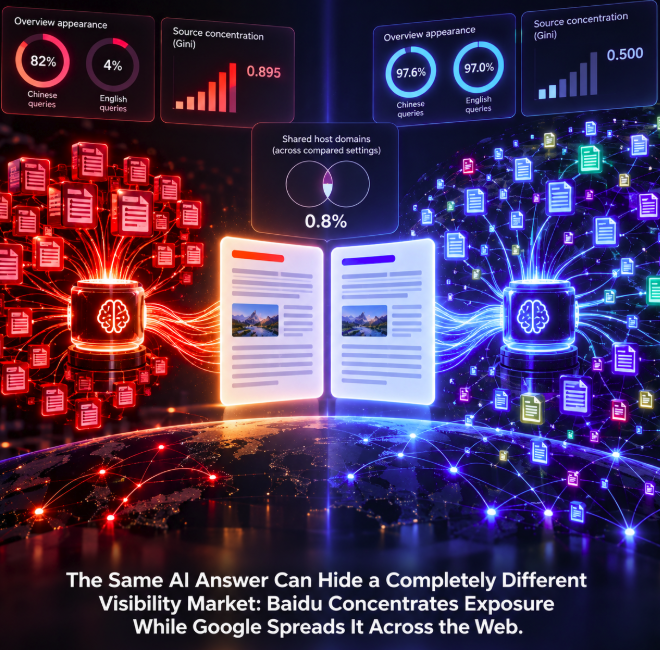

Two AI search engines can give users broadly similar answers while directing attention to almost completely different parts of the web. A new academic audit of Baidu and Google finds that answer similarity and source visibility can diverge sharply, creating distinct “visibility markets” even when the underlying information need is the same.
The study, “Auditing Source Exposure in Baidu and Google AI Search,” was submitted to arXiv on September 21, 2026 by researchers Yibo Li, Enci Guan, Yuedan Cai, Geng Liu and Francesco Pierri of Politecnico di Milano. The paper is listed as accepted at WAC @ EMNLP 2026, but the arXiv version should still be read as a preprint rather than as evidence that every result generalizes to all Baidu and Google users.
Across 1,998 platform-query observations collected between June 20 and July 10, the researchers found striking differences in how often AI overviews appeared, how concentrated their visible sources were and how much the underlying domain inventories overlapped. Google generated an overview for 97.6% of Chinese queries and 97.0% of English queries in the experiment. Baidu generated one for 82.0% of Chinese queries but only 4.0% of English queries.
The bigger GEO finding, however, is what happened behind the answers. Baidu’s Chinese-language source exposure was far more concentrated than Google’s, while aggregate overlap between some platform-language source inventories was extraordinarily low. Yet matched answers remained semantically similar enough to show that comparable output does not require comparable publisher exposure.
The researchers compared the same information needs across platforms and languages
The study began with 500 queries sampled from MS MARCO, a dataset built from real anonymized Bing searches. Researchers retained the original English queries and automatically translated them into Simplified Chinese, creating approximately aligned versions of each information need.
Those queries were submitted to four settings: Baidu in Chinese, Baidu in English, Google in Chinese and Google in English. One Google observation was missing from each language condition, producing 1,998 collected records rather than the intended 2,000. Because Baidu produced only 20 successful English-language overviews, that condition was retained for overview-appearance statistics but excluded from most downstream source analysis.
The collection environment is important. Searches were automated with Playwright in Google Chrome from Milan, Italy. Google searches were performed while logged into an account with the interface and Search language set to English, while Baidu used its Chinese interface. The researchers did not use a VPN, proxy or incognito mode.
That means the experiment is a controlled comparison of observed platform-language settings, not a definitive measurement of what a typical user in Beijing, Shanghai, London or New York sees. The authors explicitly warn that accessing Baidu from Milan may not reproduce the experience of mainland Chinese users.
Google generated overviews for almost every query in the sample
Overview activation differed dramatically across the four settings. Google produced qualifying AI overviews for 487 of 499 Chinese queries, or 97.6%, and 484 of 499 English queries, or 97.0%. Baidu produced overviews for 410 of 500 Chinese queries, or 82.0%, but only 20 of 500 English queries, or 4.0%.
The Baidu English result is so sparse that the authors avoid using it for source-oriented comparisons. They also caution against interpreting the difference as a clean measurement of language alone. Regional routing, interface behavior, product support and the Milan collection environment could all contribute to the observed pattern.
Within the Chinese query set, Baidu’s activation also varied more by topic. The paper reports a 97.7% overview rate for Health and 70.6% for Shopping, while Google stayed above 90% across all of the study’s topic categories in both retained language settings.
Baidu exposed a much more concentrated source ecosystem
The clearest difference appears in source concentration. The researchers normalized visible source references to host domains and measured how unevenly exposure was distributed using the Gini coefficient. A higher Gini means a smaller group of hosts captures a larger share of the visible references.
Baidu Chinese produced a Gini coefficient of 0.895. Google Chinese measured 0.500, while Google English was lower still at 0.462. The contrast also appears in the leading source share: Baidu Chinese’s most frequently referenced host accounted for 27.1% of all observed host occurrences, compared with 6.6% for Google Chinese and 5.5% for Google English.
The source composition helps explain the concentration. Among Baidu Chinese’s most visible hosts were baike.baidu.com, baijiahao.baidu.com and zhidao.baidu.com. The researchers keep these as separate host domains because they represent distinct user-facing services, but all sit within the broader Baidu ecosystem. Google’s Chinese and English results exposed a more mixed set of external hosts, including Wikipedia, Mayo Clinic and ScienceDirect among prominent sources.
This creates an important distinction for publishers. An AI overview can display numerous citations while the underlying exposure remains highly concentrated among a small group of source providers. Counting citations alone therefore says little about how broadly an AI search system distributes visibility.
The Baidu-Chinese and Google-English domain inventories barely overlapped
The researchers compared aggregate host-domain sets using Jaccard similarity, which divides the number of shared hosts by the total number of unique hosts across both sets. All three comparisons produced low overlap.
Google Chinese and Google English had the highest Jaccard similarity at 0.034. Baidu Chinese versus Google Chinese measured 0.032. Baidu Chinese versus Google English fell to 0.008: only 25 hosts were shared across a union of 3,095 hosts.
That 0.008 value is often easier to describe as 0.8%, but the wording needs precision. It is a Jaccard similarity over the aggregate host inventories, not a statement that exactly 0.8% of Baidu’s sources or 0.8% of Google’s sources were shared. The denominator is the combined union of unique hosts from the two settings.
The authors also caution that Jaccard is unweighted and sensitive to rare domains. A host that appears once counts toward the set in the same way as a host appearing repeatedly. The extremely low overlap therefore describes the breadth of the aggregate inventories rather than proving that every individual query draws from mutually exclusive sources.
Similar answers did not require similar source markets
The study’s most consequential result comes from comparing source overlap with the semantic similarity of generated answers. For the 331 query intents where Baidu Chinese, Google Chinese and Google English all produced an overview, the researchers encoded the answer text and calculated cosine similarity.
Median similarity ranged from 0.701 to 0.813. Google Chinese and Baidu Chinese were the most semantically similar pair at 0.813, followed by Google Chinese and Google English at 0.791. Baidu Chinese and Google English had the lowest median at 0.701, but even that indicates substantial semantic relatedness under the study’s embedding measure.
The researchers explicitly warn against claiming a query-level causal relationship between answer similarity and source overlap because the two metrics operate at different aggregation levels. The semantic scores are calculated for matched individual queries, while the Jaccard values compare entire host inventories accumulated across a setting.
The defensible conclusion is narrower and more useful: systems can exhibit relatively similar answer content while their aggregate visible-source ecosystems remain dramatically different. What users learn and who receives exposure are separate dimensions of AI search.
For GEO, “the answer” is only half the market
Generative engine optimization often measures whether a brand appears in an answer, whether its website is cited and how often competitors are mentioned. This study suggests another layer is necessary: the structure of the source market itself.
On a highly concentrated platform, earning visibility may depend disproportionately on a relatively small group of dominant hosts or platform-owned properties. On a more distributed system, opportunities may be spread across a much larger set of publishers, institutions, encyclopedias, commercial sites and specialist sources.
The same content strategy may therefore produce very different results across AI search engines. A publisher visible to Google’s distributed source environment may have little presence in Baidu’s more concentrated Chinese-language ecosystem, even when both engines generate answers covering similar information.
This reinforces another result previously covered by NetContentSEO: Google Search and AI Overviews shared only 18% of their sources in an 11,500-query study. Visibility cannot safely be inferred from a neighboring discovery surface simply because the products belong to the same company or answer the same query.
Language itself can create a different visibility universe
The comparison between Google Chinese and Google English is also revealing. These two settings share the same search provider, yet their aggregate host-domain Jaccard similarity was only 0.034. The answers were considerably closer semantically, with a median cosine similarity of 0.791.
That means multilingual GEO cannot be reduced to translating an English page and assuming the same authority graph will carry over. Different languages can surface different encyclopedias, institutions, media organizations, community sites and specialist publishers even when users are expressing essentially the same information need.
The study’s Chinese queries were machine translations rather than independently collected native Chinese queries, so the result should not be generalized too aggressively. Still, the observed gap is large enough to make source-market analysis an important part of international AI visibility work.
Source concentration creates a different kind of platform power
Traditional search distributes attention through ranked links. AI overviews add another editorial decision: the platform decides which sources remain visible beside an answer that may already satisfy much of the user’s information need.
When that exposure is concentrated, a small set of hosts can capture a disproportionate share of the remaining source visibility. Baidu Chinese’s 0.895 Gini and 27.1% top-host share illustrate that pattern in this particular experiment. Google’s lower concentration suggests a broader source pool, although “broader” does not automatically mean higher quality, fairer distribution or better factual support.
The study deliberately does not evaluate source credibility or claim-level citation support. A diverse source ecosystem can still contain poor evidence, and a concentrated one can contain authoritative material. Concentration measures who receives exposure, not whether the sources deserve it.
AI visibility dashboards need platform-language segmentation
The findings create a practical problem for AI visibility measurement. A dashboard that reports one global citation score can hide radically different source environments across platforms and languages. Even measuring the same prompts may not solve the problem if the monitoring setup does not reproduce the geography, account state and interface experienced by actual users.
NetContentSEO recently covered research showing that consumer chatbot interfaces and APIs can expose largely different citation ecosystems. The Baidu-Google study extends the measurement challenge in another direction: platform and language can reshape the visibility market even when answer semantics remain relatively stable.
A useful GEO dashboard should therefore preserve platform, language, location and collection method as first-class dimensions rather than averaging them into a single visibility number. The question is not merely whether a brand is visible “in AI.” It is visible to whom, in which product, in which language and within which source ecosystem.
The study is a snapshot, not a universal map of Baidu and Google
The authors document several limitations that matter for interpretation. The sample contains 500 base query intents and was collected during a three-week period in summer 2026. Search products change rapidly, so overview activation and source selection can shift after the observation window.
Google searches were logged in, potentially allowing account state to influence results. Baidu was accessed from Milan, which may behave differently from Baidu accessed inside mainland China. The Chinese queries were automatically translated from English MS MARCO queries rather than sampled directly from Chinese users, and the topic distribution was heavily weighted toward general-knowledge queries.
The researchers also measured visible host references in the rendered interface, not the complete internal evidence set used by either engine. Their source-extraction validation achieved a 96.7% exact-match rate on a manually reviewed sample, but interface changes can still affect automated collection.
These constraints make the study best understood as an audit of specific observed conditions rather than a permanent ranking of Baidu and Google. Its methodological lesson, however, is broader.
AI search creates an answer market and a visibility market
For users, two AI overviews that communicate roughly the same information may feel interchangeable. For publishers, they can represent completely different economies of attention. One system may repeatedly expose a concentrated cluster of hosts; another may spread citations across thousands of external sources.
That distinction changes what success means in generative search. Measuring answer accuracy alone cannot reveal who benefits from the interface. Measuring citations without concentration cannot reveal whether exposure is broadly distributed. And measuring one language or platform cannot describe a global AI-search market whose source ecosystems barely overlap.
The Baidu-Google audit therefore adds a useful metric to GEO: not only whether an AI engine cites sources, but how concentrated the opportunity to become one of those sources actually is. In the study’s Chinese-language observations, Baidu and Google could produce semantically similar answers while allocating visibility in radically different ways.
For brands and publishers, that means there may be no single “AI visibility” market to optimize for. The answer can look familiar while the competitive landscape underneath it has changed completely.