

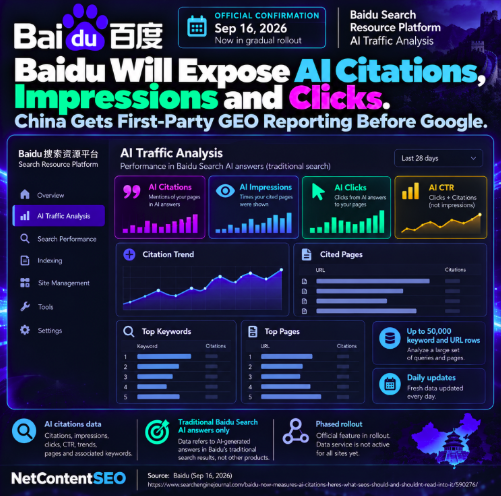

Baidu is preparing a first-party AI visibility report for publishers. The new AI Traffic Analysis section in Baidu Search Resource Platform will show how a site's pages are used inside AI-generated answers appearing in Baidu's traditional search results.
Baidu confirmed the feature in a September 16, 2026 platform notice after Chinese webmasters began spotting the new section. The rollout is phased, and the data service has not yet been activated for all sites.
Baidu will report AI citations, impressions and clicks
The dashboard is built around four metrics: AI Citations, AI Impressions, AI Clicks and AI CTR. Baidu's own Search Resource Platform says the tool is designed to show when site content is cited by AI Search and the exposure and clicks those citations generate.
This creates a direct first-party link between being used as a source in an AI answer and the downstream visibility and traffic generated by that use.
AI CTR uses an unusual denominator
There is an important methodological detail: Baidu defines AI CTR as AI clicks divided by AI citations, rather than clicks divided by impressions.
That means the metric should not be interpreted exactly like conventional search CTR. Because Baidu tracks citations and impressions separately, publishers may also want to examine clicks relative to visible impressions when evaluating how citations convert into visits.
The report includes citation trends and cited-page counts
AI Traffic Analysis will provide trend reporting so site owners can track changes in citations over time. It also shows the number of pages being cited, giving publishers a way to distinguish between concentrated visibility on a small set of URLs and broader citation coverage across a site.
Top keywords connect citations back to demand
One of the most useful parts of the report may be its keyword table. Baidu will show the keywords associated with AI answers that cite a publisher's content, creating a first-party view of the search demand behind those citations.
For GEO teams, this provides something third-party citation trackers can struggle to reconstruct reliably: the relationship between Baidu search queries and the site's appearance inside generated answers.
Top pages reveal which URLs AI Search actually uses
The report also includes a top-pages table, making it possible to identify the URLs receiving AI citations and clicks. Both the keyword and page tables are capped at the top 50,000 entries, and data is expected to update daily for the previous day, although Baidu warns that updates may sometimes be delayed.
The scope is limited to traditional Baidu Search
The biggest limitation is scope. Baidu says the data covers the traditional search scenario: AI-generated answers presented within Baidu's regular search results.
The wording does not support treating the report as coverage of every Baidu AI product, and it does not include competing Chinese AI ecosystems such as Doubao, DeepSeek, Qwen/Quark or Kimi.
The data service is not fully live yet
Although the feature itself is official, Baidu says rollout is occurring in phases and the underlying data service has not formally started for everyone. Empty dashboards during the initial rollout are therefore expected.
Publishers should treat this as an announced first-party reporting capability rather than assume every verified property already has usable historical data.
The NetContentSEO view
Baidu's move is significant because it exposes the complete measurement chain that publishers increasingly want from AI search: citation → impression → click → keyword → page → trend.
Google has expanded Search Console reporting for AI and multimodal search, but Baidu's dedicated citation metric creates a particularly explicit first-party view of when publisher content becomes a source inside generated answers.
For China-focused SEO, this could become one of the most actionable GEO datasets available directly from a search engine. Instead of relying only on synthetic prompts and third-party monitoring, publishers will be able to analyze AI citation behavior using Baidu's own data.
One caution remains essential: Baidu has not said that receiving AI citations improves traditional rankings. AI Traffic Analysis should be treated as a visibility and traffic measurement system, not as evidence of a new ranking factor.