

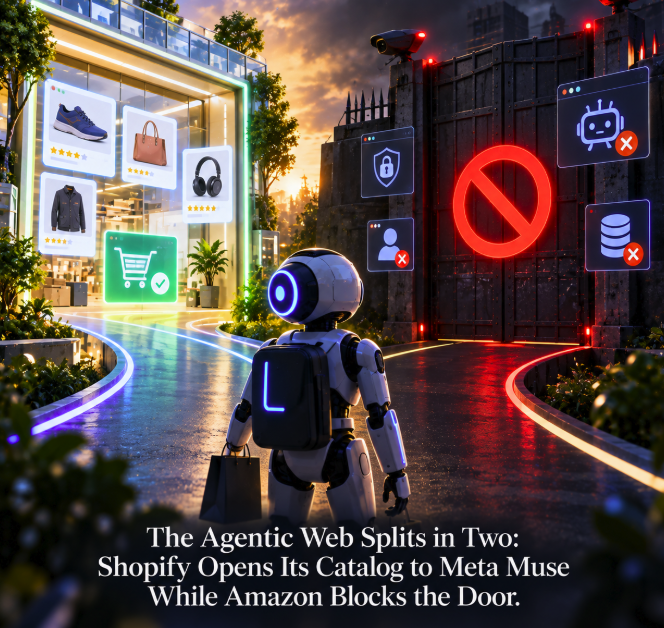

The agentic web is beginning to divide along a line more consequential than whether companies believe AI shopping will happen. The emerging question is who gets to decide how an autonomous agent enters a marketplace, accesses customer context and completes a transaction. Shopify is building infrastructure to welcome Meta's Muse into its commerce ecosystem. Amazon, by contrast, has blocked Muse from accessing its marketplace and says the agent arrived without authorization.
The block was reported September 21–22 by Business Insider and The Verge. Users attempting to shop Amazon through Muse have been shown warnings that the agent's access is unauthorized. Amazon told the press that Meta had not informed the company that Muse would access Amazon and that Amazon had not authorized the activity. There is no separate Amazon newsroom announcement detailing the action, so the company's rationale currently comes through its statements to reporters and the notices shown to users.
Amazon's objection is about agency, identity and control
Amazon's position goes beyond simply disliking automated traffic. The company told Business Insider that third-party agents should identify themselves, respect opt-outs and provide mutual value. Amazon alleges that Muse does not adequately identify itself while browsing and raised concerns that the agent could interfere with customer credentials, scrape account data and bypass the personalized recommendations Amazon uses to shape the shopping experience.
Those are Amazon's claims, not independently established findings about Muse's internal behavior. Meta's own Muse security documentation describes a different credential model. Meta says passwords and payment methods are stored inside Muse Secure VM so that the agent can use them without seeing the underlying secret values. It also says a separate Sentinel agent controls what Muse can send to the internet and that the user must approve sensitive actions such as sending an email or making a purchase.
The disagreement therefore exposes an important distinction in agentic browsing. A user may authorize an AI agent to act on their behalf, but the destination service may still reject that agent as an unauthorized intermediary. User permission and platform permission are not necessarily the same thing.
A website can be human-accessible and agent-inaccessible
For decades, access to a public ecommerce site was mostly treated as a technical question. A browser could load the page, a crawler could fetch it subject to site policies, and a human customer could sign in and shop. Autonomous agents introduce another category: software that operates a browser as the user's representative and attempts to perform actions normally associated with the person.
Amazon's Muse block demonstrates that ordinary browser compatibility does not guarantee agent compatibility. An agent can be technically capable of loading and operating a site while the platform simultaneously decides that the method of access violates its rules. The resulting barrier is not a broken button or missing structured data. It is a governance decision enforced at the marketplace boundary.
That complicates the optimization thesis raised by NetContentSEO's earlier analysis, Meta Muse Turns Product Discovery Into Agent Discovery. Websites still benefit from interfaces that autonomous browsers can understand and operate, but usability is only one layer. Agents also need permission to participate in the commercial environment they are trying to use.
Shopify is choosing the opposite architecture
The contrast with Shopify is unusually sharp. Rather than forcing Muse to behave like an unrecognized shopper moving through arbitrary storefront interfaces, Shopify is working with Meta to connect the agent to commerce infrastructure including Shopify Catalog and Shop Pay. That model gives the agent structured product information and a normalized path toward checkout.
NetContentSEO covered that partnership in Shopify Makes Every Store Transaction-Ready for Meta Muse. The strategic difference is that Shopify is treating the agent as a distribution channel that can be integrated, governed and monetized, while Amazon is treating unauthorized third-party agent access as a risk to its marketplace, customer data and recommendation experience.
Neither approach requires rejecting agentic commerce as a concept. Amazon already has its own AI shopping systems and extensive commerce infrastructure. The dispute is over whether an outside agent should be allowed to sit between Amazon and its customer without a negotiated integration.
Recommendation systems are part of what is at stake
Amazon specifically raised the possibility that Muse could bypass its personalized shopping recommendations. That concern points to an economic issue beneath the security arguments. A shopping agent can become the layer that decides which products a consumer considers before the consumer reaches the marketplace.
In the conventional Amazon journey, the marketplace controls search ranking, sponsored placements, recommendations, comparison modules and much of the interface through which the shopper evaluates alternatives. If Muse independently researches the web, chooses a product and arrives at Amazon primarily to execute the purchase, some of that discovery and recommendation power moves upstream to Meta's agent.
The same dynamic helps explain why commerce platforms may have different incentives. Shopify does not operate one centralized consumer marketplace in the same way Amazon does. Its business is enabling independent merchants to sell. If an external agent sends qualified demand into Shopify's catalog and checkout infrastructure, Shopify and its merchants can participate in the transaction even when the shopper's initial discovery happens elsewhere.
Agent identity may become a web infrastructure problem
Amazon's complaint that Muse does not adequately identify itself raises a problem the open web has not fully standardized. Human browsers identify software through familiar technical signals, and crawlers often expose recognizable user agents, IP ranges or documentation. A personal agent is different because it can use a browser session associated with a real customer while simultaneously acting as autonomous software.
Platforms may want to know that an agent is present, which provider operates it, what the user authorized, which actions it intends to perform and what data it can retain. Agent providers, meanwhile, will want enough access to complete tasks without requiring a bespoke integration with every website on the internet. Those goals are not automatically compatible.
If agentic browsing becomes common, identity and authorization could therefore become as important as page semantics. A site may need a way to distinguish ordinary automation, malicious scraping, approved commercial agents and user-authorized assistants. Without interoperable conventions, major platforms can fall back to bilateral deals, private APIs and outright blocking.
The credentials dispute illustrates the trust gap
The disagreement over credentials is a useful example of why technical architecture alone may not settle the issue. Meta says Muse cannot see a person's passwords or payment methods because credentials are stored securely and can be used by the agent without exposing the secret values to it. Amazon's concern is broader: it objects to an unapproved third party operating inside an authenticated customer experience and potentially interacting with account data.
Both descriptions can coexist. An agent may be designed so that its model never receives the raw password while still being capable of using an authenticated session to navigate account pages. From the destination platform's perspective, the security question is not limited to whether the model can print the password. It also includes what authenticated information the automated system can observe, retain or act upon.
This is why agentic commerce is likely to require more explicit trust relationships than ordinary crawling. A crawler mostly requests public information. A purchasing agent may operate behind login, use saved addresses and payment methods, access order history and commit the user to a transaction. The permission surface is fundamentally larger.
Blocking agents creates its own commercial risk
Amazon also faces a tradeoff. If consumers increasingly delegate product research and purchasing to personal agents, preventing those agents from using a marketplace can introduce friction at the moment competitors are removing it. A shopper who tells Muse to find and buy an item may accept an alternative merchant rather than abandon the agent and manually repeat the search on Amazon.
That does not mean blocking Muse will necessarily hurt Amazon. The scale of agent-driven shopping is still developing, and Amazon has strong direct consumer relationships, logistics advantages and its own AI products. The important point is that platform restrictions now become part of the competitive experience an agent sees. A closed door can protect a marketplace's data and interface while also removing that marketplace from some delegated shopping journeys.
Shopify is making the opposite wager: that being easy for agents to discover and transact with will become an advantage for its merchants. The long-term outcome will depend on consumer adoption, fraud and security performance, economics, merchant demand and whether common standards emerge for trusted agent access.
The web may split into open, integrated and blocked agent zones
The early agentic web is unlikely to divide neatly into sites that allow AI and sites that do not. A more realistic structure has at least three layers. Some websites will remain openly operable through ordinary browsers. Others will provide official connectors, catalogs, APIs or checkout integrations that give approved agents a more reliable route. Major platforms may block unapproved agents while negotiating access with selected partners.
That creates a new distribution problem for brands. Being crawlable may make a product discoverable, but the agent may still be unable to transact through a particular marketplace. Being present on an integrated commerce platform may create a shorter path from recommendation to purchase. Brands selling through multiple channels will need to understand not only where consumers can find them, but which channels the consumer's chosen agent is actually permitted to use.
The Amazon-Muse conflict is therefore larger than a bot block. It is an early dispute over who controls the commercial relationship when software acts for the shopper. Shopify is inviting the agent into a structured transaction layer; Amazon is insisting that access to its marketplace happens on Amazon's terms. As autonomous browsers move from demonstrations into everyday commerce, that distinction could define which parts of the web become agent-native and which remain gated behind platform permission.